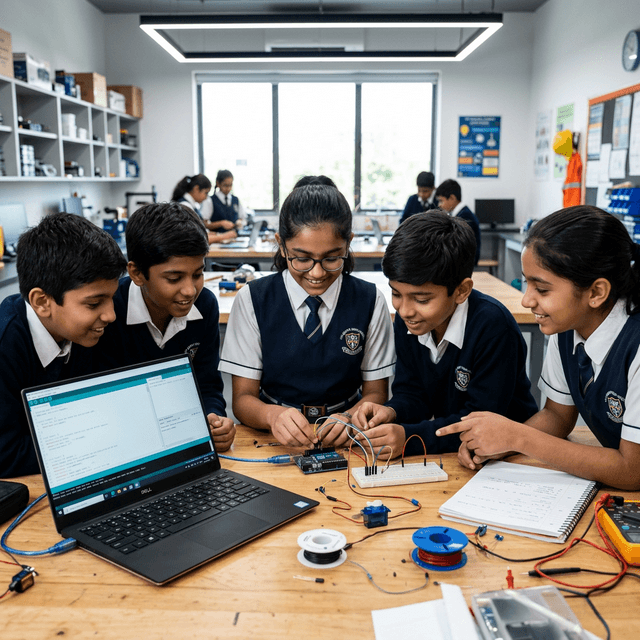
Progression Matters More Than Complexity
Students do not need advanced tools on day one. They need a sequence that builds confidence and curiosity at every stage. Rushing to advanced content before foundational logic is solid produces frustrated students and teachers who feel out of their depth.
A good framework moves from logic → control systems → applied AI in physical devices. Each stage should feel achievable while pointing clearly toward the next. The curriculum isn't a race to complexity; it's a structured journey toward genuine capability.
Suggested Stage Mapping
Each stage should balance concept depth with build time. Projects should fit realistic school schedules — a 45-minute period requires different pacing than a two-hour lab block.
- Grades 3–4: Logic games, sensors, and simple automation. Students learn cause-and-effect in physical systems.
- Grades 5–7: Block coding, robotics mechanics, and debugging. Students begin writing code that controls physical outcomes.
- Grades 8–10: Python, computer vision, and IoT workflows. Students build projects with real-world applicability.
The jump between each stage should feel like a natural extension, not a sharp gear change. Students at Grade 7 who have spent two years with blocks will be well-prepared for text-based coding — the concepts are identical, only the interface changes.
Assessment Should Be Portfolio-Based
Written tests capture theory but miss build quality, iteration speed, and teamwork. A student who can write a perfect answer about servo motors may completely freeze when one stops working in a real project. A student who struggles to articulate motor theory on paper may debug a broken circuit intuitively.
Portfolio reviews with demo days provide better evidence of student readiness for advanced stages and real-world careers.
A student's portfolio — the projects they built, the problems they solved, the failures they navigated — tells a more complete story than any exam score.
Portfolios also give students something tangible to show parents and future institutions. That sense of ownership over real work is itself a significant motivator that keeps engagement high year after year.
How Scaleopal's 7-Phase Curriculum Maps to This Framework
The Scaleopal curriculum is built on this exact progression principle. Seven phases, each building on the last, mapped from Class 1 through Class 10. Every phase has clear competency outcomes, project milestones, and assessment rubrics.
The curriculum is co-designed with NEP 2020 requirements as the foundation — not retrofitted to comply, but built from the ground up around the policy's vision for experiential, project-based learning.