The Pune Zilla Parishad CBSE school at Khanwadi, in Purandar taluka, opened on 11 April. It stands on 12 acres, has science and computer labs, and charges needy students nothing, with meals and uniforms included. It belongs to the district's own government body.
Most private schools in Pune district noticed. Fewer have worked out what it means for them.
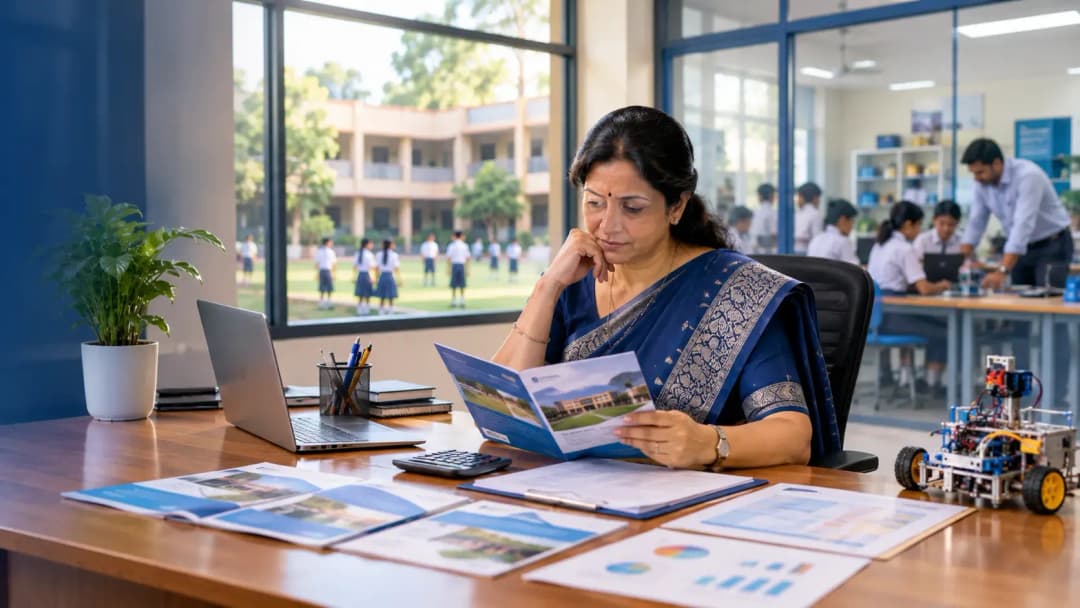
Picture the principal of a 600-student private CBSE school near Saswad (an illustrative school, not a client). For ten years her pitch to parents has been three things: CBSE, English medium, labs. Now a free school in her own taluka says the same three things. We do not think that is a reason to panic. We do think it is a reason to look hard at what your school actually gives a child on a Tuesday morning.
What has Pune Zilla Parishad actually launched?
The school at Khanwadi is called Jyoti-Savitri, after Mahatma Jyotiba Phule and Savitribai Phule. Khanwadi is Phule's native village. The Chief Minister described it at the inauguration as the first Zilla Parishad school in the state to follow the CBSE pattern from Class 1 to 12. ZP officials say it will run from Junior KG to Class 12.
The numbers are worth reading carefully. It began with classes from kindergarten to Class 2 and about 260 students. The plan is to grow to Class 12 and nearly 2,000 students, with a hostel for 280 students arriving next year. The campus has 24 classrooms, digital classrooms and laboratories. Reports describe it as a pilot.
The structure matters more than the buildings. Fiat India Automobiles provided major CSR funding, with contributions from the district planning committee and Pune Zilla Parishad, and the state supplied the land. Christel House India, a non-profit, leads academics, recruitment and admissions, while the Zilla Parishad oversees infrastructure. In other words, a district government chose a partnership over building and running everything alone.
What is Pune ZP planning next?
Here we have to separate what is done from what is proposed. Khanwadi is done. The rest is announced.
In its 2026-27 budget of ₹301 crore, presented in March, Pune ZP proposed bringing one outstanding Zilla Parishad school in each taluka under CBSE affiliation. The same budget announced a "Kaushal Setu" programme to help students in Classes 1 to 8, and their teachers, learn AI. We found no report yet that either has been rolled out, and nothing that confirms how many schools the CBSE proposal will cover.
So treat the school near Saswad as one school and the rest as a direction. But the direction is hard to miss. The state's own board is already moving toward a CBSE pattern by 2028, and now a district government is building CBSE-pattern campuses with AI in the plan.
Is a free CBSE school a threat to private schools in Pune district?
Zilla Parishad schools have always been the free option in Pune district's villages, so free alone is not new. What is new is the CBSE pattern, the campus, and an AI plan on the same page. That combination is what private schools have to answer.
It depends on which school you run. We see three cases.
The taluka-town school selling CBSE and English medium. This school is the most exposed. If your brochure's headline claims are a board and a language of instruction, a free alternative now makes the same claims. The pressure arrives first at the front door: Nursery and Class 1 admissions, because Khanwadi's first cohort is the youngest one.
The school with a real lab story. If parents can see students building things every week, the comparison favours you. A parent can compare a board. She can also compare a Tuesday.
The premium city school. Direct pressure is limited today. But the signal still counts: when the public system adds CBSE and AI, "we have a computer lab" stops being a reason to pay fees anywhere in the district.
And what about the grades above Class 2? Right now Khanwadi has none. A private school with a Class 10 track record has something the new campus needs years to build. That edge will not last forever, but it is real this admission season.
What will parents compare?
Parents do not weigh a circular. They weigh what they can see. At an open day, a free campus with CSR-funded labs will look impressive. A fee-paying school that cannot say what happens inside its lab will look expensive.
Parents do not choose a board. They choose what their child will do on Tuesday at 11.
So build the answer to that question. How many periods a week does a Class 6 student spend in the lab? Who is in the room? What did last term's students make, and can a parent see it? We wrote about how to present your school's AI lab at an open house, and the same logic applies here: specifics beat adjectives.
What can a private school offer that a new ZP school can't quickly match?
Be honest with yourself about this list. It is where your fees have to earn their keep.
- A full run of grades with board results. You have students who have already finished Class 10. A campus that opened in April is still building its first Class 3.
- Speed. A principal and a trust can decide in a week. A public body works through budgets, approvals and tenders.
- Accountability to parents. Fee-paying families expect an answer within days, and your school is built to give one.
- A named person in the lab. Kaushal Setu is a proposal today. A school that already has an engineer running sessions every week can show it.
- Visible outcomes. Projects, demonstrations and showcases that parents attend. Our post on student project showcases and parent engagement covers how to run one.
None of this is a criticism of the Zilla Parishad. A rural child who gets a free, well-equipped CBSE-pattern school is a good outcome. It simply means the private school's case has to rest on delivery, not labels.
Can private schools use the same partnership playbook?
Look again at how Khanwadi was built. It was not funded from one treasury. It used CSR money, district funds, state land and a non-profit operator, each doing the part it does best.
A private school can borrow the logic. You can see how the model runs on our Schools page, and our AI lab setup page for Pune schools covers the local picture. Under our partnership model, we fund and deploy the lab on your campus at zero setup cost, an on-campus engineer runs the sessions, and we share the revenue the lab earns with the school. Deployment takes 45 days from partnership confirmation.
This matters most for the budget school in a taluka town. CBSE's own booklet puts a Composite Skill Lab at roughly ₹3 to 6 lakh, and existing schools must have one by 22 August 2027. For a school with thin margins, that is a real decision. Our month-by-month plan for the 22 August 2027 deadline shows how to sequence it, and our guide to Composite Skill Labs for CBSE schools in Pune covers the sector choices. You can also read what a zero-cost AI lab can do for NEP compliance and revenue.
What should a principal do before the 2027-28 admission season?
Start with a plain test. Put your brochure next to Khanwadi's and strike out every claim both could make. Whatever is left is your real pitch. If it is short, you have found your work for this term.
Next, write the lab timetable down, with real periods per week for each class, and give parents a copy. Then schedule a student showcase before admissions open, because a parent who has watched a Class 7 student explain a project needs no persuading about the lab. Our guide on how an AI lab helps a school fill more seats walks through the sequence.
And decide the lab route before the compliance clock decides it for you. If your school is in the middle of the CBSE mandate, our piece on what Pune schools must do now that the CBSE AI mandate is live lays out the steps. Whatever route you pick, get the sectors delivered and the name of the person who will run the lab in writing.
Frequently Asked Questions
Is there a Zilla Parishad CBSE school in Pune district?
Yes. The Jyoti-Savitri school at Khanwadi in Purandar taluka opened on 11 April 2026. It follows the CBSE pattern and was described at its inauguration as the first Zilla Parishad school in the state to do so from Class 1 to 12.
Is the Khanwadi Zilla Parishad school free?
ZP officials say it offers free education to needy students from Junior KG, along with meals, uniforms and transport support. Check eligibility with the school or the Zilla Parishad, because the details can change.
Will every taluka in Pune district get a ZP CBSE school?
That is not confirmed. The 2026-27 budget proposed bringing one outstanding ZP school in each taluka under CBSE affiliation. We found no report that the proposal has been carried out.
What is Kaushal Setu?
It is an AI learning programme for students in Classes 1 to 8, and their teachers, announced in Pune ZP's 2026-27 budget. We found no report on its rollout yet.
Does this affect private schools in Pune city?
In our view, much less than it affects private schools in taluka towns, at least for now. But the signal travels: when public schools add CBSE and AI, a lab becomes something parents expect from every school.
Read the signal, then decide
Go back to the principal near Saswad. She does not need to fear a school with 260 students. She does need an honest answer to a simple question: what does my school give a child that a free campus, a CSR sponsor and a non-profit operator cannot?
If the answer is a lab that runs every week, with a person in the room and projects on show, she is in a strong position. If it is a brochure, she has one admission season to change that. You can see what a lab could earn for your school, or start the conversation with us and we will work through it together.