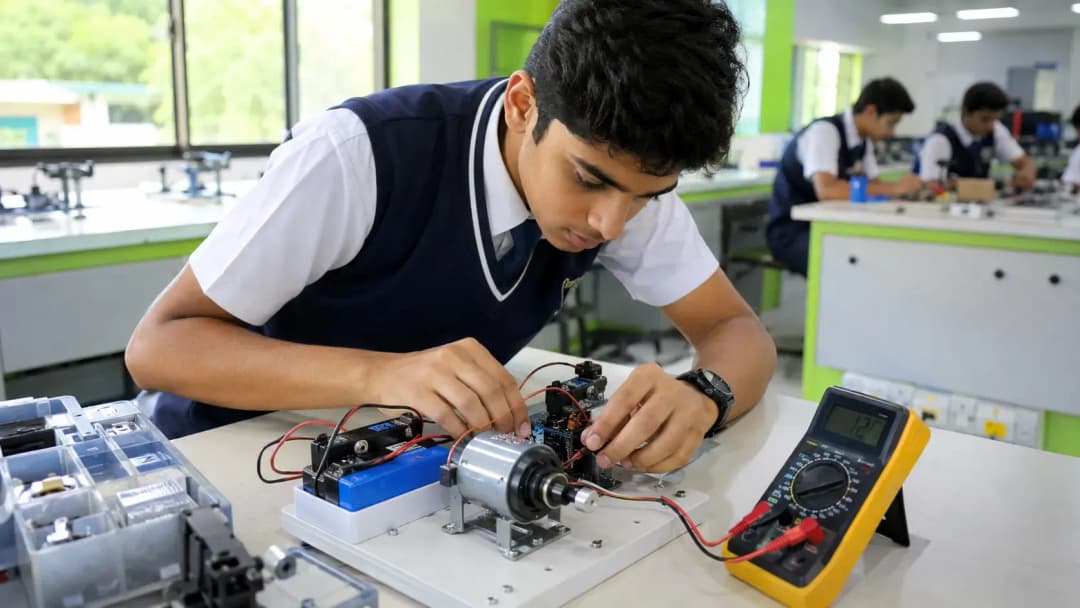
A principal in Delhi asked us something recently that we hear a lot: "I keep seeing EV labs mentioned in school proposals. But what do students actually do in one?"
It is a fair question. EV lab is one of those phrases that sounds impressive in a brochure but rarely gets explained. So let us fix that.
This post is for school leaders who want a clear, honest answer about what an EV lab for schools actually covers, why it matters right now, and whether it belongs in your school's innovation programme.
Why EV Education Is Becoming Urgent for Schools
Here is the number that should get any school leader's attention: the Ministry of Skill Development and Entrepreneurship projects that India's EV industry will generate 1 crore direct jobs and 5 crore indirect jobs by 2030. That is not a distant promise. 2030 is four years away. The students sitting in your Classes 8 through 12 today will be entering the workforce right in the middle of that transition.
And here is the problem. A SIAM report found that only 30% of technical competencies in EVs overlap with traditional automotive or engineering training. The remaining 70% requires entirely new skills, in battery chemistry, power electronics, motor control, and energy management systems. Less than 10% of Indian universities currently offer dedicated EV courses.
So the gap is wide, it is opening fast, and it starts long before engineering college. The students who arrive at university already fluent in EV concepts, battery systems, and energy thinking will have a significant head start. That is the case for introducing EV technology education in a school lab well before Class 12.
What Students Actually Do in an EV Lab
An EV lab is not a garage. Students are not fixing cars. So what does the learning actually look like?
The curriculum builds in layers, starting with foundational concepts and progressing toward applied problem-solving. Here is what a well-structured EV lab programme covers across different grade bands.
Understanding How Electric Vehicles Work
Before anything else, students need a working mental model of an EV. This is not theory for its own sake. A student who understands that an electric vehicle converts stored chemical energy into electrical energy and then into motion has already crossed a threshold that most adults have not.
At this stage, students explore battery types, understand the basic difference between series and parallel circuits in the context of energy storage, and build simple motor-driven models. Think: a small electric cart that students wire, test, and troubleshoot themselves. The hands-on nature matters. A student who has burned out a motor by short-circuiting it remembers why voltage regulation exists in a way that no textbook can replicate.
Battery Systems and Energy Management
This is where the curriculum gets genuinely interesting. Batteries are the defining challenge of the entire EV industry. Range anxiety, charging time, thermal runaway, recycling, second-life applications, every one of these industry problems traces back to the battery.
Students learn how lithium-ion cells work, how battery management systems (BMS) monitor charge and discharge cycles, and why thermal management is not optional. In practice, this involves working with real battery modules (safe, low-voltage, education-grade), measuring voltage and current, and understanding how a battery pack maintains balance across multiple cells.
A Class 10 student who can explain why a battery gets hot during fast charging, and what happens if it is not managed correctly, understands something that matters deeply to every EV company hiring right now.
Motor Control and Power Electronics
Electric motors are elegant machines. Students learn the difference between DC and BLDC (brushless DC) motors, how an inverter converts DC battery power into the AC that drives the motor, and how regenerative braking feeds energy back into the battery during deceleration.
They get to experiment with motor speed control, understanding how pulse-width modulation (PWM) governs how much power reaches the motor. This is not abstract electronics. Students can see the motor respond in real-time when they adjust parameters. It builds intuition for systems thinking that applies well beyond EVs.
Energy Efficiency and Sustainability
An EV lab is also an opportunity to connect technology to the larger climate and energy conversation in a grounded, engineering way. Not slogans. Numbers.
Students calculate energy consumption for different driving scenarios. They model the efficiency of regenerative braking. They compare the energy cost of moving a given weight over a given distance using different motor configurations. This kind of quantitative thinking about energy is exactly what NEP 2020's vocational education thrust is asking schools to build, see the practical implementation guidance for NEP 2020 compliance for how this aligns at the curriculum level.
Project-Based Capstone Work
At the senior levels, students integrate everything into projects. A group of Class 11 students might design and build a small EV prototype with a custom battery pack, motor drive, and a basic BMS. Another team might build an energy monitoring dashboard using an IoT module connected to a battery system. These are not decorations for the school exhibition. They are the kind of projects that go into a portfolio.
And portfolios matter. A student applying to engineering college or an apprenticeship programme with documented hands-on EV projects is in a different category from someone who only has exam marks.
What an EV Lab Is Not
It is worth being direct about this, because some vendors oversell and underdeliver.
An EV lab is not a car servicing centre. Students are not learning to change tyres or diagnose a fault code on an Ola Electric. That is automotive vocational training, and it is a different thing entirely.
An EV lab is also not a pure theory classroom. If students are sitting through lectures about battery chemistry without ever touching a cell, a multimeter, or a circuit, the lab is not working.
A good EV lab programme is practical, progressive, and taught by someone who understands the actual engineering. That last point is where most school programmes fall short, and where having a qualified on-campus engineer run every session makes the difference between a functioning lab and a room full of equipment that nobody knows how to use.
Who Is This For, Grade-Wise?
EV technology as a full subject sits best in Classes 8 through 12. But foundational concepts, energy, circuits, motors, can be introduced as early as Class 6 as part of a broader STEM and innovation programme.
At Scaleopal, EV Technology is part of our Cognitive AI & Advanced Robotics Lab, designed for schools that want to go beyond the basics. It sits alongside AI, Advanced Robotics, Drone Technology, IoT, AR/VR, and Tech Entrepreneurship in a seven-domain, 10-year curriculum. Schools that adopt it are not doing EV in isolation. They are building a coherent innovation pathway from Class 1 through Class 12.
The Question Principals Usually Ask Next
At this point in the conversation, most principals ask one of two things. Either: "Where do I find a teacher who can teach this?" Or: "What is this going to cost?"
On the teacher question: you probably cannot find one. Not because great educators do not exist, but because EV-competent educators at the school level are extraordinarily rare. The honest answer is that the teaching should not fall on your existing staff. It should be handled by someone with actual engineering experience in the domain, which is why our model places a working engineer on campus rather than expecting a computer science teacher to become an EV specialist overnight.
On the cost question: the traditional answer would be somewhere between ₹15 and ₹28 lakhs for hardware, installation, and a vendor agreement that leaves you holding the bag for maintenance. Our answer is different. The zero cost model we operate under means the school invests nothing in setup. Scaleopal funds, installs, maintains, and staffs the lab. The school earns a guaranteed profit margin per enrolled student. You can read the full financial structure on our school financial model page.
That model exists for all our labs, including EV Technology, which is part of our advanced programme tier.
Why Now, Not Later
There is a version of this conversation where a principal says: "Let us wait until EV becomes more mainstream." And it is a reasonable instinct. Schools should not chase every trend.
But EV is not a trend. It is a structural shift in one of India's largest industries, backed by government mandate, global capital, and a demographic wave of young people who will spend their working lives in it. The schools that start building EV literacy now, in Classes 8, 9, 10, are the ones whose alumni will be genuinely ready. The schools that wait until 2030 will be starting a conversation their students needed five years earlier.
There is also a differentiation argument. Right now, how schools attract and retain students increasingly turns on the perception of future readiness. An EV lab is a tangible, explainable signal to parents that your school is genuinely preparing students for the world they will actually inhabit. A robotics lab and an AI lab say one thing. Adding EV Technology says something more specific: we understand where the jobs are going, and we are building your child's readiness for them now.
Frequently Asked Questions
What age group is an EV lab suitable for in Indian schools?
EV Technology as a dedicated curriculum domain is best suited for Classes 8 through 12. Foundational concepts like circuits, motors, and energy can be introduced from Class 6 as part of a broader STEM programme. At Scaleopal, our structured EV curriculum begins at Class 8 within our 10-year innovation pathway.
Does a school need special infrastructure or space for an EV lab?
An EV lab does not require a garage or workshop. Education-grade EV lab kits are compact, safe, and designed for standard classroom or lab spaces. You need reliable power supply, workbench space, and adequate ventilation. A standard innovation lab room of 400 to 600 square feet is sufficient.
How is an EV lab different from a regular electronics or science lab?
A science lab focuses on demonstrating known principles. An EV lab focuses on applying engineering concepts to real systems, battery management, motor control, energy efficiency, circuit design. The emphasis is on building, testing, and troubleshooting working systems rather than observing experiments. It is applied engineering education, not theoretical science.
Is EV education recognised under NEP 2020 or CBSE curriculum?
NEP 2020 strongly emphasises vocational skills, experiential learning, and exposure to emerging technologies from Class 6 onwards. EV Technology aligns directly with this intent. For CBSE schools, it can be integrated as part of the vocational elective or innovation hour framework. Our team works with each school to map the curriculum appropriately to their board requirements.
Can existing teachers run an EV lab, or does the school need a specialist?
Honestly, existing teachers are unlikely to have the EV engineering background needed to run the programme effectively. At Scaleopal, an on-campus engineer, an active working professional, conducts every session. Your teachers do not need to become EV specialists. The on-campus engineer handles delivery; your staff focuses on coordination and pastoral support.
What is the cost of setting up an EV lab in a school?
Traditional vendors quote ₹15 to ₹28 lakhs for hardware and setup, with ongoing maintenance costs that schools bear independently. Scaleopal's Lab-as-a-Service model eliminates setup cost entirely. The lab is funded and deployed by Scaleopal. Schools earn a guaranteed profit margin per student enrolled. There is no upfront capital expenditure.