For a long time, the admissions pitch for a private school in India followed a familiar script. Board results. Faculty credentials. Auditorium size. Maybe a swimming pool. A principal with thirty years of experience and a wall of trophies.
That script still matters. But it is no longer enough to win the room.
The parents sitting across from you at an open house in 2026 are different from the parents who sat there five years ago. They grew up watching the IT boom reshape India's economy. They have colleagues who were displaced by automation and colleagues who thrived because they understood it early. They are not asking whether technology matters. They already know it does. What they are asking, sometimes quietly and sometimes bluntly, is whether your school is taking it seriously.
And the honest answer, for most private schools in Maharashtra, is: not yet.
The Old Benchmark Is Gone
Think about what school quality signals used to communicate. A high CBSE pass percentage told parents that students were being prepared for the board exam. A good student-teacher ratio suggested individual attention. A sprawling campus in Nashik or Nagpur implied institutional credibility and financial stability. These were all valid signals.
But here is the problem. Over the last decade, these signals have become table stakes. Most mid-to-premium private schools in Pune, Mumbai, and Thane now clear a reasonable bar on all of them. Academic outcome gaps between competing schools are genuinely narrowing. A parent walking into three schools in Hadapsar is unlikely to see a dramatic difference in board results or faculty credentials.
So what do they look for instead? They look for something that feels like the future. Something they can show their spouse and say: this is the school that gets it.
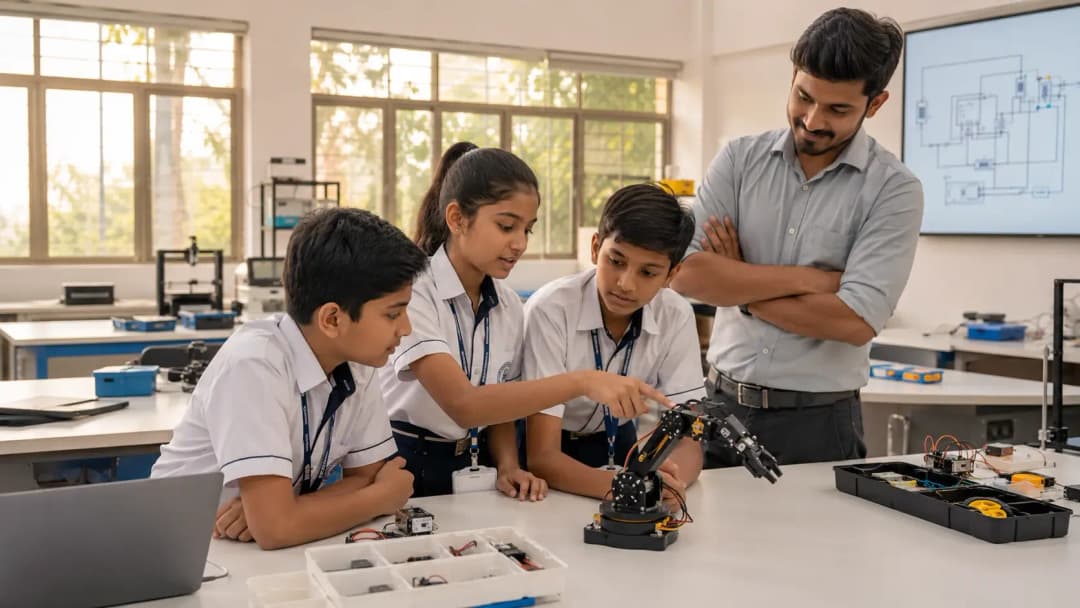
A functioning, well-run AI and robotics lab is the clearest visible proof point available right now. It is tangible in a way that a curriculum framework is not. A parent watching a Class 7 student build and programme a robotic arm does not need an explanation. They feel it.
What Parents Are Actually Asking During Open Houses in 2026
We hear this consistently from school leaders across Maharashtra: the questions at open houses have changed.
Three years ago, parents asked about the student-teacher ratio, the board exam results, and the transport routes. Today, they ask about the timetable for AI and coding classes. They ask whether the school has complied with the new CBSE mandate for computational thinking from Class 3. They ask what projects students actually build, not what the syllabus says they will learn.
And increasingly, they compare notes. The parent WhatsApp groups in Pune and Mumbai are full of screenshots from school open house tours. A picture of a drone flying in a school lab gets shared thirty times. A photo of students in front of a robotics kit travels faster than any school brochure. Word of mouth, for a school in 2026, is heavily visual. And innovation infrastructure photographs better than anything else on your campus.
Parents evaluating schools in the 2026 admissions season are doing something previous generations did not do at scale: they are comparing schools on their innovation credentials. A school that can demonstrate genuine AI integration, not a computer lab with a sign that says "AI Room", has a real and measurable competitive advantage. One that shows up in inquiries, in campus tour conversions, and in year-on-year enrollment.
Why School Differentiation Has Never Been Harder
There are 1,849 private schools in Pune alone. Across Maharashtra, that number is in the tens of thousands. Every one of these schools is competing for a finite pool of students in a city or town where the middle-class population (the families who pay premium fees) is not growing as fast as the school supply.
Why school robotics labs often fail to hold their value is a question worth sitting with. But before getting to that, it is worth understanding why the differentiation problem is so acute right now.
Three forces are converging simultaneously. The first is that parents have become far more sophisticated in how they evaluate schools. They research online, consult ranking platforms, read Google reviews, and visit an average of three to five schools before deciding. The school that wins is not always the one with the best infrastructure. It is the one that makes the clearest case for itself.
The second force is NEP 2020. With AI and computational thinking now mandatory from Class 3 onwards, every school is under pressure to demonstrate implementation. A well-equipped, genuinely-run AI lab is the most visible proof that a school has moved from policy to action, not just added the words "NEP aligned" to its prospectus.
And third: the gap between schools that have innovation labs and schools that do not is starting to show up in enrollment data. A CBSE school in Pune that partnered with an AI and robotics lab provider saw admissions applications increase by 40% in the academic year following launch. The lab did not just teach technology. It gave parents a concrete reason to choose that school over the one next door.
The Admissions Maths: What One Lab Can Do for Enrollment
Let us make this concrete, because trustees respond to numbers more than narratives.
A mid-size private CBSE school in Nashik with 800 students and an average annual fee of ₹60,000 per student generates ₹4.8 crore in fee revenue. Every 50 additional students, one additional section at full strength, adds ₹30 lakhs to the top line annually. Over five years, that is ₹1.5 crore in additional revenue from a single cohort, before accounting for fee revisions.
So the question for a trustee is not "does an AI lab help admissions?" The question is: "how much does one additional section per year justify in terms of investment?" And when the answer to that investment is zero setup cost, because the lab is funded and deployed by a partner who earns only when the lab runs well, the maths shifts completely.
This is the part of the conversation that most lab vendors are not having with school management committees. They are pitching hardware. They are talking about curriculum alignment and NEP compliance. But they are not connecting the lab directly to the enrollment outcome that trustees actually care about.
We have built a financial model that shows schools exactly what this looks like for their specific student strength and fee structure. The numbers are worth reviewing before any procurement decision.
The Part Most Trustees Miss: Differentiation That Pays for Itself
Here is what makes the admissions case for an AI lab genuinely different from any other infrastructure investment a school can make.
A swimming pool attracts students. It does not earn revenue beyond the marginal enrollment uplift. A smart classroom costs ₹3-5 lakhs to install and requires maintenance that the school funds entirely. An auditorium expansion requires a 10-15 year horizon to break even through enrollment growth.
An AI lab, deployed through the Lab-as-a-Service model, works differently. The lab is funded by Scaleopal. The school adds a nominal technology integration fee to the existing student fee structure. The school collects the full fee from parents, keeps a guaranteed profit margin per student, and we receive our operating cost share. The lab is live in 45 days. Year-round maintenance and upgrades are included. The on-campus engineer who runs every session is a working professional from our team, not a freelance instructor hired on a month-to-month contract.
So the school gets an admissions asset that costs it nothing to build, earns it a margin on every enrolled student, and runs reliably without burdening the existing faculty.
But the differentiation only works if the lab actually runs. This is the piece that most vendor relationships fail to deliver on. A lab that sits idle three days a week because the assigned teacher has other classes to manage, or breaks down in October and gets repaired in February, does not create parent word-of-mouth. It creates the opposite.
The only way a lab becomes an admissions asset is if students are building real things, showing those things to parents, and talking about them at home. That happens when the lab is engineered to run consistently, not handed over to a school with a user manual and a warranty card.
What "Real" Looks Like to a Parent
This is worth saying plainly because it gets glossed over in most lab vendor conversations.
Parents in 2026 are not impressed by the existence of a lab. They are impressed by what students are doing inside it. The distinction matters enormously for how you position the lab during admissions season.
A parent who tours your campus and sees a room with robotics kits in sealed boxes and a whiteboard with "AI Innovation Lab" written on it walks away skeptical. A parent who watches a Class 8 student demonstrate an IoT-based smart home model they built last semester and can explain how it works, walks away and calls three friends.
So when we talk about an AI lab as an admissions asset, we are talking about a lab that runs 40-50 hours per academic term per class, produces visible student projects, and has enough structure that a student in Class 5 can describe what they learned and what they built without prompting.
That is what a 10-year, 7-domain curriculum designed by engineers, not by EdTech content teams, actually produces. It shows up in students who can explain what they did, in parents who share it on open house tour videos, and in school rankings where robotics labs are now cited by 70-80% of parents as a unique differentiator.
If you are evaluating AI lab setup in Pune or AI lab setup in Mumbai, the question to ask any vendor is not "what is in the kit?" It is "what will a student in my Class 6 be able to build and demonstrate by December?"
If the vendor cannot answer that with specifics, the lab is a compliance checkbox. Not an admissions asset.
A Word for Principals Who Have to Make This Case to Trustees
We know this conversation is hard. You believe in the lab. You have read the research, seen what other schools are doing, and you know that parents are starting to ask questions you cannot answer yet. But the trust meeting is next month and the proposal on the table is ₹22 lakhs upfront with a three-year software subscription.
That proposal is not the only option available.
The schools that become founding partners with Scaleopal pay nothing upfront. They do not take on depreciation risk. They do not hire a specialist AI teacher. They do not manage a vendor who disappears after installation. And they do not write a proposal asking the trust to approve capital expenditure with an uncertain ROI.
They present a revenue-sharing partnership. One where the lab pays the school back. One where the admissions case is the upside, not the justification.
That is a very different conversation to have in a trust meeting.
If you are a principal working through how to frame this, we have had this exact conversation with dozens of school leaders across Maharashtra. Becoming a founding partner gives you direct access to the engineering team, not a sales representative, and a model that is designed to survive a hard question from a skeptical trustee.
Frequently Asked Questions
Does an AI lab actually increase school admissions, or is that just marketing?
The data from Indian private schools is consistent: schools that deploy genuine, well-run AI and robotics programs see measurable increases in admissions inquiries and open house conversion rates. A CBSE school in Pune reported a 40% increase in admissions applications in the academic year after launching a comprehensive AI and robotics program. The key word is "genuine". A lab that runs three periods a week and produces visible student projects creates word-of-mouth. A lab that sits underused does not.
How do parents know whether a school's AI lab is real or just for show?
They ask what students have built. They look at whether the school posts project demonstrations on their social media. They ask current students during the campus tour. The schools that come out ahead in this conversation are the ones where students can describe their projects without being prompted. That only happens when the lab has been running consistently with a structured curriculum and a qualified engineer running sessions.
Will adding a technology integration fee put off fee-sensitive parents?
Not if it is positioned correctly. A ₹500-800 per month technology integration fee, clearly explained as covering an AI and robotics program taught by an engineer and not an add-on activity, is absorbed well by the demographic that most private CBSE and ICSE schools in Maharashtra target. Parents in this segment are already paying for extracurricular coaching, tuition classes, and hobby programmes. A structured lab programme with a visible curriculum is a more defensible fee line than most of what is already on the statement.
Can a smaller school with 400-600 students make the admissions case for an AI lab?
Absolutely. In some ways, smaller schools benefit more. A lab in a 400-student school becomes a campus identity marker faster than in a 2,000-student institution. Parents visiting a smaller school are more likely to notice and remember the lab. And the per-student economics of the technology integration fee work at smaller enrollment numbers. The margin stays the same regardless of school size.
How long before a school sees the admissions impact after launching a lab?
In our experience across Maharashtra, the first admissions season after a lab launch tends to show noticeable uptick in open house inquiries and parent engagement. The second year, when there are visible student project outcomes, a track record of sessions run, and parent word-of-mouth in the local community, is when the enrollment impact becomes measurable. The 45-day deployment timeline means a school that starts the conversation now can have a live, running lab before the next admissions season opens.