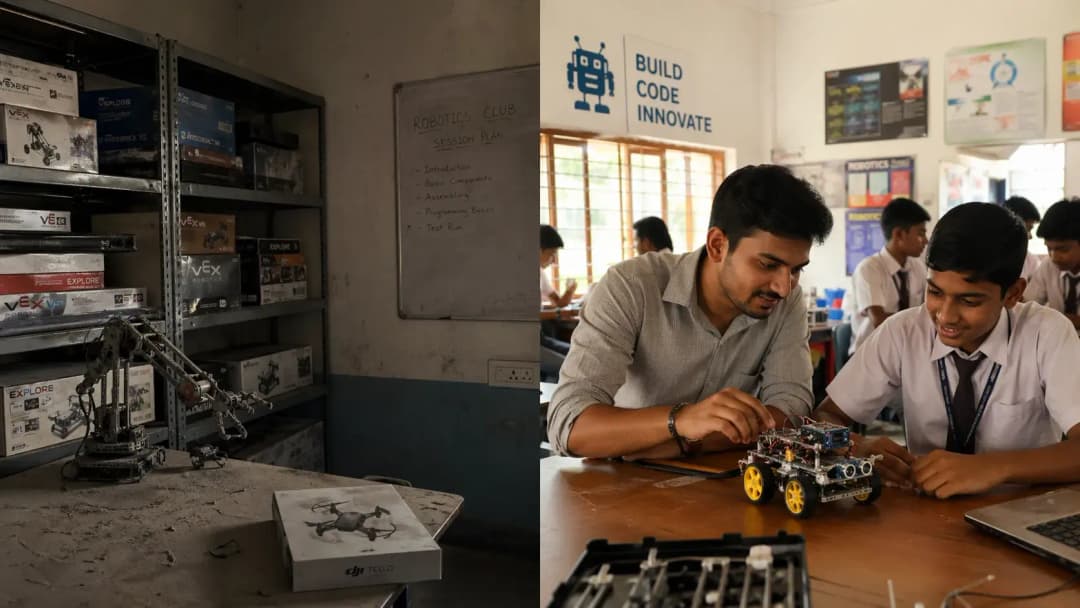
Walk into the right school in Nashik, and you will find it. A room with a neat sign on the door: "Innovation Lab" or "Robotics Centre" or "STEM Hub." Inside: rows of robotics kits in original packaging, a few units partially assembled and never finished, a whiteboard with session notes from eighteen months ago. Maybe a drone still in its box.
The lab exists. It just does not run anymore.
This is not a rare situation. It is, in fact, one of the most predictable outcomes in school technology infrastructure across India. Schools invest, install, and launch with genuine excitement. And then, quietly, the lab stops. Not with a formal announcement. Just a gradual slowdown: fewer sessions per week, then one session per month, then nothing at all. By the time someone notices, the equipment has already aged by two budget cycles.
We have seen this pattern up close. And we think it is time to talk honestly about why it happens.
The Excitement Always Starts the Same Way
A vendor arrives at the school. They have a polished deck, a demo kit, and a confident pitch. The lab will take six weeks to set up. The curriculum is NEP 2020 aligned. The trainer will be trained. The students will love it. Sign here.
So the school signs. The management approves ₹18 lakhs, or ₹24 lakhs, or sometimes more. The hardware arrives in three shipments. A vendor technician spends two days setting things up. There is a launch event, a few photos for the school's social media. Parents are impressed. The principal feels good about the decision.
For the first six months, things run reasonably well. The trainer is enthusiastic. Students are genuinely excited by robots and sensors. Some sessions go brilliantly. A few students build something they are proud of.
And then, somewhere around month eight or nine, the first cracks appear.
What Actually Happens After the Vendor Leaves
The trainer the vendor provided is a freelancer or a part-time hire. He has three other schools. His availability starts slipping. The school's computer teacher is asked to fill in, but she has not been trained beyond a one-day workshop, and the curriculum materials are not detailed enough for her to run the sessions confidently. So a few sessions get cancelled.
Then a component breaks. A microcontroller stops working. A sensor gives wrong readings. The school raises a support ticket with the vendor. The vendor responds in two weeks with a quote for a replacement part. The school's accounts department needs three approvals to release even ₹3,000. The part is ordered. It arrives in another three weeks. Meanwhile, that station sits idle.
Then the trainer leaves entirely, because another school offered him more hours.
Now the school is looking for a replacement. But finding someone who can teach robotics and AI to Class 7 students, on a school's budget, on a school's timetable, is genuinely hard. The vendor offered to help recruit but the SLA they agreed to has already lapsed.
By month fourteen, the sessions are running once a fortnight, if at all. By month eighteen, the lab is functionally closed. The equipment is still there. The subscription to the LMS platform expired and nobody renewed it. The annual maintenance contract the vendor offered at ₹3 lakhs per year was quietly not renewed because the school did not see the value.
This is not a hypothetical. It is a pattern documented across school labs in India. UDISE+ data shows only 57.1% of Indian secondary schools have a functional science lab, and that includes basic chemistry and physics labs that have been around for decades. Technology labs, with their faster depreciation and higher skill requirements, fare even worse.
A Pune-based school, MKSSS, which received an Atal Tinkering Lab grant in 2017, ran into exactly this. Disorganized material, improper storage, lack of documentation, and coordination issues caused a visible decrease in activity pace. And this was a government-funded lab, not a privately-purchased one.
It Is Not a Budget Problem. It Is a Model Problem.
Here is what most schools conclude after going through this: "We did not budget enough for maintenance." So the next time they evaluate a lab proposal, they ask for a more detailed maintenance plan. The vendor comes back with a revised quote that includes a ₹2.5 lakh annual maintenance contract and a teacher training module.
But that is not the root cause. The root cause is incentive misalignment.
When a vendor sells you a ₹20 lakh lab, they have already made their money. Your success or failure after that is genuinely not their business problem. They may care, personally. But structurally, their revenue does not depend on your lab running in Year 2 or Year 3. They already got paid.
So the trainer they provide is the cheapest person who can do the job. The maintenance contract is priced to be skipped. The curriculum support is a PDF and a WhatsApp group that goes quiet after month four. Most vendors offer free lab maintenance for only 1 year; after that, the cost of any replacement part or ongoing maintenance falls entirely on the school.
This is a transaction masquerading as a partnership.
And the school, which never wanted to be in the business of managing a robotics lab, now finds itself exactly there. Hiring trainers. Ordering parts. Chasing vendors. Managing a program that was supposed to run itself.
The Hidden Cost Nobody Quotes You Upfront
The ₹20 lakh figure on the vendor's proposal is the setup cost. It does not include:
- The annual maintenance contract (₹2-3 lakhs per year, often optional and therefore skipped)
- Consumables that deplete: solder, wiring, 3D printing filament, sensor replacements
- Trainer salary or stipend if the vendor's trainer is not included beyond Year 1
- LMS subscription renewals
- Hardware upgrades as the technology ages over 3-5 years
- The hidden cost of staff time: your computer teacher, your lab coordinator, your accounts team processing vendor payments
When you add these up over five years, a lab that cost ₹20 lakhs to set up often costs another ₹12-18 lakhs to sustain, if it is sustained at all. Most schools, when they see that number in hindsight, realise they paid to have a lab that ran for eighteen months and then stopped.
We are not saying this to make you feel bad about a past decision. We are saying it because the financial model your school chooses for a lab determines its fate far more than the quality of the hardware or the curriculum. A great curriculum in a broken model will still fail. A modest curriculum in a model that keeps the operator accountable will still run.
What a Managed Lab Actually Looks Like in Practice
The alternative is not to spend more on the same model. The alternative is a model where the lab operator has skin in the game.
At Scaleopal Labs, we set up the lab on your campus at zero upfront cost. We supply the hardware, the curriculum, and an on-campus engineer who is a working professional from our team, not a freelancer, not a part-time hire. That engineer runs every session. Year-round maintenance and hardware upgrades are included at no additional cost to the school, because the lab's performance is our operating concern, not a service ticket you raise.
The school adds a nominal technology integration fee to its existing fee structure. Parents pay it alongside the regular school fees. The school collects it and keeps a fixed profit margin per student, per year, guaranteed by contract. We earn only when the lab runs. So we have every reason to keep it running.
This is the Lab-as-a-Service (LaaS) model. And it is structurally different from the vendor model in one important way: our incentives are aligned with yours. We do not get paid when the invoice is signed. We get paid when students are learning.
The lab does not go dark in Year 2 because Year 2 is when we start seeing the returns that justify the model. And Year 3. And Year 5.
Read more about how the zero-cost lab model works for your school, or how Scaleopal deploys a lab in under 45 days from partnership confirmation.
What Schools in Maharashtra Are Doing Differently
A growing number of school managements in Pune, Nashik, and Chhatrapati Sambhajinagar are asking a different question when they evaluate lab proposals. Not "how much does setup cost?" but "who is accountable for this lab running in Year 3?"
That question tends to end conversations with most vendors quickly.
Because the honest answer, from a hardware vendor, is: nobody. You are. Your computer teacher is. Your coordinator is. The vendor will be available on email.
But it changes the conversation entirely with a managed lab operator whose revenue depends on Year 3 going well. That is a different kind of promise. And it is backed by a different kind of contract.
If your school has been through the cycle of a lab that went quiet, or if you are evaluating a proposal right now and wondering who will still be running sessions in 2028, we think it is worth having that conversation with us. We are happy to walk through the model honestly, including the parts where we earn and the parts where we do not.
You deserve a lab that still runs when the novelty wears off.
Frequently Asked Questions
Why do school robotics labs stop running in India?
The most common reasons are trainer unavailability after the vendor's initial contract period ends, hardware maintenance gaps after the first-year warranty lapses, and the absence of a dedicated budget for consumables and replacements. The deeper issue is a model where the vendor's incentive ends at the point of sale, leaving the school responsible for ongoing operations it was never set up to handle.
What is the typical cost of maintaining a school robotics lab in India?
Setup costs from most vendors range from ₹15 to ₹28 lakhs. Annual maintenance contracts, when offered, typically cost ₹2-3 lakhs per year. Add trainer costs, consumable replenishment, and LMS renewals, and a school can spend ₹12-18 lakhs additionally over five years, often without realising it at the time of the initial decision.
How is a managed lab model different from buying a lab outright?
In a managed lab model, the operator deploys and maintains the lab at no upfront cost to the school. The school adds a technology integration fee to its fee structure, collects it from parents, and retains a profit margin per student per year. The lab operator continues to run sessions, maintain equipment, and upgrade hardware because their revenue depends on the lab remaining active. The incentives are aligned in a way that a one-time hardware purchase cannot replicate.
Can a school with an existing but underused lab switch to a managed model?
It depends on the condition of the equipment and the terms of any existing contracts. In some cases, an existing lab can be brought under a managed operations model without replacing all the hardware. The more common scenario is schools that are starting fresh or replacing a vendor relationship that has broken down. Reach out to us directly and we can assess your current situation.
What happens to the lab if the partnership with Scaleopal ends?
The hardware we deploy remains on the school's campus for the duration of the partnership term. Terms of what happens at the end of a contract are outlined clearly before signing. We are transparent about this because we believe a partnership that is not honest upfront will not last the first year, let alone five.
Most school labs do not fail because the school did not care enough. They fail because the model they were sold was not built to survive the end of the launch enthusiasm.
The equipment is only as useful as the system keeping it running. And a system built to collect a payment and move on is not a system built to educate students in 2028.
If you want to talk about what a different model looks like for your school, we are ready when you are.