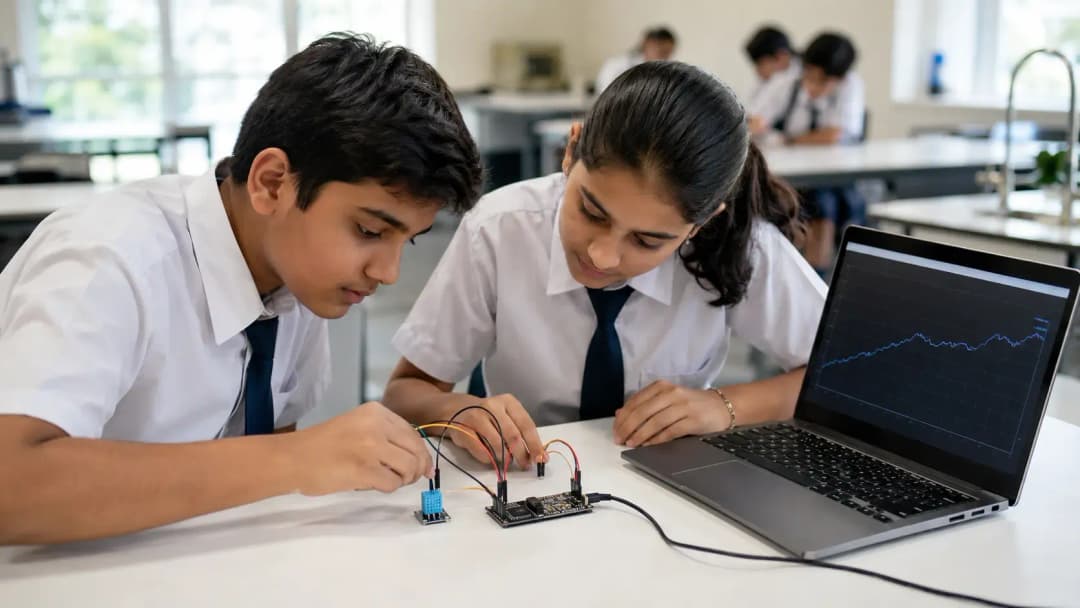
Ask most school leaders what an IoT lab teaches and you will get a version of the same answer: "something to do with sensors and the internet." Which is technically true the way "something to do with chemicals" describes a chemistry lab. Accurate, but not useful.
So let us be specific. What does a student in an IoT lab for schools actually sit down and build? What does the progression look like from Class 6 to Class 12? And why does any of it matter beyond the lab itself?
Those are the questions this post answers.
Why IoT Is No Longer Optional in School Curriculum
India's IoT market is growing fast. The industrial IoT segment alone is projected to hit USD 18 billion by 2030, growing at over 20% annually. The broader IoT market, covering consumer devices, healthcare, agriculture, and smart cities, is expected to reach USD 50 billion by 2029. Every one of those rupees represents a product that someone has to design, build, deploy, and maintain.
The skill gap is already showing up. Sensors, microcontrollers, cloud connectivity, and real-time data analysis are the building blocks of this industry, and very few engineering graduates arrive with hands-on fluency in them. The reason is straightforward: exposure to these technologies still happens mostly in the final year of an engineering degree, if at all. By then, three years of theory have already settled into habits that are hard to shift.
The schools that start IoT education in Class 7 or 8, through a structured IoT and electronics curriculum, give their students a four-to-six-year head start on that fluency. That gap matters enormously when students reach engineering entrance exams, college interviews, and their first internship.
And NEP 2020 is pushing in this direction. The policy explicitly calls for exposure to emerging technologies, including IoT, from the middle grades onwards. CBSE's new Composite Skill Lab guidelines reinforce this, recommending that CBSE-affiliated schools create multi-functional skill spaces that include connected device work. The policy intent is clear. The implementation, for most schools, is still catching up.
What Students Build, Grade by Grade
This is the part most vendors skip over. They show photos of students holding sensors. They do not explain what the students actually understood, built, and were able to do independently by the end of the session. Let us fix that.
Classes 6 to 7: Learning to Talk to the Physical World
At this stage, students are just beginning to understand that a computer can interact with the physical world, not just process information on a screen. The foundational concept is deceptively simple: a sensor measures something real (temperature, light, distance, moisture), and a microcontroller reads that measurement and does something with it.
Students work with basic components. An LED that switches on when a light sensor drops below a threshold. A buzzer that triggers when a motion sensor detects movement. A small fan controlled by a temperature reading. None of these projects are complex. But each one teaches something irreplaceable: that the physical and the digital worlds are connected, and that students can be the ones who decide how.
A student who has wired up a temperature sensor to an Arduino and written the three lines of code that make a fan turn on when the reading exceeds 30 degrees has crossed a conceptual threshold. They now understand input-processing-output not as an abstract principle but as something they built with their hands.
Classes 8 to 9: Adding Intelligence and Connectivity
By Class 8, students are ready to go beyond local circuits. This is where IoT really starts, because IoT is fundamentally about connected systems, not just smart components.
Students learn to send sensor data to a cloud platform and display it on a live dashboard. A weather station project is a good example. Students place temperature, humidity, and air pressure sensors around the school campus. The data from each sensor is collected by a microcontroller, uploaded to a cloud platform via Wi-Fi, and visualised on a dashboard that updates in real time. The school can see which corridor runs hottest at midday. The science teacher can use the data for a unit on weather patterns.
That is a real system with real data. And students built it.
Other projects at this stage include smart irrigation controllers, automatic dustbins with fill-level sensors that send alerts when they need emptying, and simple home automation setups where students control lights and appliances through a mobile interface they programmed themselves.
Each project introduces a new layer of complexity: wireless communication protocols, cloud APIs, data logging, and basic data visualisation. Students learn to think in systems, not just components.
Classes 10 to 11: Problem-First Design
This is where the shift from building prescribed projects to solving self-defined problems happens. Students are given a problem space, not a solution.
A group of four students in a Nagpur school might be asked to address food waste in the school canteen. Their solution: an IoT-enabled inventory system with weight sensors on storage containers that logs consumption patterns and flags when supplies are running low. The kitchen staff gets a notification. The canteen manager can see a week of data at a glance.
Did it solve world hunger? No. But those four students understood sensor integration, wireless communication, data logging, notification APIs, and basic dashboard design well enough to build a working prototype. They also understood how to frame a problem, divide it into subproblems, and integrate solutions from different team members into a single working system.
That is the kind of thinking that CBSE competitions, IIT JEE advanced problems, and engineering college interviews test for. And it cannot be built in a classroom. It requires a lab.
Other projects at this level include smart parking systems using ultrasonic sensors, hospital room monitoring rigs that track patient vitals and alert duty staff, and agricultural monitoring systems that measure soil moisture and trigger irrigation automatically.
Class 12: End-to-End Systems and Cloud Architecture
By Class 12, students who have followed a structured IoT curriculum from Class 6 are operating at a level most first-year engineering students have not reached. They understand full-stack IoT: from the physical sensor, through the embedded firmware on the microcontroller, across the wireless communication layer, into a cloud database, and out to an analytics interface.
Capstone projects at this level are genuine engineering exercises. A student team might design a predictive maintenance system for the school generator, combining vibration sensors, temperature sensors, and an anomaly detection algorithm that flags when readings fall outside expected ranges. Another team might build an energy monitoring dashboard for the entire school building, identifying peak consumption hours and recommending efficiency improvements.
These projects go into portfolios. They come up in interviews. They distinguish students in ways that marks alone cannot.
The Three Things IoT Teaches That No Other Subject Does
It is worth stepping back from the projects themselves and saying clearly what IoT education is actually developing in students. Because the projects are the vehicle. The destination is something deeper.
Systems thinking. IoT forces students to think about how components interact across layers. A bug in an IoT system could be in the sensor calibration, the firmware, the wireless protocol, the cloud parsing logic, or the dashboard query. Finding it requires understanding the whole stack. That kind of diagnostic, layered thinking is the foundation of engineering and, increasingly, of most knowledge work.
Data literacy. Every IoT project produces data. Students learn to read it, question it, spot anomalies, and draw conclusions. A temperature reading of 110 degrees Celsius in a school corridor either means the corridor is on fire or the sensor is miscalibrated. Students learn to distinguish between the two. That scepticism about data, and comfort with questioning it, is exactly what NEP 2020's emphasis on critical thinking is trying to build.
Iterative problem-solving. IoT projects rarely work perfectly the first time. A sensor drops readings. A Wi-Fi connection times out. A cloud query returns null. Students learn to debug, iterate, and test again. This builds a tolerance for failure that classroom education, with its emphasis on getting the right answer the first time, tends to suppress.
What Separates a Real IoT Lab from a Box of Kits
Here is where we need to be direct, because there is a lot of noise in this space.
Many vendors will sell a school a box of sensors, a handful of microcontroller boards, and a PDF syllabus. They will call it an IoT lab. Some will include a one-day teacher training session and then disappear.
What happens next is predictable. The computer science teacher, who was trained to teach Python and database theory, is now expected to teach circuit design, sensor calibration, cloud connectivity, and embedded firmware. Within one academic year, the equipment is gathering dust.
This is not a criticism of teachers. It is a structural problem. IoT requires someone who builds these systems for a living, not someone who attended a workshop about them. The difference in quality is enormous. A teacher who has spent a decade teaching Python can explain sorting algorithms beautifully. They cannot debug a MQTT broker connection issue on the fly in front of Class 9 students.
This is why we insist on placing a working engineer on campus for every session. Not a freelancer. Not a trainer hired for the programme. An active professional from our team, the same team that builds IoT and AI systems for enterprise clients. That engineering depth is what makes the difference between a lab that runs for a decade and one that stops in year one.
It is also why the STEM lab teacher shortage is not something schools can simply train their way out of. Bringing in the right person is faster, cheaper, and more effective than trying to upskill existing staff into a domain that took engineers years to master.
A Note on What IoT Connects To
IoT does not exist in isolation within a strong innovation programme. It connects naturally to the other technology domains that future-ready schools are building.
Sensors generate data. AI algorithms analyse that data and find patterns. Robotics systems act on those patterns in the physical world. Cloud infrastructure stores and serves the data. These are not separate subjects. They are layers of the same stack.
In our STEM and AI Foundation Lab, IoT and Electronics is one of the core domains, sitting alongside Artificial Intelligence, Advanced Robotics, Drone Technology, EV Technology, AR/VR, and Tech Entrepreneurship. Students who move through all seven domains across their school years graduate with a coherent, end-to-end understanding of how technology systems actually work together, not a collection of isolated skills.
For schools in Pune, Mumbai, Nashik, and across Maharashtra that are asking how to build genuine future-readiness into their curriculum, the IoT domain is one of the most practical and highest-impact places to start. The hardware is affordable. The projects are tangible. The industry demand is unambiguous. And the skill gap being created by not starting early is, year by year, getting wider.
Frequently Asked Questions
What age is appropriate to start IoT education in school?
IoT fundamentals can be introduced from Class 6 with age-appropriate projects focused on basic sensors, simple circuits, and physical-digital connections. Cloud connectivity, data logging, and system design are better suited to Classes 8 through 10. By Class 11 and 12, students can work on end-to-end IoT systems with real-world applications. A structured progression is essential; dropping students into advanced projects without the foundational layer rarely works.
What equipment does an IoT lab need?
A functional school IoT lab requires microcontroller boards (Arduino, ESP32, or similar), a range of sensors (temperature, humidity, motion, ultrasound, soil moisture), actuators (motors, relays, buzzers), breadboards and component kits, reliable Wi-Fi connectivity, and access to a cloud IoT platform for data logging and dashboards. The hardware is far less expensive than most school leaders expect. The curriculum and the person delivering it matter far more than the equipment specification.
How does an IoT lab align with NEP 2020 requirements?
NEP 2020 mandates experiential learning, vocational skill development from Class 6, exposure to emerging technologies, and project-based assessment. An IoT lab satisfies all four requirements directly. CBSE's Composite Skill Lab guidelines further reinforce the expectation that schools build multi-functional skill spaces covering applied technology. For schools seeking practical NEP 2020 compliance, an IoT-integrated lab programme is one of the most direct pathways.
Can IoT be taught by an existing computer science teacher?
IoT spans electronics, embedded programming, wireless networking, cloud platforms, and data visualisation. Most computer science teachers are trained in programming theory and software tools but have limited hands-on experience with hardware systems and cloud integration. A teacher who attended a one-day IoT workshop is unlikely to sustain a functioning lab through the inevitable debugging challenges, hardware faults, and student questions that arise. A working engineer with real IoT experience delivers dramatically better outcomes. At Scaleopal, this is a non-negotiable part of how we run every lab.
How is an IoT lab different from a basic computer lab?
A computer lab teaches students to use software. An IoT lab teaches students to build systems. In a computer lab, the computer is the end product of technology. In an IoT lab, the computer (or microcontroller) is a tool that students use to build something new. The shift from consuming technology to creating it is the fundamental difference, and it is the shift that NEP 2020, industry, and the job market are all asking schools to make.
What does an IoT lab cost to set up in India?
Traditional vendor quotes for a school IoT lab range from Rs 3 lakh to Rs 12 lakh depending on the grade band, kit quality, and whether curriculum and training are included. Maintenance, hardware upgrades, and teacher support are usually separate. Scaleopal's Lab-as-a-Service model removes the upfront cost entirely. The lab is funded and deployed by Scaleopal. Your school earns a guaranteed profit margin per enrolled student, turning a cost line into a revenue stream. You can explore the full structure on our financial model page.