The NCERT AI module for Classes 9 to 12 landed on 23 October. Six days later, CBSE took the CT & AI modules out of this year's Class 9 curriculum. If you run academics at a school, you are now holding a well-made 108-page book and no clear instruction on what to do with it.
So here is a plain read of the NCERT AI module: what is in it, where it stands, and what it deliberately leaves out. We have tried to answer the question principals are actually asking. Is it required, and is it enough?
What has NCERT released, and who built it?
NCERT announced the module on Friday, 23 October 2026. The textbook is "An Introductory Module on Computational Thinking and Artificial Intelligence for the Secondary Stage", code UN514, first edition, 108 pages. It suggests 20 class hours across five units. Faculty from IIT Madras and IIT Jodhpur wrote it with NCERT's CIET team.
It assumes no prior AI knowledge. It needs no coding and no maths beyond school level, and it is meant as a common foundation that works in any of Classes 9, 10, 11 or 12.
The stated aim is modest on purpose. NCERT does not want to turn every student into an AI engineer. It wants careful, confident users who can judge what AI tells them. A note to students makes the point bluntly: this is a set of habits to practise, not a module to memorise.
What do the five units actually teach?
The units are meant to be taught in order. The hour split below is NCERT's suggested plan, and the last hour is a closing presentation.
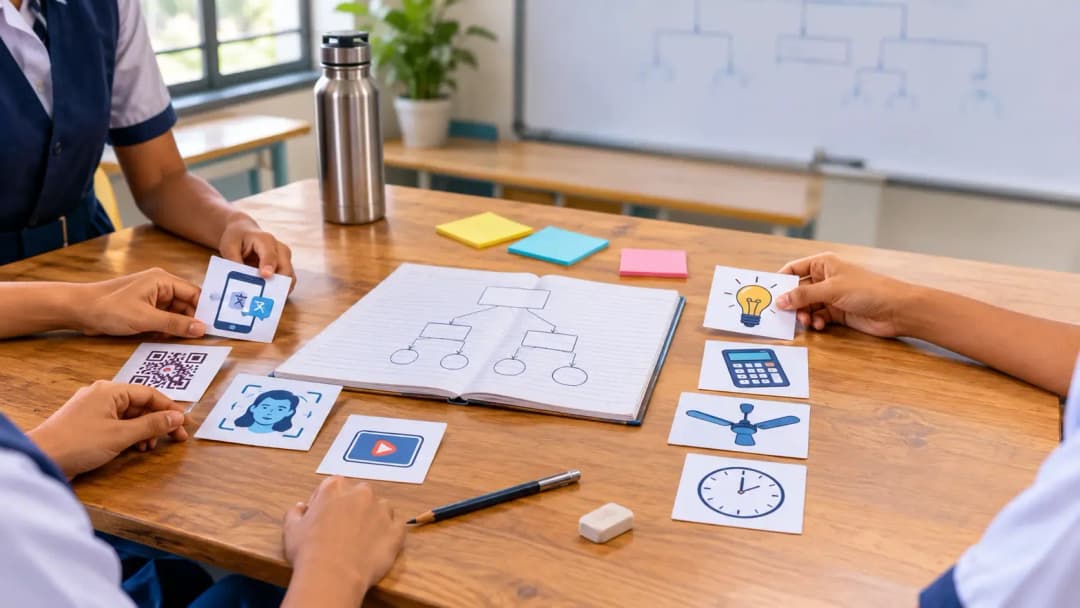
- Unit 1, AI Is Already in Your Life (3 hours): Students trace AI through an ordinary day and learn to tell real AI from older rule-based automation. The examples are Indian: Bhashini for translation, Aadhaar face authentication, UPI checks that briefly hold unusual transfers. The textbook follows fictional classmates from Bhopal, Visakhapatnam, Bhubaneswar, Kohima and Surat. Output: an AI Diary.
- Unit 2, How Machines Learn from Examples (5 hours): This is the conceptual core. Students compare how they learn with how a system learns, then meet features, labels, training and test data, and the three ways machines learn. The centrepiece is Train-and-Break: train a simple image classifier on everyday objects, then try to make it fail. Faces, classmates and ID cards are off limits. Output: a Train-and-Break log.
- Unit 3, When AI Gets It Wrong (5 hours): Why models fail, how deepfakes work, and how our own biases colour what we believe. Students learn the Five Checks (source, claim type, compare, pause, confidence) and run a Hallucination Hunt in a subject they know well. The unit also names the reporting route for harmful content: cybercrime.gov.in and the 1930 helpline.
- Unit 4, Your Data, Your Rights, Your Responsibility (3 hours): Four kinds of data (identifying, behavioural, sensitive and inferred), consent in plain language, and the DPDP Act, 2023 with the 2025 Rules. There is a clear list of what never goes into an AI tool, including Aadhaar numbers, PAN, passwords, OTPs and photos of ID documents. Output: a Privacy Policy Dissection of an app the student really uses.
- Unit 5, Working with Modern AI Tools (3 hours): Better prompts, and a stance NCERT calls helper, not replacement. The student writes the first draft; the tool suggests; the student decides. Output: a personal Prompt Library.
Look at where the hours go. Units 3 and 4, on checking AI and protecting data, take 8 of the 20 hours. That is 40% of the module. It is a judgment and safety module far more than a technology module, and we think that is the right call. Unit 4 pairs naturally with your obligations under the DPDP Act for school AI labs, and Units 3 and 5 sit comfortably beside a written AI policy for Indian schools.
How is it taught and assessed?
Every hands-on activity comes in three modes. In Full mode, each student or pair has a device. In Teacher-Demo mode, one shared screen carries the activity. In Unplugged mode, it runs on paper, objects and discussion, with no tools at all. NCERT's advice to teachers is to change the mode rather than skip the unit.
That matters in a country where device access varies school to school. A school with no lab can still deliver the core. And it removes the easy excuse that the module needs infrastructure the school does not have.
There is no exam. Assessment lives in a running portfolio called the Curious Notebook, which gathers the five unit outputs. It is formative, and NCERT says plainly that it is a working record, not a fair copy. Crossed-out answers and wrong first guesses count as evidence of thinking, so students should not lose marks for them.
We like the intent. But portfolio assessment is only as good as the feedback teachers give on it. A notebook nobody reads quietly turns into one more worksheet.
Is the module compulsory? Where it stands after Acad-70/2026
The short answer is no, not yet, and the paper trail explains why.
On 9 April, CBSE's Circular Acad-18/2026 discontinued all other AI courses for Class 9 from 2026-27 and said NCERT would supply CT & AI modules for Classes 9 to 12, to be taught for internal assessment. On 23 October, NCERT released the module. Then on 29 October, Circular Acad-70/2026 removed the CT & AI modules from the Class 9 curriculum for the current batch, in order to align the introduction of this area with the implementation schedule. Press reports add that the same batch will not have them in Class 10 in 2027-28 either.
Here is what we could not find. We saw nothing in the coverage of Acad-70 about Classes 10, 11 and 12 this session. We also found no published rollout schedule for later batches. Press summaries can miss school-level detail, so read the circular text yourself before you act.
Available is not the same as required. Treat the module as a choice you make, not an order you follow.
Our reading is that CBSE has paused the module for one cohort while the schedule is sorted out. It has not withdrawn it.
What the module leaves out, and where a lab picks up
Here is the comparison that put the module in perspective for us. CBSE's Classes 6 to 8 framework gives students 100 hours a year, and the reported split sets aside about 20 of those hours for AI fundamentals. We covered that structure when the CBSE CT and AI curriculum for Classes 3 to 8 went live. The whole Classes 9 to 12 module is the same 20 hours. One slice of one middle-school year, spread across four grades.
So what does a student not get? No coding. No sensor, no robot, no model to deploy. No project beyond a five-item notebook. The module teaches students to question AI, not to build with it. That is a sound foundation, and a school that skips it will regret it. But is it a lab course? No, and NCERT never claims it is.
The gap shows up two ways. The first is continuity. Students who spent Classes 6 to 8 on projects and data will find 20 hours of literacy a step back in hands-on time. We explored this in why your school's AI lab can't stop at Class 8, and the resource books for Classes 3 to 8 show how much practice the earlier years carry.
The second is the board path. A student who wants depth can take AI as one of the 22 skill subjects, with a Class 10 board exam. Our post on Kaushal Vikas vs skill subject for Class 9 explains how to decide. For a CBSE school, the sensible reading is simple: the module builds judgment, and the lab builds capability.
A literacy module still needs a skilled person in the room. Running Train-and-Break with 40 students, then helping them pull a weak classifier apart, is not a task for a teacher who met the module last week. That gap is exactly what an on-campus engineer fills, and it connects to the teacher training problem nobody warns schools about.
What should an academic director do with it this term?
Read Units 3 and 4 yourself first. They carry 8 of the 20 hours and the highest-stakes ideas, and they will tell you quickly whether your teachers are ready.
Then decide whether to pilot. NCERT built the module as a common foundation for any of the four grades, and we found nothing that stops a school from teaching it as enrichment. If you do, run it in one section, tell parents it is not part of the assessed scheme, and keep notes on what works. A pilot in Unplugged or Teacher-Demo mode costs almost nothing.
And hold off on rebuilding your timetable around it. Until CBSE says more, a 20-hour module is easy to add later and expensive to unpick if the schedule changes. Pair the pilot with a short session for teachers on the helper stance, because that habit will outlast any circular.
Frequently Asked Questions
Is the NCERT AI module compulsory?
Not as far as we can find. CBSE's Acad-70/2026 removed the CT & AI modules from the Class 9 curriculum for the current batch, and we found no published rollout schedule for other classes. Check the circular text and any later CBSE notice before you plan around it.
Is the NCERT AI module part of the Class 9 curriculum this year?
No, for the current Class 9 batch. Circular Acad-70/2026 says the CT & AI modules are not part of the curriculum for these batches. Class 9 is assessed by the school this year, and the module is not in that scheme.
Do students need coding skills or a computer lab?
Neither. The module needs no coding and no prior AI knowledge. Every hands-on activity has an Unplugged version using paper and discussion, so schools without devices or internet can complete the core.
How many hours and units does the module have?
It has five units over a suggested 20 class hours: 3, 5, 5, 3 and 3 hours for the units, plus a closing hour in which each student presents one notebook artefact.
How are students assessed?
Through the Curious Notebook, a formative portfolio of five unit outputs: the AI Diary, the Train-and-Break log, a verification checklist or Hallucination Hunt, the Privacy Policy Dissection and the Prompt Library. There is no board exam.
Does the module replace AI as a skill subject?
No. They are separate. Artificial Intelligence (417) remains one of the 22 skill subjects, with a board exam in Class 10, while the NCERT module is a short literacy foundation.
Make the module the floor, not the ceiling
Go back to the six days between the release and the pause. A school that read both headlines and did nothing has lost nothing yet. A school that rebuilt its Class 9 timetable around a module that then vanished has lost weeks.
The sensible path is the calm one. Read the book, pilot a unit, and keep your real investment in the thing no module can supply: a lab, a trained person and a pathway that carries students from literacy to building. You can see how that pathway runs across our 10-year curriculum, or start the conversation with us if you want help planning the years after this module.