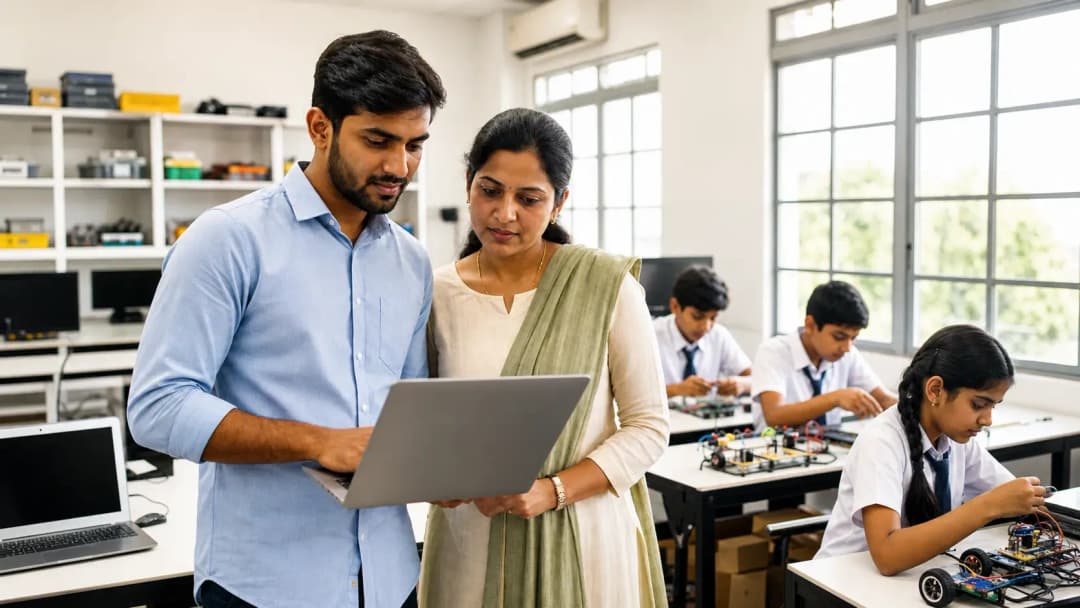
The robotics kits are on the shelves. The computers are connected. The management committee has approved the budget. A brand-new AI lab just got installed in your school.
And somewhere on campus right now, a Maths teacher is quietly dreading Monday morning.
This is the part nobody talks about. Every vendor pitch focuses on the hardware, the curriculum binders, the inauguration photos. But the moment the last engineer from the installation team leaves the building, the real question surfaces: who is actually going to run this thing?
In schools across Delhi, Bengaluru, Lucknow, and Jaipur, we have seen the same story play out. A school invests in a lab, sends a computer science teacher to a two-day workshop in January, and by April the lab is running at 30% capacity because that teacher quit, or was assigned three other subjects, or simply ran out of confidence. The equipment sits. The students miss out. And the principal is fielding questions from parents about the "AI program" they were promised.
The failure is not the lab. It is the assumption that a lab installs itself into a school's academic culture.
What CBSE's 2026 AI Mandate Actually Asks of Teachers
In April 2026, CBSE issued Training Notification TRG-02, which officially designated "Computational Thinking and Understanding AI" as the mandatory teacher training theme for the entire 2026-27 academic session. This is not a suggestion. Every CBSE-affiliated school in India is expected to participate in district-level workshops, expert-led talks, and regional orientation programmes - and to nominate teachers for each.
The new AI and Computational Thinking curriculum rolls out for Classes 3 to 8 this year. For Classes 3 to 5, the approach is unplugged - no lab needed, no computers required. CT concepts are woven into Maths, EVS, and Language classes. But from Class 6 onwards, CBSE expects something more deliberate: teachers from different disciplines working together to integrate AI ideas into their own subject areas. A Science teacher demonstrating pattern recognition during a data experiment. A Social Studies teacher exploring how AI is used in weather forecasting.
So the question is no longer just whether your computer science teacher knows Python. The question is whether your entire middle school faculty understands AI well enough to teach alongside it - or at least not actively work against it.
And that is a very different challenge.
The Three Teachers Every School Has Right Now
Walk into any staff room at a CBSE school in India today, and you will find some version of these three faculty members.
The Enthusiast. Usually a younger teacher, possibly the computer science faculty or the innovation coordinator. Has watched YouTube videos on ChatGPT. Excited about the lab in a real way. The problem is that enthusiasm is not a curriculum plan, and this person is already stretched across five other responsibilities.
The Skeptic. Ten to fifteen years of experience. Has seen "educational revolutions" come and go - smart boards, e-learning portals, tablet programs. None of them fundamentally changed how students learn, but all of them created extra admin work. The skeptic is not wrong to be cautious. They are waiting for proof.
The Anxious One. Quietly terrified. Has been told that AI will be part of their Maths or Science class from June. Does not know where to start. Does not want to ask questions because they do not want to look incompetent. This teacher is the most common, and also the most underserved by the current training ecosystem.
NISHTHA, CBSE's official training channel via the DIKSHA platform, provides free modules for all three. But self-paced video training only goes so far. A teacher who finishes an online module on a Friday evening and walks into a lab full of 35 Class 7 students on Monday morning is not prepared. They have watched someone else do it. That is not the same thing.
What Teachers Do NOT Need to Know
Here is where we want to be direct about something, because a lot of professional development programmes are making this harder than it needs to be.
Teachers do not need to become AI engineers. Full stop.
A Class 5 teacher introducing computational thinking through sorting puzzles does not need to understand neural networks. A Class 8 Science teacher running a data classification exercise does not need to know Python. The CBSE curriculum for Classes 3 to 8 is, by design, conceptual and interdisciplinary. The hard technical execution happens in the lab sessions - not in the regular classroom.
What teachers actually need is much more manageable. They need to understand what AI is at a functional level. They need to know how to connect the concepts their students explore in the lab back to the subject they teach. And they need to trust that when something breaks or goes wrong technically, someone else will handle it.
That third one is where most schools fail. Because they build a programme that depends entirely on one teacher knowing everything, and then that teacher carries the entire weight alone.
The result? Burnout. Dropoff. A lab that runs for one academic year and quietly fades into a storage room by the next.
Why the On-Campus Engineer Changes Everything
There is a structural difference between schools where AI labs thrive long-term and schools where they do not. And it is not budget. It is not the brand of robotics kit. It is not even the teacher's enthusiasm.
It is who is in the room during every single session.
When an on-campus engineer is present - an actual working professional from an engineering background, not a trainer who visits once a month - the dynamic changes completely. The teacher does not need to know how to debug a sensor or explain a machine learning loop on the spot. That is not their job anymore. Their job is to bring their subject expertise: the pedagogy, the student context, the relationship with the class.
The engineer brings the technical depth. The teacher brings the classroom understanding. Together, they deliver something neither could alone.
"Most schools hire one person to do everything - teach AI, maintain the lab, write curriculum, train other faculty, and also teach two other subjects. That is not a programme. That is a person on the edge of burning out."
This is the model Scaleopal Labs is built on. Our on-campus engineers are not instructors who follow a script. They are professionals from Scaleopal's parent engineering team - the same people who build AI automation and machine learning pipelines for enterprise clients. When they are on your school campus, they run the session. The subject teacher is a partner, not a solo performer.
And because they are there every week, not just at installation and not just at the annual review, they actually become part of the school's fabric. Students know them. Teachers grow alongside them. The lab does not feel like a foreign body that got bolted onto the school from outside.
A Practical First Month: What Subject-Wise Integration Looks Like
For Academic Directors who are thinking about how to structure the transition, here is what the first four weeks can realistically look like when the right support is in place.
Week 1: Orientation, not training. No teacher should sit through a full-day AI workshop before they have seen the lab in action with students. The better move is to let the on-campus engineer run the first two sessions while subject teachers observe. Watch how students respond. See what breaks. Notice what excites them. Only then does a conversation about integration make sense.
Week 2: The connection exercise. Each subject teacher maps two or three concepts from their syllabus that naturally connect to something in the lab. Maths teachers will find this easiest - algorithms, patterns, data. Science teachers pick up on sensors and classification. Language teachers are often surprised to find that prompt engineering for a chatbot is fundamentally a writing exercise. Social studies can connect to AI ethics and bias. This does not require technical knowledge. It requires a curriculum conversation.
Week 3: The first co-taught session. One subject teacher joins an AI lab session as a co-facilitator. Not to teach the technology - to make the subject connection explicit for students. "Remember the probability unit we did last month? Watch what this algorithm is doing with data." That moment of bridging is enormously powerful for students. It shows them that the lab is not separate from school. It is school.
Week 4: Debrief and document. What worked? What confused students? What needs to be introduced earlier in the term so students have the conceptual grounding before they hit the lab? This is where a structured programme builds its own memory across academic years.
This is also where the Scaleopal curriculum design does the heavy lifting. The 10-year, 7-domain learning path is built with exactly this kind of cross-subject integration in mind. Teachers are not handed a syllabus and told to figure it out. The progression is mapped for them.
The Real Measure of Faculty Readiness
School leadership often asks us: "How do we know if our teachers are ready for an AI lab?" But we think that is the wrong question. No teacher is ever fully ready before they start. They become ready by doing it - with the right support structure around them.
The better question is: "What does the support structure look like, and will it still be there in Year 2?"
A two-day induction workshop is not a support structure. A teacher WhatsApp group with a curriculum PDF is not a support structure. An annual review from the vendor is not a support structure.
A professional who shows up every week, runs every session, is accountable for outcomes, and is available to the teacher between classes - that is a support structure. It is also exactly what the vendor-install model cannot offer, because once the hardware is sold, the incentive to keep showing up disappears.
This is a core reason Scaleopal Labs built the partnership model the way it did. Our on-campus engineers are not an add-on. They are the product. The lab only runs well when the human infrastructure around it runs well.
And for a school that is trying to implement India's new AI curriculum mandate in a way that actually sticks, that distinction matters more than any robotics kit specification.
FAQ
Do all teachers need AI training to support a school lab?
No. The CBSE curriculum for Classes 3 to 5 requires no technical knowledge from teachers - all activities are unplugged and integrated into existing subjects. For Classes 6 to 8, CBSE expects collaborative teaching between subject teachers and computer faculty, but the bar is functional understanding of AI concepts, not programming ability. The technical delivery should be handled by a dedicated lab resource.
What does CBSE's mandatory teacher training for 2026-27 involve?
CBSE's Training Notification TRG-02 (dated April 9, 2026) designates "Computational Thinking and Understanding AI" as the session theme. Schools are required to conduct or participate in district-level deliberation workshops (6 CPD hours), expert-led talks (3 CPD hours), and regional workshops through CBSE Centres of Excellence. All of this can be logged under Domain-II of the CPD framework. Schools can organise joint workshops through their Sahodaya School Complex.
What happens if the teacher who was trained for the AI lab leaves mid-year?
This is one of the most common reasons school AI programmes collapse. If the entire programme depends on one internally trained teacher, any change in that person's role or departure effectively shuts down the lab. The more resilient model is one where technical delivery is handled by an external on-campus professional whose continuity is contractually guaranteed - independent of the school's own staff churn.
Is the Science or Maths teacher expected to teach coding?
No - and this expectation is a major misconception that creates unnecessary anxiety among faculty. Subject teachers are expected to make conceptual connections between their domain and AI thinking. A Maths teacher explaining algorithmic logic is doing their job. A Science teacher connecting sensor data to experimental design is doing their job. Actual coding instruction, where applicable, is the responsibility of a dedicated technical resource, not the subject faculty.
How long before a faculty member feels comfortable in an AI lab environment?
Based on our experience working with school teachers across India, most subject teachers reach a confident co-facilitation level after 6 to 8 weeks of weekly observation and participation - provided they have an on-campus engineer running sessions alongside them. One-time training workshops, without this ongoing in-room exposure, rarely translate into lasting comfort or classroom integration.
Does NEP 2020 require schools to train teachers specifically for AI?
NEP 2020 emphasises continuous professional development for all teachers as a structural requirement, not a one-time event. The policy specifically calls for 50 hours of CPD per year per teacher. The CBSE AI curriculum mandate for 2026-27 is a direct outcome of this framework. Schools that invest in faculty development as an ongoing system - not a checkbox exercise - will find implementation significantly smoother.