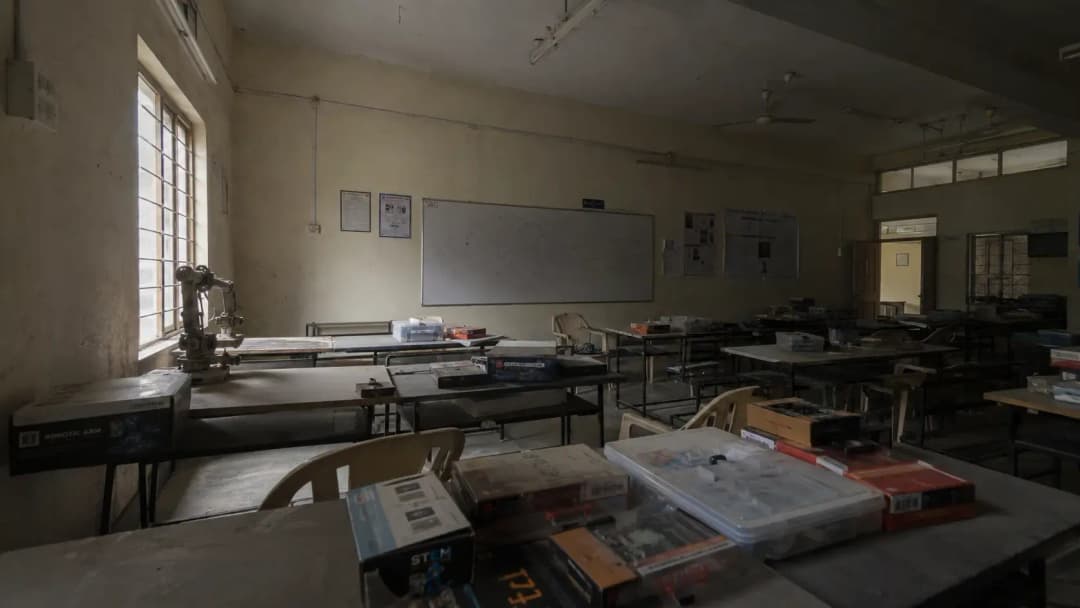
Ask a principal in Nagpur, a trustee in Thane, or an academic director in Nashik who invested in a school robotics lab vendor support arrangement two or three years ago, and most of them will tell you the same thing: the equipment is still there. The sessions are not.
This is not a rare horror story. It is a pattern. And it plays out in CBSE schools, ICSE schools, and state board schools alike, across Maharashtra and the rest of India. Schools spend ₹15 to ₹28 lakhs on a lab, the vendor installs it over a few weeks, photographs it for their own marketing materials, and then the handover happens. After that, the school is largely on its own.
We have had enough conversations with principals and trustees to know that most of them suspected this would happen. They proceeded anyway, because the alternative at the time appeared to be doing nothing.
That is the real problem. Not the vendor. The model.
The Pattern Most Schools Have Already Seen
Here is how a typical school lab vendor engagement unfolds in India, stripped of the sales language:
A company arrives with polished brochures, a curriculum PDF, and a demo kit. The pitch is compelling. Robots that assemble themselves. Students learning Python in Class 6. Drones. AR/VR headsets. NEP 2020 compliance, neatly packaged.
The principal is interested. The trustee asks about cost and gets a proposal somewhere between ₹18 and ₹25 lakhs for hardware, software licences, and installation. A training workshop for two or three teachers is included. There might be a year of "support." After that, annual maintenance contracts are available -- optional and separately priced.
The lab opens. There is a ribbon-cutting moment. Photos for the school's Instagram account. Parents are impressed at the open day.
Then the school year gets busy. The teachers who attended the workshop are also handling their regular timetable. The robotics content is not integrated into their existing classes. Running the lab requires preparation time that nobody budgeted. One of the trained teachers leaves the school entirely, which happens more often than any vendor will acknowledge.
By the second year, the lab runs irregularly. By the third year, it runs mostly during inspection periods and parent visits.
We wrote about this in detail in why school robotics labs go dark in India. The reasons are structural, not individual. No principal is lazy for letting this happen. They were set up to fail by a procurement model that was never designed to sustain the lab in the first place.
Why Vendor Models Are Designed the Way They Are
Understand the economics and the behaviour makes complete sense.
A traditional lab vendor earns their money at the point of sale. The ₹20 lakh transaction is the transaction. Everything that follows -- teacher training, curriculum updates, hardware repairs, software compatibility -- is either a cost to them or an optional upsell. Their incentive ends the day the PO is signed.
This is not cynicism. It is how hardware distribution businesses work. The vendor is not accountable to your school's learning outcomes. They are accountable to their next sale. Once your cheque has cleared, your school is in the queue behind ten other schools waiting to close deals.
What this creates is a structural gap between "installation" and "operation." Vendors fill the first gap. Nobody fills the second.
The specialised teacher problem makes it worse. As we have covered in our post on solving the specialised teacher shortage in schools, there is no ready supply of qualified AI and robotics educators in India right now. A STEM kits vendor can train a biology teacher to use their platform in a two-day workshop. But a two-day workshop does not make someone a confident, year-round AI educator. Six months later, that teacher is back to teaching what they actually trained for, and the lab equipment is gathering dust.
Most vendors disappear after installation. That is not a partnership. That is a transaction. And schools are the ones left holding the depreciating hardware.
What "After the Vendor Leaves" Actually Looks Like, Practically
Let us be specific. Because the problem is not just "the lab stops running." There are real, compounding costs.
Hardware depreciation with no usage. Robotics kits, microcontroller boards, drone components -- these are not museum pieces. They are designed to be used, maintained, and replaced over time. A lab that runs twice a year still depreciates. You paid ₹20 lakhs for assets that are losing value without generating any educational return.
The software trap. Most lab vendors bundle proprietary platforms into their packages. Licences renew annually. If you do not renew, the platform stops working and your students lose access to their project history. You are either paying indefinitely for software your school barely uses, or you are starting over.
Curriculum drift. The PDF syllabus you received in year one was already dated by year two. AI and robotics education moves fast. What passed for an advanced curriculum in 2023 is entry-level in 2026. Vendors rarely update these materials after the sale. A robotics lab setup for schools that was impressive three years ago can feel behind today if nobody is actively maintaining the content.
The compliance problem no one talks about. CBSE's AI integration requirements and NEP 2020's experiential learning mandates are not static. They are evolving. A lab that was NEP-compliant in 2024 may not fully satisfy the curriculum requirements your board expects in 2026. Vendors who sold you compliance do not automatically maintain it.
Reputational cost with parents. This is the one trustees feel most acutely, because parents increasingly know the difference between a lab that is running and a lab that is being shown around. A parent in Pune whose child attends three sessions per year in the AI lab and a parent whose child attends twenty sessions per year have very different conversations at parent evenings. Word travels.
What You Should Have Asked Before Signing Anything
Hindsight is clean. But for schools that are currently evaluating lab partners -- or considering whether to revive a dormant lab -- these are the questions that separate vendors from genuine operating partners:
Who runs the sessions? Not "who trains your teachers." Who physically conducts the lab sessions, week after week, for the full academic year? If the answer is "your existing staff after our training program," you are signing up for teacher burden, not a lab program.
What happens when a component breaks? Hardware fails. Sensors stop working. Drone rotors break. Ask for the replacement SLA in writing. If the vendor hedges, that tells you everything.
What does the curriculum look like in year three? Ask them to show you year-three content. If it looks identical to year-one content, you are paying for a static syllabus, not a living curriculum.
What are your revenue projections for this lab? If the vendor looks confused by this question, it is because they have never thought about your school as a beneficiary of the lab. They have thought about themselves.
What happens if this does not work out? Ask directly. What is the exit process? Who owns the hardware? What are your obligations? A vendor who bristles at this question is one who expects a one-sided arrangement.
Choosing a lab partner for your school is a ten-year decision. The questions above are not obstacles to a deal. They are the minimum due diligence for a commitment that will touch every student on your campus.
The Question That Changes Everything: Who Benefits When the Lab Runs Well?
This is the question traditional vendor models cannot answer cleanly.
In a standard procurement model, the vendor benefits at the point of sale. After that, the school's success is the school's problem. The vendor has moved on.
The model we built at Scaleopal Labs starts from the opposite premise. We fund the lab. We deploy an on-campus engineer -- not a freelancer, not a teacher pulled from another class, a working professional from our AI engineering team -- who runs every session. We maintain the hardware and update the curriculum continuously. We charge a technology integration fee through the school's existing fee structure, and we earn our operating share from that fee.
Which means if the lab does not run, we do not earn.
That one structural change makes every other problem in this post go away. Our incentive to keep the lab running, to keep students engaged, and to keep parents satisfied is exactly the same as yours. Because our income depends on it.
This is the Lab-as-a-Service model, and it is how we have structured every AI lab setup for schools in India we have deployed. The school pays zero for setup. The lab goes live in 45 days. And there is a Scaleopal engineer in that lab every week for as long as the partnership runs.
You can read more about the financial structure -- including what schools typically earn from the revenue-share arrangement -- on our school financial model page.
The Honest Difference
We are not the only company deploying school labs in India. And we are not saying every vendor operates in bad faith. Some have good intentions and limited follow-through. Some have good products and broken support models. Some simply built businesses around the transaction and never figured out what to do next.
But the pattern is real. Too many AI and robotics labs across India are running at 20% of their potential because the people who sold them have no stake in their performance.
The fix is alignment. Partner with someone whose income depends on the lab running well. Everything else -- the curriculum updates, the hardware maintenance, the qualified instruction -- follows naturally when the incentive is right.
That is not an idealistic pitch. It is just how aligned business models work.
If your school is evaluating its next step, whether that is setting up a new lab or reviving one that has gone quiet, we would like to talk. The conversation takes 15 minutes. We will be honest about whether our model fits your school. And if it does, the lab can be live before the next academic year begins.
Start the conversation with our team -- no deck, no pressure, just a direct conversation about what your school needs.
Frequently Asked Questions
Why do school robotics labs in India stop being used after a few years?
The core reason is a structural mismatch between how labs are sold and how they need to operate. Vendors earn at the point of sale and have no ongoing financial stake in the lab's performance. Schools are left to run complex, equipment-heavy programs without specialist staff or consistent support. Teacher turnover and curriculum staleness accelerate the decline. It is not a willpower problem. It is a model problem.
What should a school look for in a school lab vendor for long-term support?
Look for three things: a session delivery commitment (who physically runs classes, week over week), a hardware maintenance SLA in writing, and a business model where the vendor earns ongoing income tied to the lab's operation. If the vendor earns everything upfront, their support incentive is minimal. If they earn when the lab runs, their incentive stays strong throughout the partnership.
Can a school revive a dormant lab without spending more money?
It depends on the condition of the equipment and the gaps in curriculum and staffing. In some cases, a managed operating partner can take over and run the existing infrastructure. In others, hardware has degraded too far and needs replacement. The more important question is staffing: who runs the sessions and who is accountable for quality. Hardware problems are solvable. An ongoing staffing gap is harder to fix without a structural change.
How is a managed lab model different from hiring a robotics teacher?
Hiring a specialist teacher means you are managing recruitment, training, salary, retention, and professional development. If that teacher leaves, you restart the search. A managed lab model, like the one Scaleopal Labs operates, places a professional engineer on campus who is employed by us, not you. The school does not carry recruitment risk, and the curriculum is maintained by the deploying team, not an individual hire. It is the difference between owning a vehicle and having a driver on retainer.
Does the zero cost model mean the school has no obligations?
Not exactly. The school provides the physical space, a dedicated lab room, and a point of contact for coordination. A nominal technology integration fee is collected from parents as part of the regular fee structure, the same way activity fees or transport fees work. The school keeps a fixed profit margin per student per year. Scaleopal handles everything else. The full structure is explained on our school partnership page.
How long does it take to set up a lab under a managed model?
From partnership confirmation to the first session, we work to a 45-day deployment timeline. That covers hardware procurement and installation, software setup, curriculum scheduling, and the first orientation for school coordinators. It is faster than most schools expect, and the entire process is managed by our team.