
The Boardroom
Picture this. It's a Tuesday afternoon. The principal of a well-regarded CBSE school in Pune — let's call her Mrs. Sharma — walks into the management committee meeting with a proposal she's been building for three months.
She has the data. She has the NEP 2020 mandate printouts. She has brochures from two vendors. She even has a rough layout of which classroom could be converted. She believes in this completely.
The trustee glances at the budget sheet. Then looks up.
"₹28 lakhs, Mrs. Sharma? Where exactly do you expect that to come from?"
The room goes quiet. And the proposal, for the fourth consecutive year, goes back into the drawer.
If you're a school leader in India right now, there's a good chance you've been in that room. Maybe you were Mrs. Sharma. Maybe you were the trustee. Maybe you've played both roles in the same year.
This isn't a story about blame. The trustee isn't wrong — ₹28 lakhs is real money for an institution that relies on fee collections, infrastructure EMIs, and staff salaries that can't wait. And Mrs. Sharma isn't wrong either — the NEP 2020 mandate is real, the competitive pressure is real, and students are being left behind while the debate continues.
The problem isn't the people. The problem is the model. And here's the thing: that model just changed.
What the Policy Actually Says
You've heard the phrase a hundred times. "NEP 2020 compliant." It's plastered across every EdTech brochure and school prospectus in the country. But let's talk about what it actually means — and why it matters beyond the marketing.
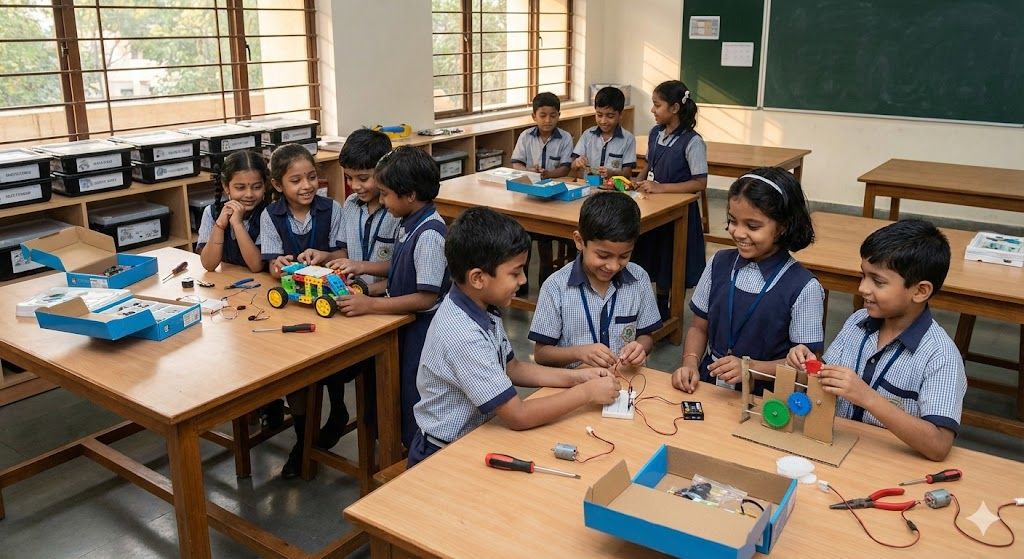
The National Education Policy 2020 makes a very specific demand of schools: stop teaching students about things and start letting them do things. It calls for:
- Coding and computational thinking from Grade 6 onward — a hard curriculum requirement
- AI, data science, and emerging technology integrated into the curriculum, not treated as extracurriculars
- Hands-on, project-based learning where students build, prototype, and test real things
- Cross-disciplinary tinkering environments where curiosity is the curriculum
- Vocational skill pathways starting in the foundational stage
NEP 2020 envisions these students actually building things, not just studying them. The gap between that vision and most school labs right now is enormous.
Here's the painful irony: most school leaders already know all of this. The ambition isn't the issue. The gap between "we want to do this" and "we can actually do this" comes down to one brutal constraint — money. Or more precisely, the wrong kind of money being asked for the wrong kind of investment.
The Trap Nobody Talks About
Mrs. Sharma got quotes from two vendors. ₹28 lakhs from one, ₹22 lakhs from another. Both "comprehensive." Both "turnkey." Both glossy brochures. But here's what neither brochure mentioned.
The real cost of a "turnkey" lab:
- Year 1: ₹22–28L setup. Ribbon-cutting ceremony. Photos for the newsletter.
- Year 1, Month 4: Teachers unsure how to use half the equipment. The lab sits at 30% utilisation.
- Year 2: Software license renewal due — ₹3–5L more. Nobody budgeted for this. The only teacher who knew the lab is on maternity leave.
- Year 3: Equipment is already one generation old. Vendor offers an "upgrade package." At cost.
- Year 3, End: The lab is a storage room with expensive robots gathering dust.
We've heard this story from school after school — not because school leaders are careless, but because the vendor model is fundamentally designed to extract value, not deliver it.
"We spent ₹24 lakhs on that lab three years ago. I don't think more than 40 students have used it in the last six months." — School Director
A vendor's job ends when the equipment is installed. Your problem begins right there. As we explored in an earlier post — We Never Got to Build Anything, Let's Change That — the real crisis in Indian STEM education isn't a shortage of hardware. It's a shortage of environments where students are truly supported to build. Equipment without mentorship isn't a lab. It's expensive furniture.
The Plot Twist — What If the Lab Didn't Cost the School Anything?
Let's go back to Mrs. Sharma. Except this time, the proposal she brings to that Tuesday meeting looks very different. No ₹28-lakh capital ask. No depreciation risk. No "what happens when the teacher leaves" problem.
Instead, she lays out a collaboration — one where an external partner brings everything to the table, and the school contributes what it already has: space, students, and institutional credibility.
This is exactly what Scaleopal Labs does. And it's worth understanding precisely, because the details matter.
Scaleopal Labs collaborates with schools not as a vendor, but as an operating partner. Here's what that means in concrete terms:
- 🔬 All hardware and software: Provided and owned by Scaleopal. Robotics kits, AI development platforms, and project tools — fully provisioned, fully maintained.
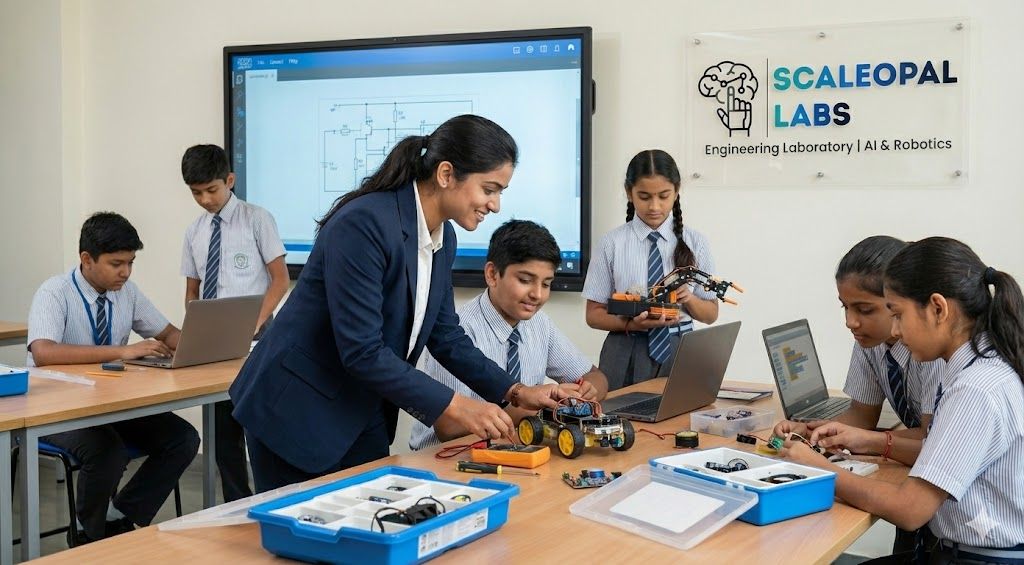
- 👨💻 Active engineer mentorship on campus: Not consultants. Not trainers. Actual working engineers who sit with students session by session.
- 📚 NEP-aligned curriculum: A structured programme that plugs directly into your existing timetable.
- 🔄 Technology refresh included: When equipment becomes outdated, Scaleopal handles the upgrade.
- 💰 Zero capital expenditure from the school: You provide the room. We bring everything else.
A Scaleopal-style lab: enterprise-grade hardware, structured curriculum, active mentorship — without a single rupee of capital expenditure from the school.
And here's the question we know is forming in your mind right now: "That sounds great. But what's in it for Scaleopal?" Fair. Completely fair. The answer is the most interesting part.
The Part That Changes Everything — The Lab That Pays the School Back
The Scaleopal model doesn't just eliminate cost. It creates revenue. For the school. This is the detail that makes Mrs. Sharma's revised proposal land very differently in that boardroom.
In addition to running the lab during school hours, Scaleopal works with school leadership to activate the lab as a revenue-generating community asset:
- Weekend enrichment programmes for enrolled students, charged per session or per term
- Summer and holiday camps open to the broader community — drawing students from nearby schools
- Teacher upskilling and certification workshops that generate revenue while building faculty capacity
- Open lab hours for students from partner institutions
A portion of the revenue from these programmes flows directly back to the school. The lab becomes a cost centre that pays its own way — and in many cases, generates a meaningful surplus.
"We stopped thinking of the lab as an expense item. It's now one of the few things on our books that actively brings money in." — School Director, Scaleopal partner institution
To put it plainly: Mrs. Sharma is no longer asking the management committee for ₹28 lakhs. She's presenting them with a zero-investment revenue partnership that also solves their compliance problem. That's a very different conversation.
A Partner Who Has Skin in the Game
Let's talk about alignment of incentives — because this is the structural reason why the Scaleopal model works where others don't.
A traditional vendor makes money when you buy the equipment. After that? Their profit is secured. Whether the lab succeeds or fails is your problem.
Scaleopal makes money when the lab runs well. When students show up. When the weekend programmes fill up. When the school renews the partnership because it's working. That means our success is genuinely, structurally dependent on yours.
Scaleopal engineers aren't instructors who follow a script — they're practitioners who build things for a living, sitting alongside students and doing it together.
Think about the difference between a student who learns robotics from a textbook and a student who spends a Saturday afternoon troubleshooting a broken servo motor with an engineer who does this professionally. The second student doesn't just learn the concept. They learn how a professional thinks. How they approach failure. How they iterate. How they stay curious when things don't work. That's the kind of learning NEP 2020 is actually trying to mandate.
The partnership unfolds in five clear steps:
- Discovery call — An honest conversation about your school's context, space, curriculum, and goals. No pitch. Just exploration.
- Custom programme design — Built with you, not for you.
- Zero-cost setup — Procurement, delivery, installation, and configuration handled by Scaleopal.
- Launch day with engineers on campus — From Day 1, our engineers are working directly with students and faculty.
- Ongoing collaboration — Regular reviews, updates, revenue programme management, and technology refresh throughout.
Is Your School Ready for This?
Not every school is the right fit for every model, and we'd rather have an honest conversation up front than a frustrated partnership six months in. Here's a quick self-assessment:
- ✓ You have a room or repurposable space of at least 600–800 sq. ft.
- ✓ Your leadership team is genuinely aligned on NEP 2020 as a strategic priority — not just a compliance checkbox
- ✓ At least one faculty member is willing and excited to co-facilitate lab sessions
- ✓ Your school has a stable student enrolment of 200+ across middle and senior school
- ✓ You see weekend and enrichment programmes as a legitimate revenue channel
- ✓ You're open to a genuine partnership model — not just a purchase
If you're nodding along to most of those, you're likely an excellent candidate. If you're uncertain about one or two, that's okay — that's exactly what the discovery call is for.
The Meeting, Rewritten
Let's go back to that boardroom. Tuesday afternoon. Mrs. Sharma walks in.
This time, she doesn't have ₹28-lakh proposals from vendors who'll disappear after installation. She has something different: a partnership proposal from Scaleopal Labs. Zero upfront capital. Engineers on campus. NEP compliance built in. And a revenue model that projects ₹8–12 lakhs per year flowing back to the school.
The trustee looks up from the balance sheet.
"So we don't spend anything? And we actually generate revenue?"
"That's correct," says Mrs. Sharma.
The proposal doesn't go back in the drawer.
That meeting is happening right now, in schools across India that have partnered with Scaleopal Labs. And it can happen in yours. The first step isn't a commitment. It isn't even a proposal. It's just a conversation — an honest, no-pressure exploration of whether and how this collaboration could work for your school.
If you're ready for that conversation, we are too.