Somewhere in a school in Bandra right now, a Computer Studies coordinator is going through next year's curriculum planning document. One line in the latest CISCE circular says the curriculum for the younger classes should "integrate Artificial Intelligence and coding," with a particular focus on computer science education for students who are still getting comfortable with a mouse. That is the entire instruction. No syllabus attached. No subject code. No hour count.
For a Class 4 textbook that currently spends a chapter on "Parts of a Computer" and another on MS Paint, that single sentence is doing a lot of work. AI and coding in ICSE classes 1 to 8 is suddenly a real planning question, and most schools have nothing to plan against.
We have had this exact conversation with three ICSE schools in Mumbai and Pune over the past month. Different campuses, same question: what is CISCE actually asking us to do for Classes 1 to 8, and what are we supposed to put in front of an 8-year-old by the time the new term starts?
AI and Coding in ICSE Classes 1 to 8: Two Very Different Announcements From the Same Board
It helps to separate what CISCE has done from what CISCE has said it intends to do.
For Classes 9 and 10, CISCE introduced Robotics and Artificial Intelligence as Subject Code 66, a Group III skill-based elective, back in 2023. Students sat their first ICSE examination in this subject in 2025. For Classes 11 and 12, the same subject arrived for the 2025-26 ISC session, with the first cohort due to be examined in 2026. We have written about what this means for ICSE schools at the secondary level here, and the short version is straightforward: it is a real, examined subject with a real syllabus, and schools either teach it properly or it shows up in the results.
Classes 1 to 8 are a different story entirely. CISCE's language here is "integrate," not "introduce as a subject." There is no subject code. There is no separate examination. The instruction sits inside the existing Computer Studies syllabus, which for most ICSE schools has historically meant typing skills, basic file management, internet safety, and perhaps a term of Scratch somewhere around Class 5 or 6.
So what is a school actually meant to deliver? Right now, honestly, that is still being worked out at the board level. And that gap between the instruction and the detail is exactly what this post is for.
Why "No Fixed Hours" Cuts Both Ways
If you want a sense of where this could be heading, look sideways at CBSE. CBSE's Computational Thinking and AI curriculum for Classes 3 to 8 is precise almost to the point of being intimidating: 50 hours a year for Classes 3 to 5, 100 hours a year for Classes 6 to 8, mandatory from the 2026-27 session, with teacher preparation routed through NISHTHA modules.
CISCE has not published anything like that for Classes 1 to 8. And that has two consequences worth sitting with.
The first is that ICSE schools have more room to design something that genuinely fits their own students, rather than retrofitting their timetable around a government-issued hour count. The second, less comfortable consequence is that without a floor, quality across ICSE schools is going to vary enormously. One school might use this as the trigger to build a real, progressive AI and coding programme. Another might add an "AI Awareness" heading to the existing Computer Studies textbook and consider the box ticked.
Parents touring schools in 2026 will not spot the difference from a prospectus. But they will notice it within a year, when one child is building a simple chatbot for a school project and another is still doing typing tests in Class 6.
What "AI and Coding" Actually Looks Like, Class by Class
Strip away the policy language, and most curriculum designers working in this space, including ICSE-aligned publishers, converge on a fairly consistent three-stage progression. It is worth knowing what good looks like before deciding what to build.
- Classes 1 to 2: pattern recognition, sequencing, and simple logic, taught through stories, games, and physical activities. Screens are optional here, and often unnecessary.
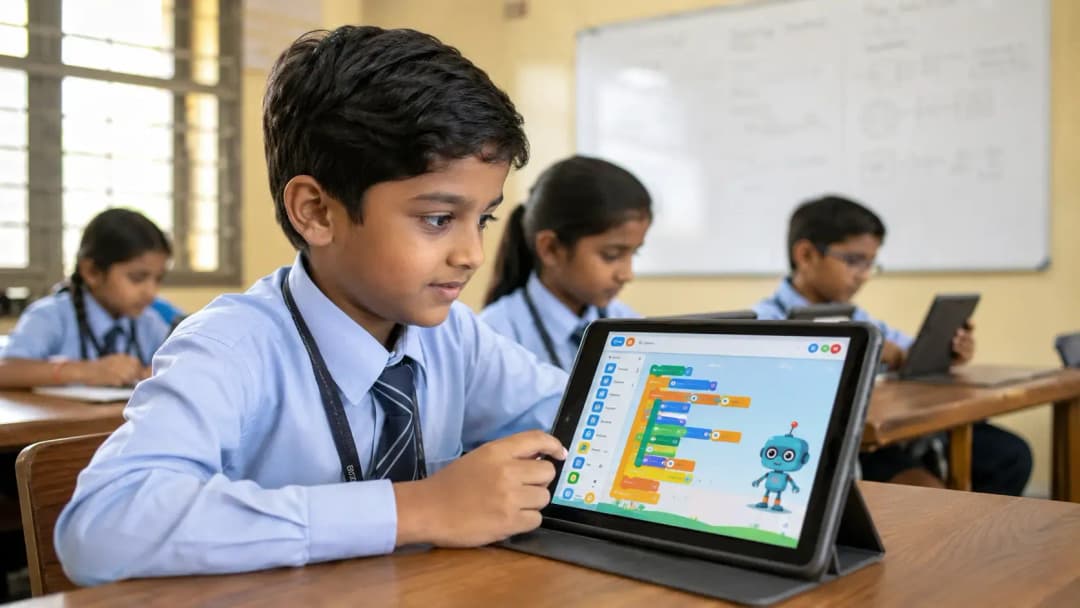
- Classes 3 to 5: block-based and graphical coding in a Scratch-style environment, basic algorithmic thinking, and an early, age-appropriate sense of where AI already shows up in a child's daily life, from voice assistants to recommendation feeds.
- Classes 6 to 8: foundational AI concepts such as classification and pattern recognition in data, an introduction to how recommendation systems work, hands-on robotics and automation with simple kits, and a gradual shift from drag-and-drop blocks toward text-based coding.
A Class 3 student in Pune solving a maze in a block-based environment and a Class 7 student in the same school sorting a set of labelled photos into categories using a basic model are both "doing AI." They are just doing it at the level appropriate to where they are. This is the part most off-the-shelf kits get wrong. They pitch the same activity to a Class 2 student and a Class 8 student, change the colour scheme, and call it differentiation.
The Real Bottleneck Is Not the Syllabus
Here is the part nobody says out loud in a staff meeting. The bottleneck is not curriculum content. Content can be bought, adapted, or written in a matter of weeks. The bottleneck is the person standing in front of the class.
Most ICSE Computer Studies teachers for Classes 1 to 8 were hired, trained, and have spent years teaching typing, office applications, and internet safety. That is a perfectly respectable skill set for the job they were hired to do. It is not the same skill set as teaching a Class 6 student how a basic AI model arrives at a decision, or running a hands-on robotics session involving sensors, motors, and a bit of trial and error.
This is the same staffing gap we have written about for schools across the country struggling to find specialised technology teachers, and ICSE schools are not exempt from it just because their board's instruction for the younger classes is less prescriptive. If anything, the absence of a fixed syllabus makes the problem easier to avoid in the short term, because there is no external structure forcing the investment. It is easy to quietly do nothing and describe it as "integration in progress."
A circular that says "integrate AI and coding" without saying how is not a compliance requirement schools can fail. It is a competitive gap schools can choose to close, or leave open for the school down the road to close first.
What a Properly Run Classes 1 to 8 Programme Looks Like
We approach this the way we would approach any multi-year curriculum problem. Design the ten-year progression first, then work out which year groups need attention most urgently.
For an ICSE school running this through Scaleopal's Lab-as-a-Service model, Classes 1 to 8 sit at the foundation of our ten-year, seven-domain curriculum, built around the same progression most curriculum researchers converge on: pattern-based thinking and stories for the youngest learners, block-based coding and an early AI vocabulary through Class 5, and a move into foundational AI concepts, basic robotics, and early text-based coding through Classes 6 to 8. By the time a student reaches Class 9, they are not meeting AI and robotics for the first time through Subject Code 66. They have already spent four years building toward it.
Sessions are run by an on-campus engineer, someone with an active background in AI engineering, not a repurposed Computer Studies period. The existing Computer Studies teacher is not displaced. They continue to own typing, digital literacy, and the parts of the syllabus they already teach well, while the AI and coding component runs as its own structured weekly programme alongside it.
And because this runs through the zero setup cost model, an ICSE school in Mumbai or Pune does not need to find ₹12-20 lakh in hardware budget and a qualified instructor before Classes 1 to 8 can have a real programme. The lab is funded through the school's existing technology integration fee structure, and deployment takes 45 days from partnership confirmation.
Frequently Asked Questions
Has CISCE made AI and coding compulsory for ICSE Classes 1 to 8?
Not in the way Subject Code 66 is compulsory for ICSE Classes 9 and 10. For Classes 1 to 8, CISCE has indicated that AI and coding should be integrated into the existing computer science curriculum, but it has not published a separate subject code, a fixed syllabus, or a prescribed hour count for these classes.
How is this different from CBSE's AI curriculum for Classes 3 to 8?
CBSE's Computational Thinking and AI curriculum specifies 50 hours a year for Classes 3 to 5 and 100 hours a year for Classes 6 to 8, mandatory from the 2026-27 academic session, with structured teacher training through NISHTHA. CISCE has not issued an equivalent hour-based mandate for ICSE Classes 1 to 8, which leaves more of the design decision with individual schools.
What should a Class 3 student actually be learning in an AI and coding programme?
At Class 3, the focus should be block-based or graphical coding, basic sequencing and logic, and a simple, age-appropriate sense of where AI shows up in everyday life. This is not the stage for text-based programming or technical terminology. It is about building intuition through hands-on activities.
Can our existing Computer Studies teacher deliver this?
Most Computer Studies teachers in ICSE schools have strong skills in digital literacy, typing, and office applications, all of which remain useful. Teaching foundational AI concepts and hands-on robotics for Classes 6 to 8 is a different skill set, and schools generally need either substantial additional training or a dedicated instructor to deliver it well and consistently.
Does an ICSE school need a separate AI lab for Classes 1 to 8?
A dedicated lab space helps, particularly for the hands-on robotics components in Classes 6 to 8, but a standard classroom converted for sessions is usually sufficient for Classes 1 to 5. What matters more than the room is a structured, age-appropriate curriculum and an instructor equipped to teach it consistently through the year, not just before an inspection.
Where This Leaves ICSE Schools
That Computer Studies coordinator in Bandra is going to make a decision either way. The school can treat "integrate AI and coding" as a line to be technically satisfied with a couple of new textbook chapters, or it can treat it as the opening of a real, multi-year programme that gives ICSE students the same four-year head start CBSE students are now required to get.
We work with ICSE schools across Maharashtra on exactly this kind of programme for Classes 1 to 8, structured to lead naturally into the Subject Code 66 syllabus by the time students reach Class 9. If you want to see what that ten-year progression looks like for your school's age groups, that is worth a conversation now, before next year's curriculum planning is locked in.