Most CBSE school principals heard about it. Many forwarded the circular to the academic team. And then the new academic year arrived, and somewhere between timetable planning, annual day rehearsals, and fee revision discussions, the circular got buried.
That is a problem. Because CBSE Circular Acad-15/2026, issued on April 1, 2026, did not announce a pilot. It launched a mandatory CBSE CT & AI curriculum for Classes 3 to 8 (Computational Thinking and Artificial Intelligence), effective from the 2026-27 academic session. All 32,900-plus CBSE-affiliated schools in India. Starting now.
This is not a repeat of the Class 9-12 AI elective conversation. This goes deeper, starts earlier, and demands something different from school leadership than a simple procurement decision.
What Changed on April 1, 2026
Union Education Minister Dharmendra Pradhan launched the curriculum at Vigyan Bhawan, New Delhi. Not a press release. A formal launch event. The curriculum was developed by an expert committee that included faculty from IIT Madras, MNIT Jaipur, NITTTR Bhopal, and Azim Premji University, led by Prof. Karthik Raman. CBSE followed up with Circular Acad-18/2026 on April 9, confirming that Student and Teacher Resource Books are live on cbseacademic.nic.in.
The mandate carries one theme for the entire 2026-27 academic year: "Computational Thinking and Understanding Artificial Intelligence." That is the official CBSE teacher training focus. Every teacher across Classes 3 to 8 is expected to engage with it, and District Level Deliberations (DLDs) are now a formal CPD activity carrying 3 to 6 CPD hours each.
But here is what most schools have not fully absorbed yet. The curriculum is not about teaching children to code. It is about building the mental architecture that powers AI, which is far more ambitious and far more interesting.
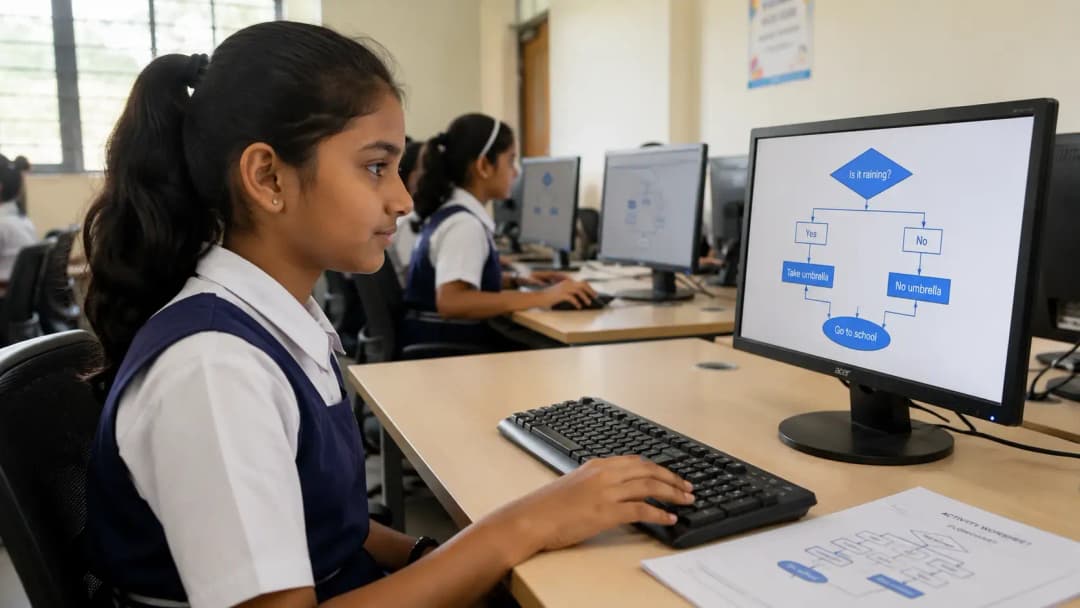
Computational Thinking is the ability to break complex problems into smaller parts, find patterns, ignore irrelevant details, and design step-by-step solutions. These are the same cognitive processes behind supervised learning, classification systems, and algorithmic decision-making. CBSE is not teaching children about AI. It is teaching them to think like the people who build AI. And it is doing this from Class 3.
If you want context on how the broader CBSE AI mandate is reshaping what schools must teach from Class 3 onwards, that framing is useful before diving into what this specific curriculum actually requires your school to set up.
Two Stages, Two Very Different Requirements
The curriculum splits cleanly across two developmental stages. Getting this distinction right is the single most important thing a school leadership team can do before making any decisions.
Preparatory Stage: Classes 3 to 5. Fifty hours per year. CT embedded directly into Mathematics and TWAU (The World Around Us). Delivered by existing Maths and subject teachers using CBSE-provided resource books. No dedicated computer lab required. No specialist AI teacher. The board's own language: "The subject teacher can integrate them into daily instruction without disrupting the lesson flow."
Middle Stage: Classes 6 to 8. One hundred hours per year. Split across 40 hours of Advanced CT, 20 hours of AI Literacy, and 40 hours of Interdisciplinary Projects. Requires a Computer Lab with at least 15 workstations. Delivered collaboratively by subject teachers and the Computer teacher. Real AI tools, data analysis, and no-code AI platforms introduced.
So yes, the same circular covers two completely different operational scenarios. A school that reads the Classes 3-5 requirements and assumes the Classes 6-8 ask is similar is setting itself up for a painful mid-year scramble.
What Classes 3 to 5 Actually Demand From Your School
Less infrastructure. But more coordination than most schools expect.
The CT content for this stage covers four skills that build progressively across three years: Abstract Thinking, Pattern Recognition, Decomposition, and Algorithmic Thinking. Grade 3 students begin with simple visual patterns and basic step-by-step instructions. By Grade 5, they are handling multi-step conditional logic and complex grid problems. The progression is deliberate. It mirrors how ML models process input: from pattern matching to rule application to decision-making.
There is no separate period. The activities attach to existing Mathematics and TWAU chapters. CBSE has designed the resource books to follow the same chapter sequence as the current Math textbook, so a teacher introducing fractions can run a CT activity on decomposition in the same period.
But here is what actually trips schools up. The activities require a hands-on, guided style, not a lecture style. CBSE is explicit: teachers should guide students to arrive at conclusions through hints and discussion, not provide direct answers. For a Maths teacher who has been teaching algorithmically for 15 years, this is a genuine shift. One orientation session will not be enough. A one-day district workshop will not be enough.
Schools that build this well will orient Maths and TWAU teachers through internal workshops that are specific to the resource book content, not generic AI awareness sessions. The teachers who will deliver this programme in a CBSE school in Nashik or Nagpur need to understand the CT framework, not just AI as a concept.
What Classes 6 to 8 Demand, and Where Most Schools Will Struggle
This is where the operational challenge becomes real.
The 100-hour requirement for Classes 6 to 8 breaks into three distinct components. The CT strand deepens significantly, moving into multi-step logic, conditional branching, iterative reasoning, and problems that mirror how AI classification works. The AI Literacy strand runs 20 hours per year across all three grades and is structured as follows:
Class 6 introduces what AI actually is, how it differs from automation, and the three types of machine learning: supervised, unsupervised, and reinforcement. Students also cover basic data concepts and digital citizenship. Privacy, online safety, and responsible AI use are part of this stage, not add-ons.
Class 7 moves into AI domains: classification, regression, clustering, Computer Vision, and Natural Language Processing. Students encounter data visualization tools, interpret bar charts and trend graphs, and begin examining AI bias. What makes an AI unfair. Who gets left out when training data is skewed.
Class 8 introduces the AI project lifecycle. Students go through a Define Problem-to-Collect Data-to-Test Tools-to-Reflect cycle. They use no-code AI platforms: image classifiers, chatbot builders, basic prediction apps. The ethics component in Grade 8 includes misinformation, social impact, and responsible digital tool use.
To deliver this, you need a Computer Lab with 15 or more functional workstations and internet connectivity. CBSE recommends free and open-source tools throughout, which is useful but also means someone on your team needs to identify, configure, and maintain these tools for three grade levels simultaneously. You need a Computer teacher who can teach the AI Literacy strand and run the Interdisciplinary Projects alongside subject teachers. And you need 100 hours per class per year scheduled into an already full timetable.
The schools that will struggle are not the ones that lack the hardware. Plenty of CBSE schools in cities like Pune, Mumbai, and Nagpur have functional computer labs sitting at a 60% usage rate. The schools that will struggle are the ones where the Computer teacher has not been prepared for AI Literacy delivery, where the interdisciplinary project component has no structured session plan, and where the entire 100 hours ends up crammed into a double period twice a week with no curriculum continuity.
This is the same failure pattern we wrote about when we looked at why STEM labs in Indian schools so often go dark within a year or two. Infrastructure without programme design produces rooms with equipment and sessions with no learning.
The Teacher Training Problem Nobody Is Talking About
CBSE has structured a formal training pathway for 2026-27. Schools are expected to run District Level Deliberations around CT and AI themes. Teachers can attend CBSE regional workshops at Centres of Excellence, with each session carrying 3 to 6 CPD hours at a ₹700 registration fee. NISHTHA modules on DIKSHA are available for self-paced online training.
This is well-intentioned. But there is a gap between what is available and what is sufficient.
A one-day DLD or a NISHTHA module gives a teacher orientation. It does not give them a session plan for 40 AI Literacy hours across a school year. It does not tell them how to run an interdisciplinary project combining AI bias (Class 7 AI Literacy) with data collection from a Social Studies project. It does not prepare them to handle a Class 6 student who asks: "If the AI is wrong sometimes, how does it keep learning?" These are classroom moments that require practitioner knowledge, not policy awareness.
The teacher training problem in Indian STEM and AI education is persistent and well-documented. The honest reality is that most school teachers are being asked to deliver AI content they were never trained to teach, using workshops that are designed for awareness rather than capacity.
This is not a criticism of teachers. It is a criticism of a system that mandates a programme without providing the depth of ongoing support that makes it work.
For CBSE schools in Pune and Maharashtra thinking about how to genuinely solve this rather than paper over it, the answer is not more workshops. It is having someone in the room who actually knows AI, every session, week after week.
The Pipeline You Are Actually Building
Here is the timeline that makes this curriculum decision more important than it might appear on first read.
Classes 3 to 8: CT & AI mandatory, starting 2026-27. That is now.
Classes 9 to 12: CT & AI structured modules from 2027-28. NCERT is developing the content. It will cover Python, data analysis, and AI model building at a more applied level.
2029: AI becomes a compulsorily board-examined subject. The Class 6 students who begin CT & AI this year will sit a board exam in AI when they reach Class 10.
Read that again. The students your school is teaching CT to in Class 6 this year will write an AI board exam in 2029. If the foundation is shaky because Classes 6 to 8 ran a compliance-minimum programme, those students will arrive at Class 10 without the reasoning skills the board exam will assess.
This is also why the Class 9 consideration matters for schools that have been running AI electives. All existing AI courses for Class 9 are discontinued from 2026-27. The new cohort enters with a CT & AI background from Classes 6 to 8. The Class 9 programme being built for 2027-28 will assume that foundation. If your middle school programme was weak, your Class 9 students in 2027-28 will be behind.
The pipeline is not theoretical. It has a board exam at the end of it, three years from now.
What Good Implementation Actually Looks Like
A school in Nagpur that does this well does not wait for the DLD invitation. It maps the 50-hour and 100-hour requirements against its actual academic calendar before June. It identifies which Maths teachers will run the Classes 3-5 content, orients them on the CT framework specifically, and builds the resource book activities into the periodic lesson plan. It ensures the Class 6-8 Computer Lab is functional with 15 workstations, sets up at least two no-code AI platforms before the session starts, and gives the Computer teacher structured session plans, not a curriculum PDF.
And then it puts someone in the room who can handle the AI Literacy component from a place of actual knowledge, not reference material. Because the Class 7 conversation about AI bias in hiring algorithms, or the Class 8 project cycle where students try to build an image classifier from scratch, requires more than good intentions. It requires someone who has built these systems before.
Our AI and robotics lab curriculum covers all seven CBSE CT & AI competency areas across a 10-year learning path from Class 1 to 12. The on-campus engineer who runs every session at a Scaleopal Labs partner school is an active AI professional, not a trained workshop runner. When a Class 7 student asks about how supervised learning works or a Class 8 group tries to understand why their no-code chatbot is giving wrong answers, the session does not pause. The engineer answers from practice, not from a handbook.
The CBSE CT & AI curriculum is a mandate. But it is also a rare opportunity to build something that genuinely develops the next generation of AI-literate students. The schools that treat it as the former will tick boxes. The schools that treat it as the latter will produce students who arrive at Class 10 ready for the board exam that is already on the calendar.
If you want to understand how our zero-cost model works for CBSE schools and what it takes to get a fully functioning CT & AI programme on your campus within this academic year, the conversation is worth having now, before the session is two months old.
Frequently Asked Questions
Is the CBSE CT & AI curriculum for Classes 3 to 8 actually mandatory or optional?
It is mandatory. CBSE Circular Acad-15/2026 (April 1, 2026) formally launched the curriculum for all CBSE-affiliated schools in India, effective from the 2026-27 academic session. It is not an elective, a pilot, or a recommendation. Every CBSE school is expected to implement it beginning this year.
Do Classes 3 to 5 need a Computer Lab or special equipment?
No. The CT curriculum for Classes 3 to 5 is embedded in existing Mathematics and TWAU (The World Around Us) classes. It uses printed worksheets and activity-based learning. No dedicated computer lab, no devices, and no specialist AI teacher are required. Existing Maths and subject teachers deliver it using the CBSE-provided resource books.
What does the 100-hour requirement for Classes 6 to 8 involve?
The 100 hours per year break into three components: 40 hours of Advanced Computational Thinking, 20 hours of AI Literacy, and 40 hours of Interdisciplinary Projects. Delivery requires a Computer Lab with at least 15 workstations, internet connectivity, and access to free AI tools and no-code platforms. Both the Computer teacher and subject teachers are involved in delivery.
What happens to Class 9 schools that were already running an AI elective?
CBSE has discontinued all existing AI elective courses for Class 9 from the 2026-27 session. Schools currently running a Class 9 AI course should verify whether their course falls under the discontinued category. New structured modules for Classes 9 to 12 are expected from 2027-28, developed by NCERT.
When does AI become a board-examined subject under this plan?
The current CBSE roadmap has Classes 3 to 8 implementing CT & AI in 2026-27, Classes 9 to 12 getting structured modules in 2027-28, and AI becoming a compulsorily board-examined subject from 2029. Students currently in Class 6 will sit the AI board exam when they reach Class 10.
How should schools approach the teacher training requirement?
CBSE has designated "Computational Thinking and Understanding AI" as the official training theme for 2026-27. Schools are expected to run District Level Deliberations (DLDs), which carry 3 to 6 CPD hours each. NISHTHA training modules are available through the DIKSHA platform. That said, these are orientation-level resources. Schools serious about quality implementation should build internal session plans and structured delivery support, not rely on external workshops alone.