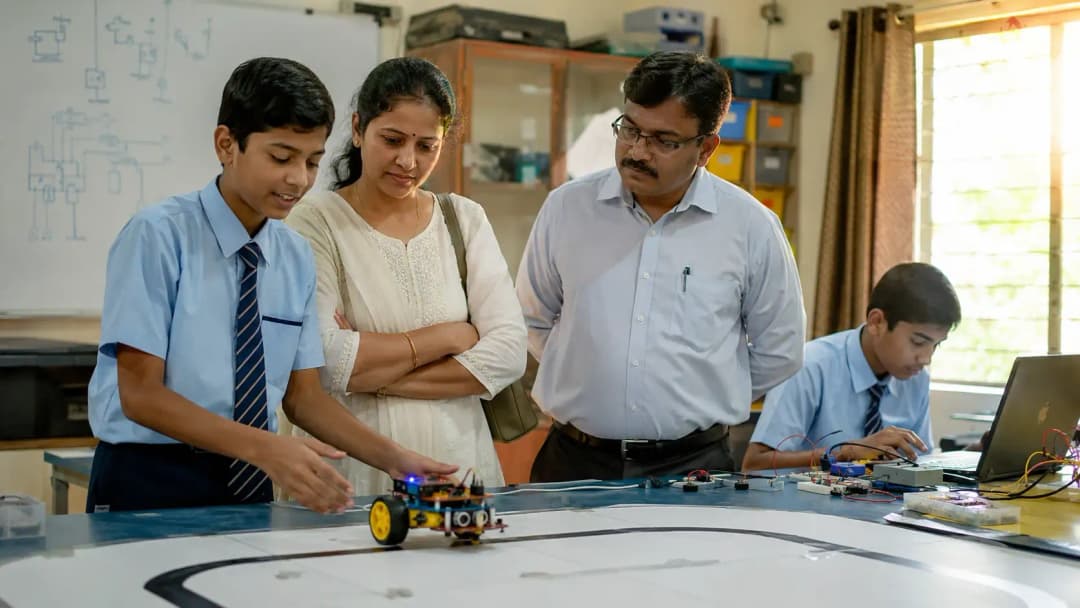
A parent in Kolhapur touring schools this admission season is not comparing your campus to the school down the road anymore. They are comparing it, at least mentally, to what they have read about Pune schools, Mumbai schools, the ones with the AI labs and the robotics showcases that show up in the group chats and the newspaper supplements. Kolhapur schools know this. What most of them do not have is a Pune-sized budget to answer it with.
That gap is exactly what a zero-cost lab model was built to close. Here is what an AI and robotics lab actually looks like for a Kolhapur school, what it costs, and why the city's own economic base makes this a sharper fit than it might first appear.
Why Kolhapur Specifically
Kolhapur is not a sleepy district town coasting on tourism and Kolhapuri chappals. It sits inside one of Maharashtra's stronger industrial and educational belts, anchored by Shivaji University, a dense cluster of engineering colleges, and a textile and sugar economy in Ichalkaranji and the surrounding taluka that has produced generations of technically minded families. Parents here are not unfamiliar with engineering as a career path. Many of them are engineers, or run businesses that depend on machinery, automation, and increasingly, software.
That background matters for how an AI lab lands with a Kolhapur audience. This is not a city where "robotics lab" needs to be explained from first principles. It is a city where a well-run lab, backed by a real engineering pedigree rather than a laminated poster and a coding app subscription, has an unusually receptive audience.
Schools here range across CBSE, ICSE, IB, IGCSE, and State Board, with names like Sanjay Ghodawat International School, Podar International School, and Sanjeevan Public School anchoring the premium end of the market. And admissions season, which typically runs from October through February across most Kolhapur schools, is exactly when a differentiated lab program does the most work.
What "Zero Cost" Actually Means Here
Most STEM and robotics vendors that reach a market like Kolhapur ask for ₹15 to ₹28 lakh upfront, sometimes more once installation and annual maintenance contracts are added. We break down the real numbers behind those figures, and what schools actually get for them, in our guide to AI lab costs for Indian schools. For a mid-sized Kolhapur school, that is not a rounding error. It is often the same order of magnitude as a full year of infrastructure budget.
Our Lab-as-a-Service model works differently, and it is worth being specific instead of vague about it.
- Scaleopal funds and deploys the entire lab: hardware, software, robotics kits, and where relevant, drone and EV systems. The school pays ₹0 upfront.
- A modest technology integration fee is added to the school's existing fee structure, the same way an activity fee or a smart-class fee already works.
- The school collects that fee from parents and keeps a fixed, contractually guaranteed profit margin per student. Scaleopal earns its own operating share from the same fee.
- An on-campus engineer, not a freelance trainer rotating between five schools, runs every session.
- The lab goes live in 45 days from partnership confirmation.
So the lab is not a cost line that sits on a trustee's desk waiting for budget approval next fiscal year. It becomes a revenue stream from day one, which is a very different conversation to have with a management committee that has seen too many ₹20 lakh proposals go nowhere.
What Students Actually Build
This is not a coding app on a shared tablet cart. The full 10-year curriculum spans seven domains from Class 1 to 12: Artificial Intelligence, Advanced Robotics, IoT and Electronics, Drone Technology, EV Technology, Immersive AR/VR, and Tech Entrepreneurship. A Class 6 student in the foundation lab is working through circuit design and basic algorithms. But by Class 10, the same student is building autonomous systems and working with Generative AI and RAG concepts most adults have not touched.
Given Kolhapur's own manufacturing and automotive-adjacent economy, the EV Technology and IoT domains tend to land especially well here. Students see the connection between "battery systems and motor control" in a classroom and the actual machine shops and auto component units many of their own families are connected to. That is a kind of relevance a generic national curriculum rarely achieves, and it is worth building into how you talk to parents at your next open house.
Why This Matters for Admissions, Specifically
We have written before about how an AI lab helps a school fill more seats, and the mechanics hold in a city like Kolhapur just as much as in a metro. Parents comparing two similarly priced schools will lean toward the one that visibly signals it is preparing children for a technology-driven future, especially in a market where engineering and technical careers are already the aspirational default for most families.
But there is a second, quieter benefit specific to smaller cities. In Pune or Mumbai, three or four schools might already have some version of an AI lab, so the differentiation is thinner. In Kolhapur, a properly run, engineer-led lab is still rare enough to be a genuine first-mover advantage. That will not stay true forever. It is true right now.
Picture a mid-sized CBSE school in Kolhapur with 900 students, sitting on the same open house circuit as three or four competitors every October. Its usual pitch is the usual pitch: good results, decent sports facilities, a music room. So what happens when that school walks a prospective parent through a working AI lab instead, with a Class 8 student demonstrating a line-following robot they built themselves? The comparison stops being about brochures. It becomes about something the parent can actually watch happen in front of them.
NEP 2020 and the Compliance Layer
None of this exists in isolation from what the state and central boards are already asking of schools. Maharashtra's own SSC and NEP 2020 push toward experiential and skill-based learning applies here exactly as it does statewide, and we have covered that shift in detail in our Maharashtra SSC and NEP 2020 guide. CBSE schools in Kolhapur are also within scope of the board's newer Composite Skill Lab and Classes 3-8 AI and Computational Thinking mandates rolling out through the 2026-27 academic year.
A managed lab does not just satisfy this on paper. It gives a school an actual, staffed answer when a parent or an inspection asks what the school is doing about it, rather than a curriculum document sitting in a drawer.
What to Actually Evaluate Before Signing With Any Vendor
If you are a Kolhapur principal or trustee weighing this decision, do not take our word for the specifics. We have laid out the exact questions worth asking any lab vendor, Scaleopal included, in our guide to choosing an AI lab vendor. Space requirements, curriculum depth, what "maintenance included" actually covers, and what happens if the vendor's business model does not survive three years, all of it applies just as much here as anywhere.
What tends to separate a real program from a hardware drop is simple. Ask who is standing in the lab on a Tuesday afternoon in the eighth month of the program. If the honest answer is "nobody, unless we call the vendor," that tells you most of what you need to know.
Frequently Asked Questions
Does the zero-cost model actually work for a mid-sized Kolhapur school, or only large campuses?
It works for both. The model scales with student enrollment rather than requiring a minimum campus size, since the technology integration fee and Scaleopal's operating share are both structured per student.
Which boards in Kolhapur can adopt this model?
CBSE, ICSE, IB, IGCSE, and Maharashtra State Board schools can all adopt the lab, since the 7-domain curriculum is designed to align with NEP 2020 and layer on top of any existing board syllabus rather than replace it.
How long does setup actually take once a school signs on?
45 days from partnership confirmation to a fully operational lab on campus, including hardware installation, software setup, and the on-campus engineer beginning sessions.
Is there a difference between the Foundation Lab and the Advanced Lab tiers for a school like ours?
The STEM and AI Foundation Lab covers AI, Coding, Robotics, IoT, and Tech Entrepreneurship, and suits schools building their first innovation lab. The Cognitive AI and Advanced Robotics Lab adds Drones, EV Technology, AR/VR, and Agentic AI, and suits schools aiming to be the regional benchmark, which is a real possibility in a market like Kolhapur where few schools have gone this far yet.
What happens to the lab if Scaleopal's engineer is unavailable on a given day?
The on-campus engineer model includes coverage and continuity built into the partnership terms, which is a meaningfully different guarantee than a freelance trainer or a single-person vendor relationship with no backup.