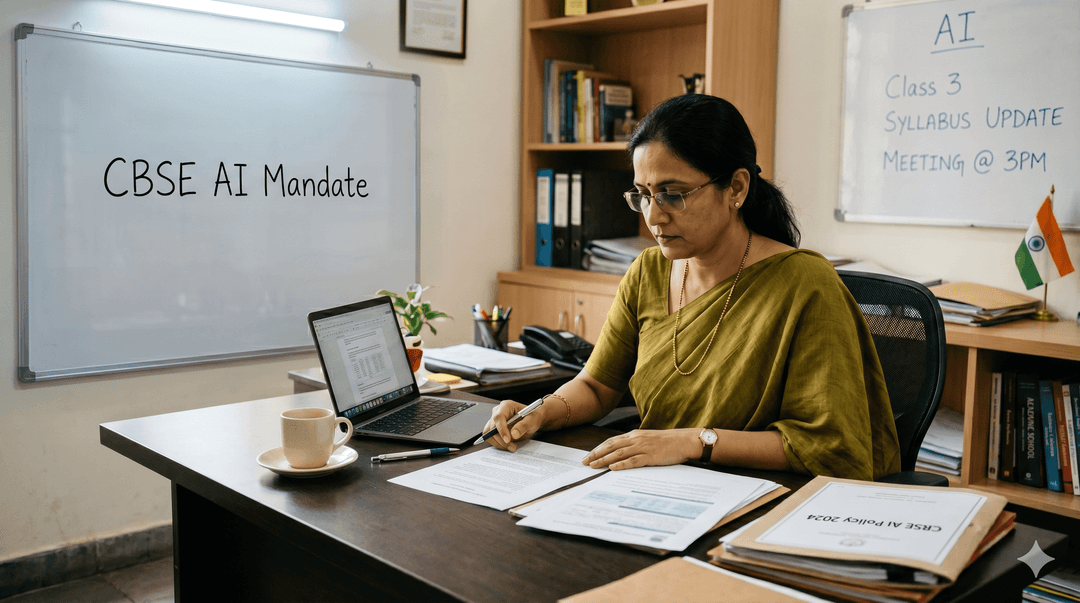
On April 1, 2026, Union Education Minister Dharmendra Pradhan officially launched the CBSE Computational Thinking and Artificial Intelligence curriculum. Eight days later, on April 9, CBSE issued a formal notification to every affiliated school in the country. The mandate is not a proposal. It is not a pilot. It is the curriculum your school is expected to deliver starting this academic session.
If you are a principal or trustee at a CBSE-affiliated school in Pune, you are reading this at the right moment. Schools that move in the next 60 days will be well ahead of the ones still waiting to "see how it plays out." And Pune, with its density of CBSE schools and a parent community that pays close attention to innovation credentials, is exactly the kind of market where being first will matter.
The CBSE AI Mandate Is No Longer a Rumour - It Is the 2026-27 Session
The Ministry of Education first signalled this direction in October 2025. By December, curriculum materials and teacher handbooks were targeted for completion. On April 1, the curriculum went live. CBSE has also declared "Computational Thinking and Understanding AI" as the official training theme for all CBSE schools for the entire 2026-27 academic session.
This is what that means in practice. The CT & AI curriculum is mandatory for Classes 3 through 8 from this year. Classes 9 and 10 follow in 2027-28. The curriculum is designed to build progressively - foundational pattern recognition and logical thinking in the early classes, hands-on AI projects and data literacy by Classes 6 to 8, and specialised AI as a compulsory subject through secondary school.
The alignment with NEP 2020's practical implementation goals is direct. This is not an add-on. The Ministry has embedded AI and computational thinking into existing subjects - Maths, Science, Social Studies, EVS - so schools cannot simply point to a standalone "coding class" and call it done.
What Exactly Does CBSE Require? Breaking Down Classes 3-5 vs 6-8
The mandate splits into two distinct phases, and it is worth understanding both before you decide what infrastructure you actually need.
Classes 3 to 5 are largely unplugged. The curriculum here focuses on pattern recognition, logical sequencing, and basic algorithmic thinking - delivered through classroom activities, games, and puzzles integrated into existing subjects. Most of this does not require a dedicated lab or specialised equipment at all. What it does require is teachers who know how to facilitate these activities and have the session plans to back it up. CBSE has mandated 50 hours per year for this cohort.
Classes 6 to 8 is where the infrastructure question becomes real. This cohort needs computer lab access with AI tools, data analysis environments, and no-code machine learning platforms. CBSE is explicit that a basic typing lab running MS Office does not qualify. The curriculum requires 100 hours per year of CT & AI learning - and that learning needs to involve actual AI workflows, not theory on a whiteboard. This is the cohort where schools without a proper setup will feel the gap most acutely.
The teacher training situation is also worth naming directly. CBSE has tied training to the NISHTHA programme on the DIKSHA platform, and it is mandatory for all teachers handling Classes 3-8. Not just computer science teachers - Maths and Science teachers are equally in scope. A school with 6 classes across these 6 grades is looking at a significant orientation effort, and the clock on that has already started.
Why Pune Schools Are Well-Placed, And What Could Still Go Wrong
Pune has something that most cities do not: a parent community that actively compares schools on innovation, infrastructure, and future-readiness. In the 2026 admissions cycle, parents are already asking whether a school's "AI lab" is a real learning environment or a room with a sign. Schools in Aundh, Baner, Kothrud, Wakad, and Pimpri-Chinchwad are competing for the same pool of aspirational families, and tech credentialing has become part of that competition.
The CBSE mandate gives every school a reason to move. But it also creates a problem most principals will recognise immediately. The vendors calling your front office this month are offering the same thing they offered last year - a hardware kit, a PDF syllabus, and a one-day teacher training. The branding has changed to say "CBSE CT & AI aligned." The model has not.
A school in Hadapsar that spends ₹18 lakhs on equipment this May and gets a trainer who visits twice a month will be compliant on paper. Whether students are actually learning, whether the equipment is maintained, whether the timetable integrates sessions properly - those questions are a different matter entirely. Pune schools that have seen how proper AI lab setups work know the difference between a functioning lab and a furnished one.
The risk is not non-compliance. The risk is spending significant capital on compliance theatre.
The Three Ways Schools Are Responding, And Which One Actually Works
We have spoken with principals and trustees across Maharashtra over the past several months. The responses to the mandate fall into roughly three categories.
The first is the wait-and-see approach. "Let's see what other schools do." This is understandable but costly. The schools that move early this session will have a full academic year of operational data - working timetables, trained faculty coordinators, student project portfolios - before the schools that waited catch up. Parent perception gaps form quickly and are hard to reverse.
The second is the capital purchase approach. Approach a vendor, get a proposal for ₹15-25 lakhs, present it to the trust, watch it sit in a drawer. This is the most common outcome across CBSE schools evaluating AI lab investments. The upfront ask is too large, the ROI is unclear, and the trust rightly questions whether the technology will still be relevant in three years.
The third approach - and the one that actually results in a running lab by June - is a fully managed partnership where the school does not fund the setup. This is where the conversation usually changes for principals and trustees who have not heard of the Lab-as-a-Service model before.
How a Pune School Can Be Fully Compliant Without Spending a Rupee on Setup
Our model at Scaleopal Labs is straightforward. We fund, deploy, and operate the entire lab on your campus. The school pays nothing for setup. A technology integration fee - structured like any other activity or facility fee - is added to your existing student fee structure. Your school collects that fee, we receive an operating cost share, and your school retains a fixed profit margin per student, guaranteed by contract. The lab does not cost your school money. It pays your school money.
This matters for the CBSE mandate specifically because compliance here is not a one-time installation. The CT & AI curriculum requires 50 to 100 hours of structured sessions per year, per cohort. That means the lab needs to run consistently across the full academic calendar - with qualified facilitators, updated curriculum, and maintained equipment - not just in the weeks before a CBSE inspection.
Our sessions are run by on-campus engineers from the Scaleopal team, not outsourced trainers. Because Scaleopal's parent company builds real AI systems for global enterprise clients - automation pipelines, RAG architectures, LLM fine-tuning - the engineers who walk into your school lab are practitioners, not instructors reading from a vendor manual. That is a meaningful difference, and it shows in how students engage with the material.
The curriculum across our 7 domains is structured as a 10-year pathway from Class 1 to Class 12, which means a school that partners with us this year is not just solving the 2026-27 mandate - it is building a learning progression that runs through board classes and beyond. The CBSE requirement is the floor. We are built to go well above it.
For the trust, the financial question is also answered differently when you see how the revenue model works. Rather than presenting a ₹20 lakh capital proposal, the conversation becomes: here is how much your school can earn per academic year from this lab. That is a fundamentally different decision.
Deployment takes 45 days from partnership confirmation. A school that confirms a partnership in May can have a running lab before the June academic session begins.
What Your School Should Do This Week
The mandate is live. The session is starting. Here is a practical set of actions for any principal reading this.
First, audit your Classes 6-8 infrastructure honestly. Does your current computer lab support AI tools and no-code platforms? Can it handle 100 hours of CT & AI sessions per year across all three classes simultaneously? If the answer is no or uncertain, that is your starting point.
Second, brief your Class 3-5 teachers on the NISHTHA training requirement. The DIKSHA platform has modules available. Getting teachers started on this now prevents a scramble in July.
Third, if you are evaluating lab vendors, add one question to every conversation: what happens when the equipment breaks down in November? The answer to that question will tell you more than any brochure. A vendor who owns the ongoing responsibility for the lab's functioning is a partner. Everyone else is a supplier.
And if you want to understand what a zero-cost, fully managed lab partnership looks like for your specific school - how many students, what the revenue projection looks like, what the 45-day deployment covers - we are happy to walk through it. That conversation takes 15 minutes and has no obligation attached. You can book a strategy call directly here.
We have also written about how schools across India are turning NEP compliance into a revenue stream if you want to understand the broader financial case before that call.
Frequently Asked Questions
Is the CBSE CT & AI curriculum mandatory for all schools from 2026-27?
Yes. CBSE officially notified all affiliated schools on April 9, 2026 that Computational Thinking and AI is mandatory for Classes 3 to 8 beginning the 2026-27 academic session. Classes 9-10 come under the mandate in 2027-28. CBSE has also named CT & AI as the central training theme for the current academic year, which means teacher orientation is expected to happen in parallel with curriculum rollout.
Do Classes 3-5 need a dedicated AI lab to comply?
Not necessarily. The curriculum for Classes 3-5 is designed to be largely unplugged - using classroom activities, games, and problem-solving exercises integrated into existing subjects like Maths and EVS. What is required is that teachers have access to NISHTHA training modules and structured session plans. Classes 6-8 do need computer lab access with AI tools and data platforms.
Will CBSE inspect schools for CT & AI compliance?
CBSE has not announced a formal compliance audit cycle at this stage. But the mandate is embedded in the formal curriculum and teacher training structure, which means it will be part of ongoing school quality frameworks. More practically, parent awareness of this mandate is growing - and schools that cannot demonstrate genuine CT & AI delivery will feel that pressure in admissions conversations before any CBSE inspector arrives.
What is the difference between a CT & AI curriculum and an AI lab?
The CT & AI curriculum is what CBSE mandates - structured content delivered across Classes 3-12. An AI lab is the infrastructure that makes that curriculum possible at the depth CBSE intends for Classes 6 and above. You can technically deliver the Classes 3-5 portion without a lab. But a school that wants to deliver the full promise of the mandate - project-based AI learning, hands-on data work, real engineering exposure - needs both.
How quickly can a school in Pune set up a compliant AI lab?
With a vendor-purchase model, realistic timelines run 2-4 months from budget approval to operational lab - accounting for procurement, installation, and teacher training. With a managed partnership model like Scaleopal Labs, deployment takes 45 days from partnership confirmation. A school that moves in May can have a running lab before the June session begins, with no upfront capital required.
Can a school comply with this mandate without spending lakhs on equipment?
Yes. The Lab-as-a-Service model means the school pays nothing for lab setup. Scaleopal funds, deploys, and operates the full lab on-campus. The school earns a fixed profit margin per student per academic year. Compliance does not have to come with a capital expenditure burden - and for most school trusts, that distinction changes the entire conversation.