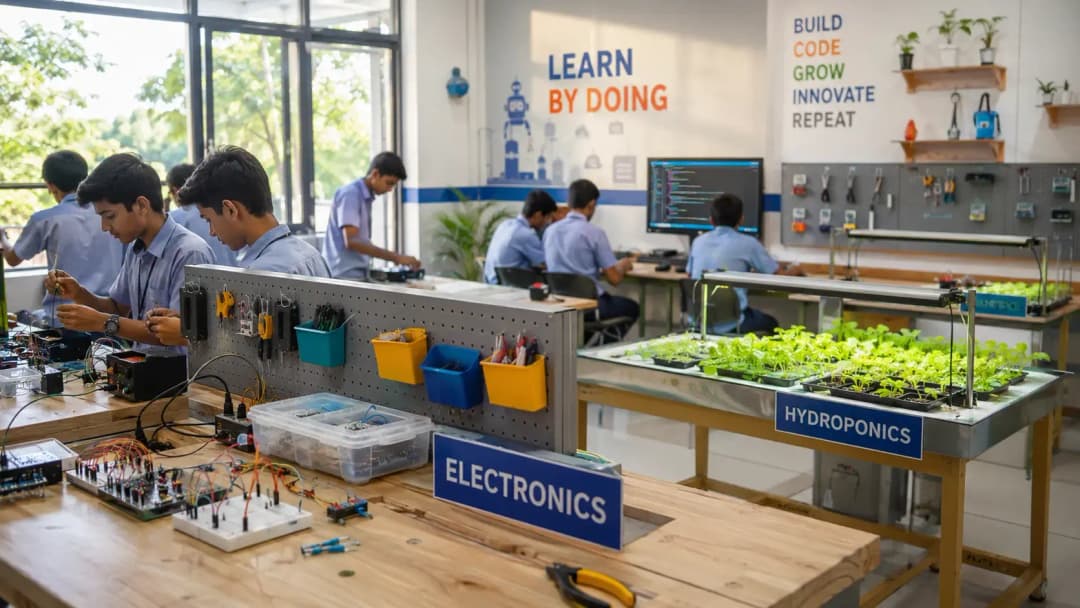
Ask a CBSE principal which Composite Skill Lab sectors their school picked, and nine times out of ten you'll hear "AI and Robotics." It's the obvious answer. It's also, on its own, not a compliant one.
CBSE's Composite Skill Lab sectors list runs to 13 official categories, and the guidelines don't let a school pick any six it likes. They ask for six skill subjects spread across three separate categories of work, called "forms of work" in the National Curriculum Framework for School Education (NCF-SE) 2023: Work with Life Forms, Work with Machines and Materials, and Work in Human Services. A school that builds its entire lab around Electronics/Mechatronics and IT/ITeS, both sitting in the same Machines and Materials bucket, has built a lab that's excellent at one thing and missing two-thirds of what the framework actually asks for.
We read CBSE's guidelines booklet cover to cover for this piece, because half the schools we talk to for our zero setup cost CBSE lab partnerships haven't been able to find a straight answer to a simple question: which sectors should we actually pick? Most of what's published right now blurs together two different things, the official CBSE sector list and individual vendors' own product categories, which makes an already confusing mandate harder to plan around. So here's the list as CBSE actually defines it, and a framework for choosing six sectors that make sense for your school specifically.
What Are the CBSE Composite Skill Lab's 13 Sectors?
CBSE's Composite Skill Lab guidelines name 13 sectors, grouped under the three forms of work.
Work with Life Forms (2 sectors)
- Agriculture and Gardening
- Food Production
Work with Machines and Materials (6 sectors)
- Electronics/Mechatronics
- Apparel
- Automotive
- Furniture & Fittings (Carpentry/Woodwork)
- IT/ITeS
- AVGC & Media Content Creation
Work in Human Services (5 sectors)
- Healthcare
- Beauty & Wellness
- Retail
- BFSI (Banking, Finance Services & Insurance)
- Tourism & Hospitality
That's the actual list, straight from CBSE's Guidelines for Setting up Composite Skill Lab in Schools. Two of these, BFSI and Tourism & Hospitality, don't even need physical tools. A computer or smartphone with internet access is enough. Everything else needs sector-specific equipment, and CBSE's own annexure runs over 20 pages of tool lists just to spec it out.
A few sectors are also moving faster than most schools realise. Automotive isn't only carburettors and gearboxes anymore. CBSE's own sector description notes the field is shifting from engine-based vehicles to electric ones, which means a lab picking Automotive today is really picking EV literacy for 2030. IT/ITeS is broader than "computer lab," too: CBSE's tool list explicitly folds in coding, AI, animation, VFX and data science under that one heading.
Why You Can't Just Pick Any Six
Here's where most of the guidance we've seen gets vague. NCF-SE 2023 says schools should offer six skill subjects over two years, and it's specific about how: two from each form of work, not six from whichever category is easiest to source.
Three buckets, not one. Work with Life Forms, Work with Machines and Materials, Work in Human Services. Every skill subject a school picks has to land in one of these, and a compliant lab needs at least two subjects from each.
For Classes VI to VIII, this plays out differently. Every grade runs three projects, one from each form of work, so a student finishes middle school having worked on nine projects across all three categories before specialising in anything. For Classes IX and X, it tightens into exactly what CBSE calls out: six vocations, two from each form of work, pitched at NSQF Levels 1 and 2.
Skip a form of work entirely and the lab isn't just thin. It's non-compliant, even if the equipment budget looks generous on paper. And that's the trap: a ₹6 lakh lab stacked entirely with Electronics/Mechatronics and AVGC hardware fails the same audit a ₹3 lakh lab passes, if that second lab covers all three forms of work with simpler tools. So what's the point of spending more if two-thirds of the mandate is still missing?
How to Actually Choose Your School's Six Skill Subjects
Once the three-forms rule is locked in, the actual sector picks come down to four questions, worth asking in order.
What do you already have on campus? CBSE's guidelines are unusually direct here. An existing Atal Tinkering Lab can deliver Electronics/Mechatronics content. An IT lab with functioning computers can cover coding, AI, finance and design work under IT/ITeS. A Home Science lab, if equipped, can support Food Production. None of these can be converted into the CSL itself, CBSE is clear the lab needs its own dedicated space, but routing a sector through existing infrastructure cuts real cost out of the six-subject plan.
What does your local context support? CBSE's own booklet uses agri-tech and mechatronics as its go-to example of cross-sector projects, precisely because so many schools sit near land that supports it. A school in Nashik with space for a kitchen garden has an easier Agriculture and Gardening rollout than a school on the fourth floor of a Lucknow high-rise. That second school might lean into Retail or BFSI instead, sectors that need nothing more than devices and internet access.
Who's actually available to teach it? CBSE allows locally trained resource trainers where a specialist teacher doesn't exist, coordinated by a regular teacher who's been briefed. But that's a workaround, not a plan. Six sectors need six credible instructors, and that's usually the real ceiling on what a school can responsibly offer, more than budget ever is. This is where an operating partnership can absorb the load directly: an on-campus engineer covering Electronics/Mechatronics, IT/ITeS, Automotive and AVGC removes four of the six staffing questions in one move, leaving a school to source trainers for just its Life Forms and remaining Human Services picks.
Where is the sector actually headed? Schools skip this question most, and it's the one that matters most for a lab meant to last through 2027 and beyond. Automotive without EV content. IT/ITeS without AI. AVGC without any immersive component. All technically compliant, all quietly outdated within a couple of years.
What This Looks Like in Practice
Two schools we've spoken with made very different picks, both compliant, both shaped by what they already had.
One is a mid-sized CBSE school in Nashik with roughly 1,200 students and a small rooftop garden that was already being used informally. They picked Agriculture & Gardening and Food Production for Life Forms, using the garden and a functioning Home Science lab. For Machines and Materials, they went with Electronics/Mechatronics and IT/ITeS, both partly absorbed by their existing ATL and computer lab. For Human Services, they chose Healthcare and Retail, mostly because a parent who runs a diagnostics chain agreed to a standing arrangement for student visits.
A CBSE school in Coimbatore took a different route. Sitting close to the city's textile industry, they picked Apparel as one Machines and Materials sector, paired with Automotive given a cluster of auto ancillary units nearby. For Human Services, Tourism & Hospitality made sense given the school's proximity to a growing hospitality corridor. Same three-form requirement, completely different sector mix. The deciding factor wasn't the mandate. It was what existed around the school gate.
Where Does AI Actually Fit In?
Here's a question we get constantly, and the answer surprises most people: AI isn't one of the 13 sectors. It's not a standalone pick at all.
CBSE treats AI as infrastructure that runs across whichever sectors a school selects, not a fourteenth category competing for a slot. The guidelines devote an entire chapter to it, separate from the sector list, and the reasoning is blunt: the World Economic Forum's Future of Jobs Report 2025 found that 86% of employers expect AI to transform their business by 2030, and CBSE doesn't want AI exposure locked inside IT/ITeS alone. A Healthcare pick can use AI for diagnostics simulation. An Agriculture pick can use it for soil sensor data. Automotive can use it for the electronics layer inside an EV. The question isn't which sector "gets" AI. It's whether the lab is built with the right digital infrastructure from day one so AI actually shows up inside all six subjects, which is a big part of what our curriculum is designed around.
Six well-chosen sectors on paper can still deliver a flat, checkbox experience if nobody's building AI fluency into the projects running inside them.
What Does Each Sector Actually Cost?
CBSE's own estimate puts a full Composite Skill Lab at ₹3 to 6 lakhs, depending on the sectors picked, the room size, and the quality of furniture and tools. That's a wide range for a reason. BFSI and Tourism & Hospitality need almost nothing beyond devices already on campus. Automotive and Electronics/Mechatronics sit at the other end, needing everything from soldering kits to an actual two-wheeler for hands-on diagnostics work. If you're still pricing this out for your own campus, our breakdown of AI and skill lab setup costs walks through what typically drives that number up or down.
The room itself has two configurations, and CBSE leaves the choice to the school: one 600 sq. ft. lab covering Classes VI through XII, or two separate 400 sq. ft. labs, one for VI to X and one for XI and XII. Neither option changes the sector math. Six subjects, two per form of work, regardless of how the floor space is split.
Frequently Asked Questions
How many sectors does a CBSE Composite Skill Lab need to cover?
CBSE recommends six skill subjects over two years, drawn two from each of the three forms of work: Life Forms, Machines and Materials, and Human Services. Fewer than six, or six from only one or two forms of work, falls short of what NCF-SE 2023 asks for.
Can a school reuse its Atal Tinkering Lab for the Composite Skill Lab?
Not directly. CBSE is explicit that an ATL or Agile ATL cannot be converted into a CSL, since it's a government-funded space set up for a specific purpose. But its tools and equipment can be used to deliver Electronics/Mechatronics content, which cuts down what a school needs to procure fresh.
Is Artificial Intelligence one of the 13 CBSE skill sectors?
No. AI sits outside the 13-sector list entirely. CBSE treats it as shared digital infrastructure that should run across whichever sectors a school picks, with its own chapter in the guidelines covering the hardware and software needed to support it.
What is the deadline for CBSE Composite Skill Lab compliance?
Existing CBSE-affiliated schools have until 22 August, 2027 to set up a compliant CSL, per Circular Skill-13/2026. Schools seeking new CBSE affiliation need one in place before affiliation is granted. We've mapped out the full compliance timeline and mandate details separately if you're still working through that piece.
Can a school choose two 400 sq. ft. labs instead of one 600 sq. ft. lab?
Yes. CBSE allows either one 600 sq. ft. lab for Classes VI through XII, or two 400 sq. ft. labs split by grade band, one for VI to X and one for XI and XII. The choice depends on available space, not on the sectors chosen.
How much does a CBSE Composite Skill Lab cost to set up?
CBSE's own guidelines estimate ₹3 to 6 lakhs, depending on which sectors are chosen, the size of the room, and the type of furniture and tools procured. Sectors like BFSI and Tourism & Hospitality need almost no physical tools, while Automotive and Electronics/Mechatronics sit at the higher end.
Getting the Sector Mix Right the First Time
The Composite Skill Lab mandate rewards schools that treat sector selection as a real planning decision, not a shopping list. Six subjects, two per form of work, chosen around what a school already has and where each sector is actually headed: that's a lab that holds up to a CBSE audit and still feels relevant five years from now.
If a large upfront investment is what's holding your sector planning back, that's usually the wrong constraint to plan around. We've written separately about setting up a compliant lab without a large capital outlay, and it changes which six sectors are actually realistic for a school to commit to.