The circular landed in March 2026. Most CBSE school principals read it, forwarded it to the admin team, and went back to the business of running a school. That was a mistake.
CBSE Circular Skill-13/2026 is not another advisory. It is a countdown. Every CBSE-affiliated school in India must have a fully functional Composite Skill Lab in place by August 22, 2027. That is just over 14 months from today. Schools seeking fresh CBSE affiliation face an even sharper reality: the CSL is already a mandatory prerequisite for new applications.
And yet, most school leadership teams have not moved beyond reading the notification.
What Is a Composite Skill Lab and Why CBSE Made It Mandatory
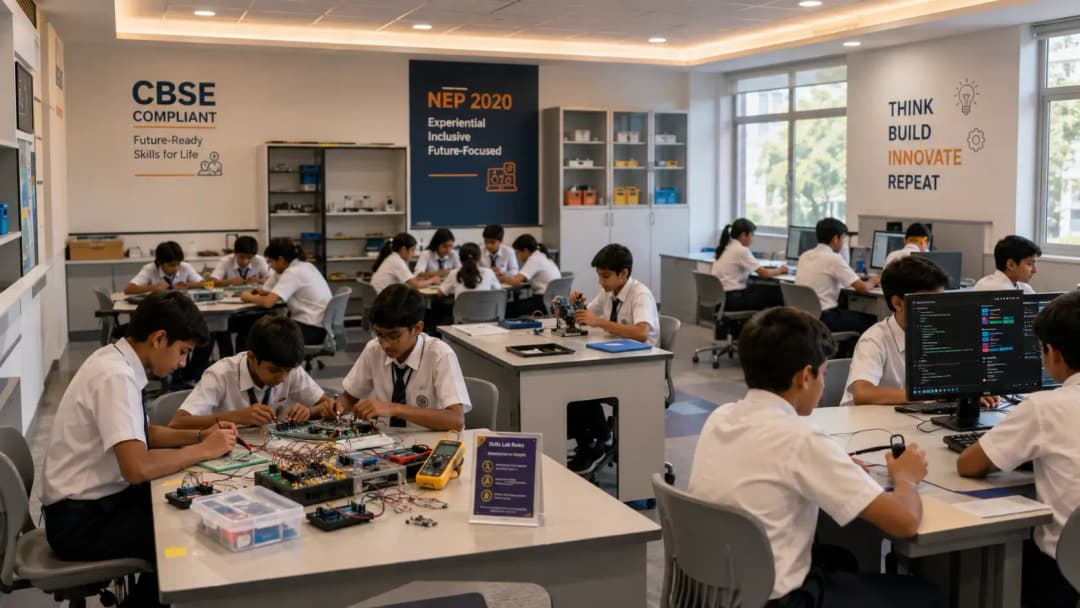
A Composite Skill Lab (CSL) is a multi-sector practical learning space where students from Classes VI to XII get hands-on exposure to vocational subjects. Not theory. Not PowerPoint slides. Actual hands-on work with real tools, real equipment, and real-world skill domains.
The mandate comes directly from two national policy frameworks. NEP 2020 (Section 16.5) set a target of giving 50% of all school learners meaningful vocational exposure. NCF-SE 2023 went further, requiring 110 hours of vocational education per year across what it calls three "forms of work": Work with Life Forms, Work with Machines and Materials, and Work on Providing Human Services.
CBSE's Circular Skill-75/2024 in August 2024 translated that policy into an operational directive for schools. Circular Skill-13/2026 in March 2026 tightened the language, updated the guidelines, and confirmed the deadline. The intent is clear: skill education is no longer optional in Indian schools. It is part of the core offer.
This connects directly to the broader shift we have been writing about for CBSE schools. If you have been following how CBSE's AI curriculum mandate is reshaping what schools must teach from Class 3 onwards, the Composite Skill Lab is the physical infrastructure that makes that curriculum possible. One without the other is incomplete.
The Deadline You Cannot Afford to Ignore
For clarity:
- New CBSE affiliations: A fully equipped CSL is already a mandatory prerequisite. No lab, no affiliation.
- Existing CBSE-affiliated schools: The deadline is August 22, 2027. Schools that fail to meet this deadline risk non-affiliation or downgrading of their affiliation status.
Fourteen months sounds like a comfortable runway. But consider what actually needs to happen between now and August 2027: space planning, procurement decisions, vendor selection, infrastructure preparation, equipment installation, curriculum alignment, and staff readiness. A school in Pune that begins planning in June 2026 and moves at a realistic pace has maybe 10 months of actual execution time. That is not generous.
And the schools that treat this like a box-ticking exercise, rushing to install the minimum required setup in the last quarter before the deadline, will end up with exactly that: a box. A room with equipment that nobody uses. We wrote about what happens to labs that go dark after the vendor leaves, and the pattern is identical. The motivation was compliance. The result was a white elephant.
So the real question is not "how do we meet the deadline?" It is "how do we build something that actually works?"
What the CBSE Circular Actually Requires
The infrastructure requirements are specific. CBSE gives schools two options:
Option 1: A single Composite Skill Lab of at least 600 sq ft, serving Classes VI to XII.
Option 2: Two separate labs of at least 400 sq ft each. One for Classes VI to X, another for Classes XI to XII.
Beyond the space, the lab must cover multiple vocational sectors. CBSE has identified 13 sectors that the CSL should support: Automotive, IT/ITeS, Electronics and Hardware, Beauty and Wellness, Healthcare, Agriculture, Retail, Tourism and Hospitality, Banking and Financial Services, Telecom, Media and Entertainment, Apparel and Home Furnishing, and Plumbing.
That last point trips up a lot of school leadership teams. When they hear "Composite Skill Lab," they think technology lab. But the CBSE guidelines are deliberately multi-sector. A school cannot set up an AI and robotics space and call it a CSL, even if it is excellent. The lab needs breadth across vocational domains, not just depth in one.
The indicative budget in CBSE's own guidelines is ₹3 to 6 lakh for basic setup. That is the floor, not the ceiling, and it does not account for curriculum, trainer costs, or ongoing maintenance.
For schools that want to understand the full picture of what NEP 2020 compliance actually looks like in practice, the CSL sits inside a larger framework, not outside it.
Can You Use Your Existing IT Lab or ATL?
Yes, but with limits. CBSE's guidelines acknowledge that many schools already have infrastructure that can partially serve the CSL purpose.
Your existing IT lab can cover skill subjects like Coding, AI, Finance, and Graphic Design. If it is already well-equipped with computers and relevant software, it can support the IT/ITeS sector within the CSL framework.
Your Atal Tinkering Lab (ATL), if your school has one, can be leveraged for Electronics and Mechatronics content. But the ATL cannot be formally converted into a CSL, because labs set up through government or special CBSE-funded programmes for a specific purpose retain that designation.
A Makers Space Lab, if it meets the space and equipment specifications, may be converted.
So for most schools, the path is not build-from-scratch or do-nothing. It is assess what you have, identify the gaps, and fill them systematically. A CBSE school in Nagpur with a functional IT lab and an ATL is not starting from zero. But it is also not yet compliant. The middle ground is where the real planning work happens.
This is also where schools confuse activity with compliance. Installing equipment is not the same as running a skill education programme. CBSE's guidelines describe the CSL as a "teaching-learning model that emphasizes experiential learning," not just infrastructure. You need the tools, yes. But you also need a structured curriculum, qualified personnel, and a timetable that actually gets students into the lab consistently. Without all three, the deadline becomes a formality and the lab becomes a showcase room.
Where Most Schools Get This Wrong
Here is what we see happen, repeatedly. A school principal gets the circular, calls two or three vendors, gets proposals ranging from ₹4 lakh to ₹12 lakh, picks one based on price or a familiar brand name, and places an order. Equipment arrives. A training session is conducted for the computer science teacher. The lab opens with a small ceremony.
Six months later, usage has dropped to twice a week. A year later, the equipment is sitting idle because the teacher who was trained left the school, nobody else knows how to run the sessions, and procurement of replacement parts has not happened because there was no maintenance contract.
Sound familiar? It should. This is precisely why school robotics labs go dark after the first year, and the same failure mode applies to a CSL.
The problem is not the intent. It is the model. When you buy equipment and hire (or assign) a person to run it, you are creating a dependency on that person. When they leave, or when they are not adequately trained, the lab dies. And for most CBSE schools, the specialized teacher training problem is real and persistent. There are simply not enough qualified vocational educators available to fill these roles reliably.
But there is a different way to approach this.
What a Well-Run Composite Skill Lab Actually Looks Like
A CSL that works is not defined by the quantity of equipment in the room. It is defined by how often students actually get into the lab, what they do there, who is guiding them, and whether those skills build on each other year after year.
At Scaleopal Labs, our AI and skill labs for CBSE schools are built on a model that addresses this directly. We deploy the lab at zero setup cost to the school. Our on-campus engineer, an active working professional not a freelancer or a reassigned teacher, conducts every session as part of a structured, multi-year curriculum. Maintenance, hardware upgrades, and curriculum updates are included in the partnership. The school does not hire a new person when something goes wrong. They call us.
That is not how most schools have been taught to think about lab procurement. The traditional model is: pay upfront, receive equipment, figure out the rest yourself. Our model is the opposite. The school provides space. We bring everything else, including the person running it every week.
For CBSE schools in Pune, Nashik, Nagpur, and across Maharashtra looking at the August 2027 deadline, our zero-cost lab model fits directly inside the CSL compliance framework. The lab we deploy can anchor the IT/ITeS, AI, and Electronics sectors of your CSL, with curriculum built across Classes VI to XII. You meet the CBSE requirement. You earn a profit margin per student. And the lab keeps running, year after year, because it is our responsibility to make sure it does.
If you want to understand how the financial side of this works, the financial model for school lab partnerships walks through exactly what a school earns and what it costs them (which is nothing upfront).
The One Thing to Do This Week
If your school is CBSE-affiliated and does not yet have a Composite Skill Lab, the single most useful thing you can do this week is not to call a vendor. It is to walk the building and identify the 600 square feet that will become this lab. That decision alone, locking in the space and communicating it to your team, starts the clock in the right direction.
Then, before you take any procurement decisions, talk to two or three different types of partners. Talk to a hardware-only vendor. Talk to a managed programme provider. Understand the difference between what you get with each. The numbers in the proposal matter less than the answer to one question: who is responsible for making this lab run, week after week, for the next five years?
Because CBSE is not asking schools to set up a room. They are asking schools to deliver skill education. That is a programme, not a purchase.
Frequently Asked Questions
Is the Composite Skill Lab mandatory for all CBSE schools?
Yes. For schools seeking new CBSE affiliation, a fully equipped CSL is already a mandatory prerequisite. For schools already affiliated with CBSE, Circular Skill-13/2026 sets a firm compliance deadline of August 22, 2027. Schools that do not comply risk affiliation consequences.
What is the minimum space required for a CBSE Composite Skill Lab?
CBSE requires either one lab of at least 600 sq ft for Classes VI to XII, or two separate labs of at least 400 sq ft each: one for Classes VI to X and another for Classes XI to XII. The space must be dedicated, well-ventilated, and equipped for practical, hands-on activity.
Can a school use its existing IT lab or ATL to meet the CSL requirement?
Partially. An existing IT lab can cover skill subjects in the IT/ITeS, AI, Coding, and Finance sectors. An Atal Tinkering Lab can be leveraged for Electronics and Mechatronics content but cannot be formally redesignated as a CSL. Schools will typically need to supplement existing infrastructure to achieve full CSL coverage across multiple vocational sectors.
How much does it cost to set up a Composite Skill Lab?
CBSE's own guideline booklet puts the indicative budget at ₹3 to 6 lakh for basic setup. But this covers only equipment and infrastructure, not curriculum development, qualified training staff, or ongoing maintenance. Schools that account for the full programme cost should budget significantly more, or find a managed partnership model where those costs are absorbed by the provider.
What happens if a CBSE school misses the August 2027 deadline?
Schools that fail to establish a Composite Skill Lab by the August 22, 2027 deadline face the risk of non-affiliation or downgrading of their existing CBSE affiliation status. CBSE has not indicated any further extensions beyond the updated Circular Skill-13/2026, so the deadline should be treated as firm.
Which vocational sectors must a Composite Skill Lab cover?
CBSE has identified 13 sectors for the CSL framework: Automotive, IT/ITeS, Electronics and Hardware, Beauty and Wellness, Healthcare, Agriculture, Retail, Tourism and Hospitality, Banking and Financial Services, Telecom, Media and Entertainment, Apparel and Home Furnishing, and Plumbing. Schools are not required to cover all 13 simultaneously, but the lab must be designed to support multi-sector skill education across the classes it serves.