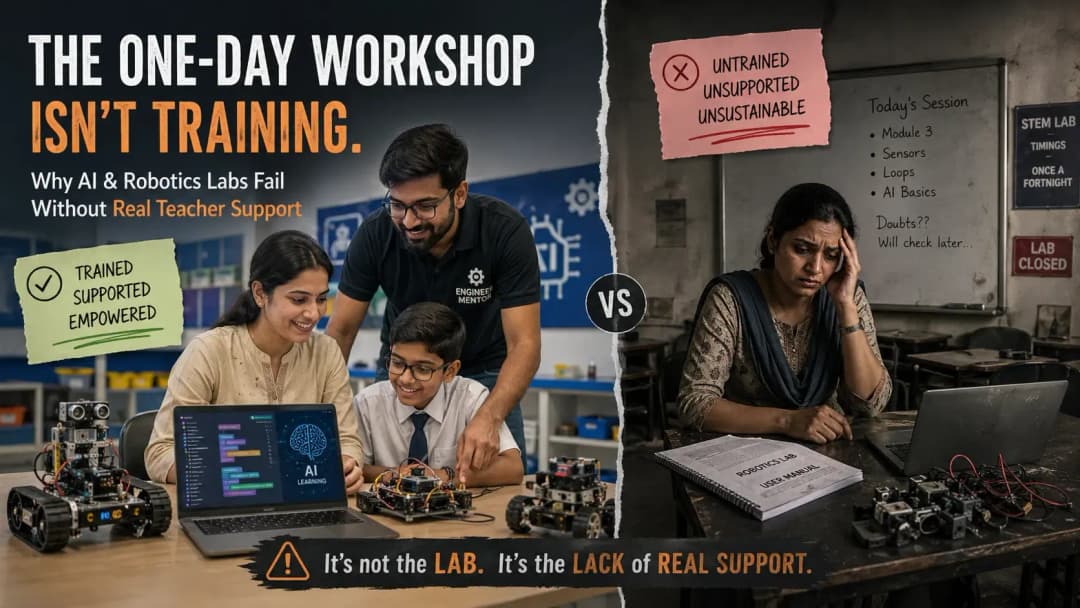
Picture this. A CBSE school in Pune signs a ₹22 lakh contract for an AI and robotics lab. The vendor delivers the hardware, spends two days on setup, and then hands the computer science teacher a printed manual and a login to an online portal. She attends a one-day workshop at a hotel in Baner. It covers the first four modules. It moves fast. She takes notes. She tries.
Three months later, she is running sessions from memory, skipping the modules she does not understand, and quietly dreading the day a student asks a question she cannot answer.
By month eight, the sessions are running once a fortnight. By month twelve, they have stopped.
This is not an edge case. It is one of the most predictable failure patterns in school STEM labs across India. And the single workshop is almost always where the collapse begins.
Why the One-Day Workshop Is Not Actually Teacher Training
Estimates suggest only about 30% of STEM teachers in India have received specific training in robotics or AI. That number drops further when you look at teachers who received training deep enough to run an ongoing programme independently.
Most STEM lab vendors offer what they call a "teacher training programme." What they deliver, in practice, is an orientation. A single day, sometimes two, held before or shortly after lab setup. The trainer is enthusiastic. The content moves quickly. Teachers walk away with a manual, a login, and a sense of mild panic.
Here is the problem. Robotics and AI are not subjects you absorb in eight hours. A Class 7 student asking why a sensor is giving inconsistent readings, or how to modify a block-code loop, or what the difference is between supervised and unsupervised learning is asking questions that require real, practitioner-level knowledge to answer well. A one-day workshop does not build that. It builds surface familiarity, which is a dangerous thing because it looks like competence for the first few weeks.
And then the students go deeper, and the teacher hits a wall.
The vendor, by then, has already moved on to the next school installation.
The Pattern Schools Keep Falling Into
Walk through this with us, because it repeats itself constantly.
A vendor wins the contract partly on the strength of their "training and support" pitch. The proposal mentions a Faculty Development Programme (FDP), ongoing curriculum updates, and a dedicated support helpline. On paper, it sounds solid.
Then the contract is signed and the lab goes live. The FDP turns out to be the two-day orientation, already delivered. The curriculum updates are a PDF emailed quarterly. The support helpline is a WhatsApp group where the vendor's sales contact responds when he remembers to check.
Your computer science teacher is now the de facto lab coordinator. She is also teaching four other subjects. She is managing a timetable that was already stretched before the lab came in. She was never trained to be an innovation coach. She does not want to be. She just wants to do right by her students.
So she does her best. She supplements with YouTube. She skips the harder modules. She loses confidence session by session. And when she eventually tells the principal that she needs help, the vendor's quote for "additional training sessions" is ₹45,000 per visit.
This is a pattern we see documented across government-funded Atal Tinkering Labs too. A study on ATL implementation in Pune noted that disorganised materials, lack of documentation, and coordination issues caused visible drops in lab activity even in schools that had genuine enthusiasm at launch. And ATL schools at least had a government programme behind them. Private schools with vendor-provided labs often have less.
The teacher training problem is not a side issue. It is the single most common reason good labs stop running.
What Schools Should Actually Be Demanding
Before signing any lab partnership, an academic director or principal should sit down with the vendor's team and ask specific questions. Not about the hardware. Not about the curriculum brochure. About the teacher.
Who conducts the sessions, in practice?
If the answer is "your computer science teacher, after our training," push back hard. Ask what happens in month six when she gets stuck on a module she was not trained on. Ask who answers the phone then.
How many training hours are included, and over what period?
A 2-day orientation and a 90-hour annual programme are very different things. Get the number. Get it in the contract.
Who is the trainer, and what is their background?
Is it a working engineer who understands what they are teaching, or is it a trainer hired to deliver a script? There is a real difference between someone who builds with AI and someone who presents about it.
What happens when your teacher is absent or leaves?
Staff turnover in schools is real. If the entire session delivery rests on one trained teacher, a single resignation can collapse the programme. Ask the vendor directly: what is your continuity plan?
Is there a documented escalation path for technical problems?
Not a WhatsApp group. A written SLA. What is the response time? What counts as an emergency? Who is responsible for parts replacement and how quickly?
These questions are not unreasonable. They are standard due diligence. But most school managements, especially during the excitement of a new lab launch, do not ask them until it is too late.
If you are currently in active vendor evaluation, our guide on solving the specialised teacher shortage in school tech programmes has a more detailed breakdown of what sustainable teacher support actually looks like.
Why Most Vendors Cannot Actually Solve This
Here is the honest answer to why the one-day workshop became the industry standard: because solving the teacher training problem properly is expensive and ongoing, and vendors who have already collected their ₹18-28 lakh setup fee have no structural reason to absorb that cost.
It is not that vendors are dishonest. Most of them genuinely want schools to succeed. But their business model does not require it. They earned when you signed. Whether your lab runs well in Year 2 is not their P&L problem.
So the training they provide is calibrated to what is cheap to deliver and looks good in a proposal, not what is actually sufficient to sustain a programme. And the gap between "what looks good in a proposal" and "what actually runs a session for 28 Class 8 students every week" is enormous.
This is the same incentive misalignment we wrote about in our post on why most school robotics labs go dark within 18 months. The teacher training failure is just an earlier stage of the same collapse.
Only 30% of STEM teachers in India have specific training in robotics or AI. That number is not going to move meaningfully through one-day workshops. The solution has to be structural.
What a Different Model Looks Like
At Scaleopal Labs, we made a deliberate decision early on: we would not put your teacher in the position of having to become an overnight AI expert.
Our on-campus engineers, working professionals from our engineering team, conduct every single session. They are not freelancers hired to cover a timetable. They are not part-timers with three other schools. They are engineers who build real AI systems for enterprise clients, and they bring that same practitioner knowledge into your school's lab every week.
Your computer science teacher does not disappear from the picture. She grows alongside the programme. She observes. She asks questions. She develops real competence over months, not a fake competence over a weekend workshop. If she wants to eventually lead some modules herself, we support that. But she is never left alone with equipment and a manual and 28 students waiting for an explanation.
This matters for two reasons. First, the sessions are consistently high quality because someone accountable is running them. Second, the school does not carry the risk of the programme collapsing the moment a teacher transfers or resigns.
Our Faculty Development Programme runs alongside the student sessions. NEP 2020 CPD hours are included. Teachers build genuine knowledge at a pace that is realistic for someone with a full teaching load, not a pace designed for a two-day hotel conference.
What Schools in Pune and Nashik Are Getting Right
A growing number of school managements in Pune, Nashik, and Nagpur are now asking a specific question during lab procurement discussions: "Who is actually conducting the sessions, and what happens when they are not available?"
That question ends most vendor conversations quickly. Because the honest answer from a hardware vendor is: your teacher, probably. Good luck.
It changes the conversation entirely when you are talking to a managed lab operator whose business model only works if the lab is running every week, in every term, across every grade.
The schools getting this right are not necessarily the ones with the biggest budgets. They are the ones asking the right questions before signing. And they are finding that a zero setup cost partnership model often works out significantly better than a large upfront investment that lands the operational burden back on the school.
If you are a CBSE school evaluating options, our page on AI lab programmes for CBSE schools covers what board-specific compliance looks like and how the model maps to your curriculum requirements.
Frequently Asked Questions
What is the biggest reason STEM labs fail in Indian schools?
Teacher capacity is the most consistent failure point. Equipment sits unused not because it is broken but because nobody on the school's staff is confident enough to run sessions with it. Vendors typically provide a short orientation, after which the full operational burden falls on a computer science teacher who was never trained for this role.
How many hours of teacher training is enough for a school AI or robotics lab?
There is no universal number, but a single 1-2 day workshop is far from sufficient. Effective teacher development for a STEM lab is ongoing, not a one-time event. The better question to ask is whether the session delivery model requires the teacher to be fully independent from day one, or whether there is a professional present to handle the teaching while the teacher builds competence over time.
What should a school put in a contract regarding teacher training?
The contract should specify the number of training hours per term, the format (in-person vs. online), who delivers it (a named trainer profile or specification, not just a generic commitment), what happens if a trained teacher leaves the school, and the response SLA for technical support queries. These terms should be written, not verbal.
Does NEP 2020 require schools to train teachers for AI and STEM labs?
NEP 2020 mandates experiential and inquiry-based learning and emphasises continuous professional development for teachers. While it does not prescribe a specific number of training hours for STEM lab programmes, schools seeking meaningful NEP compliance should be able to demonstrate that their teachers are equipped to support the programme, not just supervise a room. Our NEP 2020 implementation guide covers what this looks like in practice.
Can a school with a vendor-purchased lab fix the teacher training problem after the fact?
Sometimes. If the hardware is in reasonable condition and the vendor relationship is still active, renegotiating to include a structured, ongoing training commitment is possible. But most schools find that the vendor's appetite for this conversation is limited once the sale is complete. The more sustainable fix, for schools starting fresh or replacing a failed programme, is to choose a model where session delivery is handled by the lab partner from the start, removing the teacher dependency entirely.
The teacher training problem is not a failure of effort. Most computer science teachers who find themselves responsible for a STEM lab care deeply about doing a good job. The failure is structural.
When a model places all operational responsibility on a teacher who was given one workshop, the outcome is predictable. And preventable.
The schools getting this right are the ones who decided, before signing, that they wanted a partner accountable for session quality, not a vendor accountable only for hardware delivery. If that is the conversation you want to have, we are ready to have it.