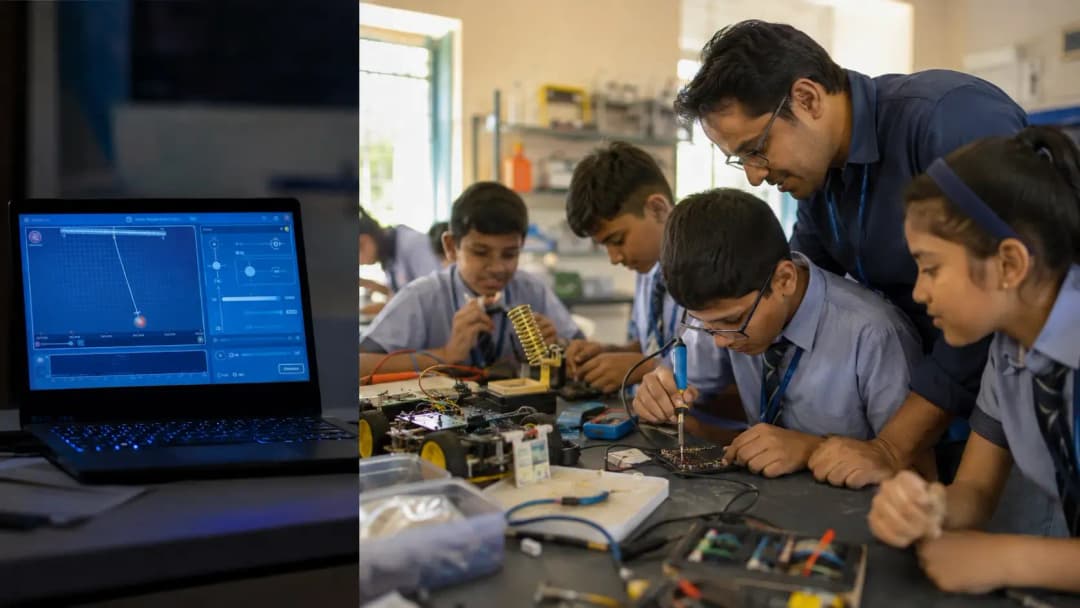
On August 13, 2026, CBSE sent every affiliated school a circular announcing that 845 curriculum-aligned virtual labs are now available free on DIKSHA. Science and maths simulations, mapped to NCERT chapters, accessible from a phone or a laptop. No procurement. No installation. No vendor calls.
Somewhere in a trustee meeting this month, someone is going to ask: does this take care of our Composite Skill Lab requirement?
It does not. And CBSE said so in the same breath.
What CBSE's August 2026 Circular Actually Says
Circular No. TRG-16/2026, dated August 13, 2026, tells schools to disseminate more than 845 virtual lab activities and digital resources built by CIET-NCERT, in partnership with the Ministry of Electronics and Information Technology. The resources sit on the DIKSHA portal and mobile app, organized by class, subject, and chapter, and they are reachable through the QR codes already printed in NCERT textbooks.
That is a genuinely useful rollout. A Class 10 student in a school with no functioning chemistry lab can now run a titration simulation on a shared tablet. A rural school without lab technicians gets some access to practical demonstration that it did not have last month.
But the circular is careful about scope. It frames virtual labs as a supplement to physical laboratory work, not a stand-in for it. That single word, supplement, is doing a lot of work. It is the same language NEP 2020 used back in 2020 when it first proposed virtual labs on DIKSHA, SWAYAM, and SWAYAMPRABHA: technology extends access to practical learning, it does not substitute for it.
CBSE has been consistent on this for six years. This circular does not soften that position. It reinforces it.
Is a Virtual Lab Enough to Meet the Composite Skill Lab Mandate?
No. And this is worth being blunt about, because the two initiatives get confused constantly.
The Composite Skill Lab mandate comes from a different circular entirely: Skill-75/2024, reinforced by Skill-13/2026 (dated March 20, 2026). It requires every CBSE-affiliated school to build a dedicated physical space, either one 600 sq. ft. lab covering Classes VI to XII, or two separate 400 sq. ft. labs split by grade band, equipped with real tools, machinery, and materials across the 13 CBSE-defined skill sectors. New schools need it in place before affiliation is even granted. Existing schools have until August 22, 2027.
A DIKSHA login does not satisfy any of that. You cannot run a hands-on electronics or automotive skill module through a browser tab. The CSL mandate exists specifically because CBSE decided that theoretical exposure, however well produced, was not building the practical competencies NCF-SE 2023 asks for. Virtual labs solve a different problem: they widen access to science and maths demonstration where physical labs are thin. They were never proposed as an answer to skill education.
If your school's CSL folder currently has "DIKSHA rollout" written down as progress toward the 2027 deadline, it should not. Those are two separate compliance tracks, and only one of them accepts a login as evidence.
Why NEP 2020 Recommends Virtual Labs as a Supplement, Not a Substitute
It helps to understand why the policy was written this way in the first place. NEP 2020's own language on this, in the section on technology use, describes virtual labs as a way to give students equal access to quality practical and hands-on experience, particularly where physical infrastructure is scarce or expensive. The policy never claims equivalence between the two modes. It treats virtual labs as a bridge for access, not a replacement for the tactile, iterative work of building something with your hands.
There is a reason for that distinction beyond bureaucratic caution. A simulation can show a student what happens when current flows through a resistor. It cannot teach them what a stripped wire feels like, or what happens when they solder a joint badly and have to redo it, or how a robotics kit behaves differently from the diagram once gravity and friction get involved. NCF-SE 2023's skill education framework, which drives the Composite Skill Lab mandate, is explicit that skill competency is demonstrated through doing, not through describing. Kaushal Bodh, CBSE's parallel skill programme for Classes 6 to 8, runs on the same logic: 80% of a student's assessment weight sits on practical work, not theory.
None of this makes DIKSHA's expansion pointless. It makes it a complement running on a separate track from your CSL obligation, not a shortcut through it.
What Happens If Your School Treats DIKSHA as Your CSL Compliance Strategy
The risk here is not abstract. Schools seeking fresh CBSE affiliation must already have a compliant Composite Skill Lab in place, no exceptions, no digital substitute accepted. Existing schools carry a real deadline: August 22, 2027. Miss it, and CBSE has been clear that non-affiliation or downgrading of affiliation status is on the table.
A trustee who reads "845 free virtual labs" and quietly deprioritizes the physical build is making a decision that will surface at the worst possible time, likely during an affiliation renewal audit, with less than a year of runway left to fix it. We have sat across the table from school leadership teams who genuinely believed a strong digital learning programme would count favorably toward CSL compliance. It will not. CBSE's inspection process for CSL affiliation looks for the room, the equipment, and the sector-mapped curriculum delivery, not a usage report from an app.
If your school currently offers a robotics or AI programme through an existing AI lab setup, it is worth checking specifically whether that existing infrastructure can be counted toward CSL compliance, because in many cases it genuinely can, with the right sector mapping and equipment additions. That is a very different, and much more useful, question than whether DIKSHA counts.
Where Virtual Labs Genuinely Help (and Where They Can't)
To be fair to CBSE's initiative, there is a real, useful role for virtual labs inside a school that has already built its physical CSL.
Virtual labs work well for pre-lab preparation, letting a student walk through a procedure once before touching real equipment, which cuts down on wasted materials and safety incidents. They work well for revision, letting a student re-run an experiment they only saw once in class. They work well for schools in genuinely resource-constrained settings where a physical science lab does not exist at all, giving some access where there was none.
What they cannot do is deliver the 13-sector, hands-on skill exposure that Circular Skill-13/2026 requires. A student cannot practice automotive diagnostics, apparel construction, or healthcare simulation through a screen in any way that satisfies NCF-SE 2023's practical assessment weighting. So use DIKSHA. Push it out to your students exactly as CBSE has asked. Just don't file it under Composite Skill Lab in your compliance tracker.
Building a Physical Lab Without the Capex Risk
Here is where the real tension usually sits, and it is not really about DIKSHA at all. It is about money. Most trustees we talk to already know a physical lab is required. What stops them is the ₹15 to ₹28 lakh upfront quote sitting in a drawer, the depreciation risk on hardware nobody on staff knows how to maintain, and the very real fear of a lab going quiet within two years because the vendor who sold it disappeared after installation.
That is the actual decision in front of most schools right now, and DIKSHA does not change it. NEP compliance and skill education were never meant to be a cost center. We built our Lab-as-a-Service model specifically around that problem: Scaleopal funds and deploys the full lab, an on-campus engineer runs it year-round, and the school earns a guaranteed profit margin per student instead of carrying the depreciation. You can see the full curriculum structure or read more about meeting the CSL mandate without upfront capital if that is the piece actually holding your school back.
Frequently Asked Questions
Does DIKSHA's virtual lab rollout satisfy CBSE's Composite Skill Lab requirement?
No. Circular TRG-16/2026 explicitly positions virtual labs as a supplement to physical laboratory work, primarily for Science and Mathematics. The Composite Skill Lab mandate under Circular Skill-13/2026 requires a dedicated physical space with real equipment across 13 skill sectors. They are separate compliance obligations.
What is the deadline for setting up a physical Composite Skill Lab?
Existing CBSE-affiliated schools have until August 22, 2027, three years from the original Circular Skill-75/2024. Schools seeking new CBSE affiliation must already have a compliant lab in place before affiliation is granted.
Can my school use its existing computer lab or AI lab for CSL compliance?
In many cases, yes, with the right adjustments. CBSE allows schools to build on existing IT labs, Makerspace labs, or similar infrastructure, provided the space is expanded and equipped to cover the required skill sectors. It is worth a direct assessment of your existing setup before assuming you need to start from zero.
What are the 845 virtual labs on DIKSHA actually for?
They are curriculum-aligned simulations, animations, and digital resources built by CIET-NCERT, mostly covering Science and Mathematics for Classes VI to XII. They are meant to widen access to practical demonstration, particularly in schools where physical lab infrastructure is limited, not to replace skill education infrastructure.
Does Scaleopal's lab model help with CBSE Composite Skill Lab compliance?
Yes. Our Composite Skill Lab setup is built specifically around CBSE's 13-sector framework and deployed at zero setup cost, with an on-campus engineer and year-round maintenance included.
The Deadline Hasn't Moved
CBSE handed schools a genuinely useful digital resource this month, and it is worth rolling out exactly as intended: alongside your practical infrastructure, not instead of it. August 22, 2027 is still the date that matters for every existing CBSE school, and it is closer than the current academic calendar makes it feel.
If your school is still weighing where to start, or unsure whether existing infrastructure already covers part of the requirement, that is a conversation worth having now rather than eighteen months from now.