A trustee at a CBSE school in Thane asked us a question last month that we think a lot of school managements are quietly asking right now: "We already spent lakhs on an AI lab two years ago. Do we now have to spend another three to six lakhs on a Composite Skill Lab, or does what we have already count?"
The honest answer is: partly. And that "partly" is worth fifteen minutes of your time, because getting it wrong in either direction costs you money. Either you build a redundant lab you didn't need, or you assume compliance you don't actually have and find out during an affiliation audit.
We have written before about what a Composite Skill Lab covers and how to comply without a fresh capital outlay. This post goes one layer deeper into a specific, underused provision: CBSE's own guidelines explicitly allow schools to repurpose existing labs for certain CSL sectors. Here is what that means for a school that already runs an AI or robotics lab.
What CBSE's Circular Skill-13/2026 Actually Says About Lab Reuse
CBSE's updated guidance, Circular Skill-13/2026 dated 20 March 2026, reinforces the original Skill-75/2024 directive and adds something the first circular did not spell out clearly: schools do not always need to build a Composite Skill Lab from a blank room. The Board lists specific existing infrastructure that can be adapted:
- An existing IT lab can cover the Coding, AI, Finance, and Graphic Design skill subjects
- A Home Science lab can be adapted for Food Production and Baking
- Open garden or green space can support Agriculture, as long as tools are still stored inside the CSL
- A Makerspace lab, if it already meets the specs, is the closest thing to a ready-made CSL
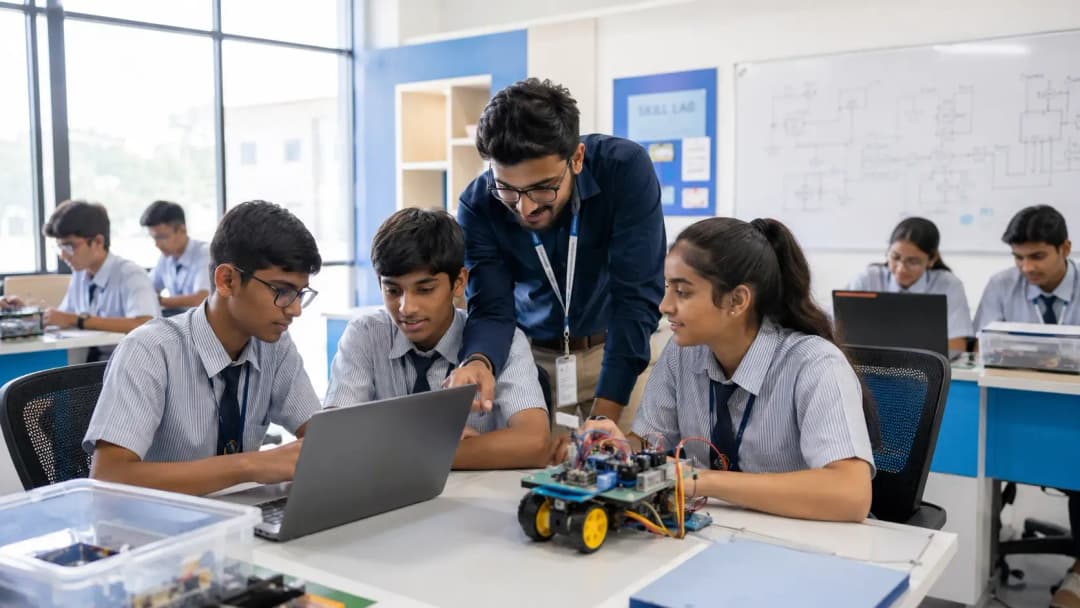
That last point matters a lot if you run a Scaleopal lab. Our AI and Robotics setup on your campus is not a computer room with extra software installed. It is a hands-on makerspace, built around real project work, sensors, coding environments, and physical builds. That is precisely the category CBSE is pointing to when it talks about labs that are "closest to a CSL."
So if your school already has this kind of infrastructure running, you are not starting from zero on your 2027 compliance clock. You are starting somewhere in the middle.
Which Sectors Your AI Lab Can Actually Cover
Let's be specific, because vague compliance advice is worse than no advice at all.
An existing AI or IT-focused lab, done properly, can reasonably satisfy the requirements for:
IT/ITeS: Core coding, software fundamentals, and basic IT operations are already what most AI labs teach from Class 6 onward.
Artificial Intelligence: This one is direct. If your lab covers machine learning basics, data handling, or generative AI concepts, you are already delivering what CBSE lists under the AI skill subject.
AVGC (Animation, Visual Effects, Gaming, Comics): Where your curriculum touches graphic design, basic animation, or interactive project work, this sector overlaps meaningfully.
Data Science: A newer addition to CBSE's skill subject list for Classes 9 and 10, and one that most AI labs are already teaching in some form without labeling it as such.
What it does not cover, and this is where schools get tripped up, is anything outside the tech-adjacent sectors. Retail, Healthcare, Beauty and Wellness, Automotive, Agriculture, Apparel, Tourism and Hospitality, Telecom, BFSI, and Plumbing are separate sectors with separate tool and space requirements. An AI lab does not touch any of those. If your school wants to offer more than the tech cluster of subjects, and CBSE requires schools to identify at least three, you will need additional infrastructure regardless of what you already have.
Why Atal Tinkering Labs Don't Get the Same Treatment
Here's a distinction that catches a lot of principals off guard. If your school has an Atal Tinkering Lab, you might assume it slots neatly into CSL the same way an IT lab does. It doesn't.
CBSE's guidance is specific on this: an ATL can be "leveraged" for Electronics and Mechatronics work, but it cannot be formally converted into your Composite Skill Lab. The reasoning traces back to funding rules. Labs set up through government or dedicated CBSE-linked funds for one purpose generally cannot be repurposed and counted against a different mandate. Your ATL keeps doing what it was funded to do. Your CSL, whatever form it takes, has to exist separately, even if the two rooms end up sharing a wall and some equipment.
This is exactly the kind of detail that gets missed when schools rely on a quick summary instead of reading the actual circular. And it is the kind of detail that shows up during an affiliation review, not before.
What You Still Need to Add for Full Compliance
Even a strong existing AI lab does not get you fully across the line on its own. Here's what typically remains:
- A minimum of three skill subjects, at least one of which should ideally sit outside your existing tech cluster, since CBSE wants breadth, not depth in one direction
- The physical space requirement: 600 square feet for a combined Classes 6-12 lab, or two separate 400 square foot spaces split by class band
- 110 hours of vocational instruction per year, which works out to roughly two to three periods a week
- Trained staff for each sector you offer, not necessarily specialist teachers, but people CBSE recognizes as qualified to run practical sessions
- A Kaushal Mela, or skills fair, held at the end of each academic year where students present their skill-based projects to the school and parent community
That last one is easy to overlook because it reads like a formality. It is not. NCF-SE 2023 treats the Kaushal Mela as a genuine assessment and visibility exercise, and schools that skip it or treat it as an afterthought tend to also be the ones that struggle most when their CSL comes up for review.
The gap between "we have an AI lab" and "we are CSL-compliant" is usually smaller than schools fear and larger than most vendors admit. Most vendors selling CSL packages have no idea what you already have running on your campus. We do, because in a lot of cases, we built it.
Why This Matters More for Schools That Move Now
The compliance deadline for already-affiliated schools is 22 August 2027. That sounds distant until you map it against a real school calendar. Vocational subject selection for Class 9 typically happens at the start of an academic year, teacher training takes months to organize properly, and CBSE's own guidance recommends running a full Kaushal Mela cycle before your review. Realistically, that leaves most schools two academic years to get this right, not three.
Newly affiliating schools have it tighter still. For them, a functional Composite Skill Lab is not a future deadline. It is a prerequisite CBSE checks before granting affiliation at all.
So the schools that audit their existing infrastructure now, figure out exactly what their AI lab already covers, and build only what's genuinely missing, end up spending a fraction of what schools starting from scratch will spend in 2027 under time pressure. That is not a sales pitch. That is how compliance timelines work in every regulated system we have seen, in education or otherwise.
We built our full curriculum framework with this kind of overlap in mind long before CSL existed, because CBSE's direction toward integrated, hands-on skill education was visible well before the mandate arrived. Schools already running our lab model are, in most cases, doing more of the CSL groundwork than they realize.
How to Actually Check Where You Stand
Don't guess. Pull out your current lab's session plan or curriculum map and check it against CBSE's skill subject list sector by sector. If you can honestly tick off Coding, AI, and one adjacent sector like Data Science or AVGC, you are most of the way to your tech cluster. What you are missing is almost always outside that cluster: something like Retail, Healthcare, or Agriculture, which needs a genuinely different space and toolset.
For CBSE schools evaluating a lab partner for the first time, this is also worth factoring into the decision. A lab built only to satisfy a robotics curriculum on paper won't stretch to cover CSL's AI and Data Science sectors later. A lab built around real coding, AI, and applied project work will.
Frequently Asked Questions
Can my school's existing AI lab fully satisfy the CBSE Composite Skill Lab requirement on its own?
No. It can cover the tech-cluster sectors like IT/ITeS, AI, AVGC, and Data Science, but CBSE requires at least three skill subjects, and most schools will need to add at least one sector outside their existing tech infrastructure to meet that requirement.
Does an Atal Tinkering Lab count toward CSL compliance?
Not directly. CBSE allows an ATL to be leveraged for Electronics and Mechatronics work, but it cannot be formally converted into or counted as your Composite Skill Lab, largely because of how ATL funding is structured.
What is the actual deadline for CBSE Composite Skill Lab compliance?
Schools already affiliated with CBSE must have a functional, compliant lab by 22 August 2027, three years from the original circular date. New schools applying for affiliation must have one in place before affiliation is granted.
How much does a standalone Composite Skill Lab typically cost if built from scratch?
Schools without any reusable infrastructure are typically quoted between three and six lakh rupees for a compliant setup, depending on the number of sectors offered and existing space availability.
What is a Kaushal Mela and is it mandatory?
A Kaushal Mela, or skills fair, is a year-end event where students present their skill-based project work to the school and parent community. NCF-SE 2023 treats it as a required part of the vocational education framework, not an optional add-on.
Can Scaleopal help us figure out what our current lab already covers?
Yes. Since we design and run the lab curriculum on many partner campuses ourselves, we can map your existing sessions directly against CSL's sector requirements and tell you specifically what's already covered and what still needs to be built.
Most schools we talk to are not short on infrastructure. They are short on someone mapping what they already have against what CBSE is actually asking for. That is usually a fifteen-minute conversation, not a fresh procurement cycle.