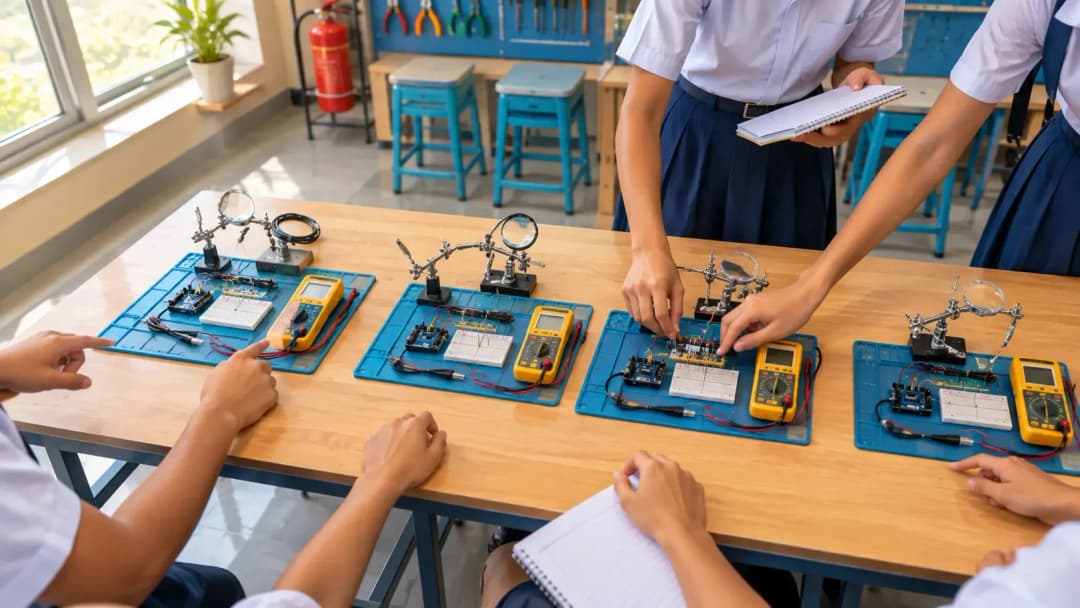
Picture Class 7B at a CBSE school in Nagpur. Forty students, one electronics session, and a Composite Skill Lab that ticked every box on CBSE's list. On the bench sit four Arduino kits.
Do the division. Ten students per kit.
The school did nothing wrong. It bought what the composite skill lab equipment list told it to buy. (This school is illustrative, not a real one.) The list is real, and so is the arithmetic. Here is what it implies, and what to do about it.
What Is on CBSE's Composite Skill Lab Equipment List?
CBSE's Guidelines for Setting Up Composite Skill Labs carry a tool list for every sector in Annexure 1: agriculture, food production, electronics and mechatronics, apparel, automotive, carpentry, IT, media content creation, healthcare, beauty and wellness, and retail. There is also a suggested kit for AI integration. In the sector lists, quantities are printed for a class of 40 students.
Two sentences in the booklet matter more than any table. One says schools may need more tools depending on the number of students in Classes 6 to 10. The other calls CBSE's own setup estimate, about ₹3 to 6 lakh, only suggestive. So CBSE describes the list as a starting point, and we will take it at its word.
And then we will do the division most schools never do.
How Many Students Share Each Item?
Divide each quantity into the 40 students it is printed for. Here is what comes out:
- Electronics and Mechatronics: 4 Arduino UNO boards, 4 multimeters, 4 soldering kits. That is 10 students per kit.
- IT: 20 computers. Two students per machine.
- AI integration: three to five desktops or laptops. Eight to thirteen students per machine.
- Healthcare: 1 CPR mannequin, 1 glucometer and 2 blood pressure machines. Forty students share the mannequin, twenty share each blood pressure machine.
- Food Production: 2 single-burner stoves and 2 pressure cookers. Twenty students per stove.
- Automotive: 1 old two-wheeler and 1 hydraulic ramp. Forty students, one vehicle.
- Agriculture: 1 hydroponic tray, 1 drip irrigation unit and 4 hand trowels. Forty students per tray, ten per trowel.
- Beauty and Wellness: 20 manicure sets and 10 hair dryers. Two students per set, four per dryer.
The ratios are all over the place. Beauty and wellness is generous. Automotive is a demonstration. There is no single logic, which tells you the list is a pragmatic minimum for a batch, not a plan for hands-on time.
One line even gives away how it was built. Jumper cables in the electronics list are counted at 20 per 10 students. So the list appears to assume four groups of ten, with one kit each.
How Does That Compare With CBSE's Science Lab Standard?
CBSE already has a picture of what a hands-on lab looks like. Its Essential SOP for the Composite Science Laboratory, required for affiliation, also counts a batch of 40 students. It asks for 10 assembled microscopes, 10 convex lenses and 10 beakers. That is one per four students.
The comparison is not perfect. Some science items sit lower, such as 4 spring balances and 4 glass prisms. But the core hands-on instruments are at one per four, and the core hands-on instrument in the electronics list is at one per ten.
Same board. Same batch of 40. A difference of two and a half times in how many hands reach the equipment.
What Does 10 Students per Kit Mean in a Real Period?
Take a Class 7 session. Two 40-minute periods make an 80-minute block, which is the unit we used in our composite skill lab timetable maths. Share four kits among 40 students and each kit serves ten. Split the block evenly and each student gets about eight minutes at the kit. That assumes no setup, no clean-up and no waiting. In Classes 9 and 10, with two 50-minute periods, it rises to ten minutes.
Group work is not the problem. Pairs and threes debug together, and the best project teams in any lab are small. Ten around one breadboard is a queue. The student at the front wires. What do the other nine do?
They plan, they document, they wait. And waiting is where a Class 7 loses the thread.
Move from 10 students per kit to 4 and you need ten kits instead of four. Hands-on time goes from eight minutes to twenty. Nothing about the room changes. The Kaushal Bodh projects that lean on electronics, such as Home Automation and the AI Assistant, are where this bites hardest, and we cover them in our guide to the machines and materials projects.
So a school can be short twice over. Short on blocks in the timetable, and short on minutes inside each block.
Is the List Built for Rotation?
There is a fair counter-argument. CBSE's safety list, also printed for a class of 40, asks for 15 hand gloves, 15 aprons and 8 rubber mats for the floor beside the workbenches. That suggests the authors did not picture all 40 students at a bench at once. Perhaps they pictured stations, with fewer than half the class soldering while the rest plan, code or document.
Fair enough. Rotation is a legitimate way to run a skill lab, and it is how 110 hours stretch across a year. But rotation turns every block into choreography. Someone has to move groups every ten or fifteen minutes, reset each station and keep an eye on the one with a hot iron. CBSE's safety guidelines ask for careful supervision of students during practical work, and ten students around one soldering iron is a supervision question before it is a learning one.
Is AI Infrastructure Mandatory in a Composite Skill Lab?
CBSE's booklet urges all affiliated schools to establish AI infrastructure in the lab. A few lines later, the wording softens to schools being encouraged to do so. Read the exact language and confirm with your CBSE regional office before treating it as a hard requirement either way.
The suggested AI kit is a specific machine: a 13th-generation Core i7 or a Ryzen 7 8000-series, 16 GB of DDR5 RAM and a 1 TB SSD. CBSE recommends three to five of them. Against 40 students, that is eight to thirteen per machine.
The IT list is a different machine. It asks for an i3-class processor, 8 GB of RAM and a 256 GB SSD, and it assumes 20 of them. Some vendor guides blur the two into a single spec, so check which list a quote is built on. Mixing them up is an easy way to overspend on one lab and underspend on another.
Why a Compliant Lab Can Still Be a Thin One
A lab can pass every check and still teach less than a Class 7 deserves. CBSE says as much itself. The booklet's foreword hopes schools will go beyond a compliant space and build something student-centred, where children learn by doing.
So the list is a floor. How far above the floor to build is the real decision, and nobody should guess that number. But a principal should know it is a decision, because cost scales with kits. Self-installing at ratios nearer four to one means buying more of everything, and the hidden costs of a self-installed composite skill lab add up fast.
Consumables scale too. The electronics list alone calls for 80 LEDs and 240 jumper cables for one class of 40. Multiply by the number of classes and sections, and replacing them is a line in your annual budget.
Five Questions to Ask Any Vendor About Ratios
Whoever you buy from, put these on the table before you sign:
- For each sector in the quote, how many students share one station in a class of 40? Ask for a number per sector, not an average.
- Is the quote built on CBSE's printed quantities or on a larger ratio? If it is the printed list, you are buying the floor.
- Which items are used by one student at a time, such as soldering irons, sewing machines and laptops? How many of those are in the quote?
- Which computer specification is in the quote, the IT list or the AI-integration list?
- Who replaces consumables through the year, and at whose cost?
Our guide to choosing a Composite Skill Lab setup company has the wider checklist.
How a Lab Partnership Changes the Maths
When you self-install, every extra kit is your capex. In our operating partnership the school pays ₹0 for setup and we fund the hardware, so the ratio is our budget problem, not yours. That changes the conversation. Instead of asking how few kits you can get away with, you can ask what ratio actually teaches a Class 7 to solder.
Kit count is only half the story, though. Someone has to run the rotations, keep the consumables stocked and notice when a kit has quietly died. In the labs we run, an on-campus engineer conducts every session. We would rather you asked us for our ratios than took our word for them.
You can read how the partnership works, see what an AI lab costs a school in India, or look at our pages for AI labs for CBSE schools and AI lab setup in Nagpur.
Frequently Asked Questions
What equipment does CBSE list for a composite skill lab?
CBSE's guidelines carry a tool list for each sector, with quantities printed for a class of 40 in the sector lists: agriculture, food production, electronics and mechatronics, apparel, automotive, carpentry, IT, media content creation, healthcare, beauty and wellness, and retail, plus a suggested AI kit. Banking and finance, and tourism and hospitality, need no specific tools.
Are the composite skill lab quantities per student or per class?
In the sector lists, per class of 40 students. CBSE says schools may need more tools depending on the number of students in Classes 6 to 10, so treat the printed numbers as a starting point, not a target.
How many computers does a composite skill lab need?
For IT-based subjects, the list assumes 20 computers for a class of 40, and an existing IT lab with at least 20 working machines can be used. For AI integration, CBSE suggests three to five higher-specification desktops or laptops.
Is AI infrastructure compulsory in a composite skill lab?
CBSE's booklet urges schools to establish it and, shortly after, says schools are encouraged to. We read that as strongly recommended, but confirm the exact position with your CBSE regional office.
How much does a composite skill lab cost?
CBSE's own estimate is about ₹3 to 6 lakh, depending on sectors, lab size and furniture, and it calls the figure suggestive. It also notes that schools may need more tools depending on student numbers.
Back to Class 7B in Nagpur
The school passed. The students still queued. A list can tell you what to buy, but it cannot tell you how many hands reach each kit. That is your call, and it is a better call before the purchase order than after.
If you want to run the ratios on your own quote, start the conversation and bring the list. No pitch deck. Just the division.