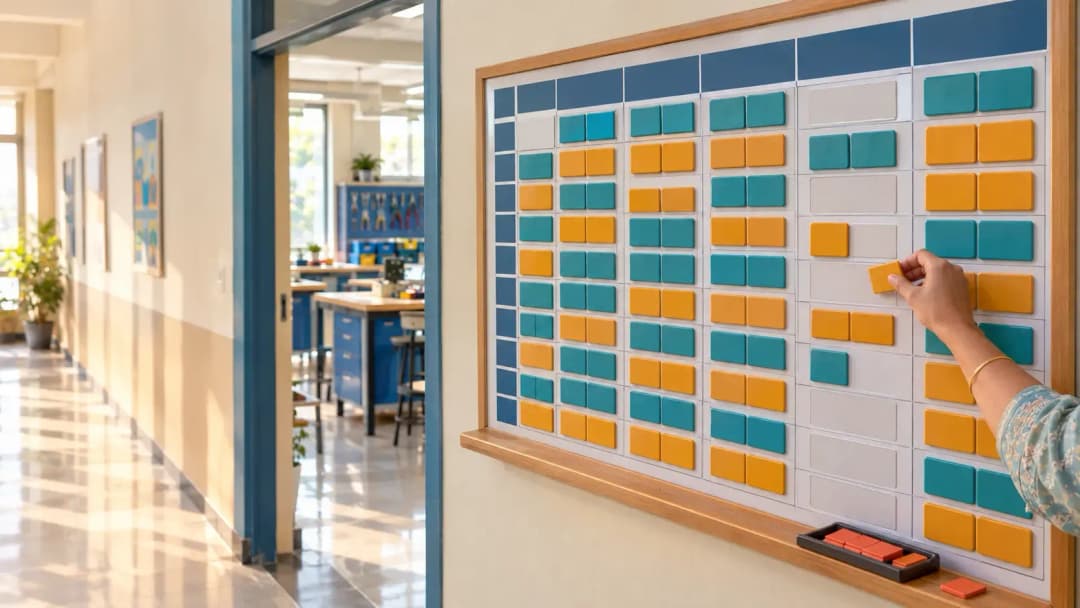
Picture the timetable coordinator at a CBSE school in Pune. Four sections in every class from 6 to 10, so twenty sections in all. The principal has just confirmed the Composite Skill Lab will be ready next year, and could she please fit in the skill periods?
She opens the weekly grid and starts building the composite skill lab timetable. By the time she has placed Classes 6 and 7, the lab is nearly full. Three classes still to go.
This school is illustrative, not a real one. The arithmetic is real. We could not find it published anywhere, so we worked it out.
How Many Periods a Week Does CBSE Skill Education Need?
CBSE's circular Skill-81/2025, dated 28 October 2025, made skill education mandatory in Classes 6 to 8 using NCERT's Kaushal Bodh books. Its guidelines ask schools to build 110 hours into the timetable, roughly 160 periods a year, and to allocate two consecutive periods, twice a week.
Four periods a week, in two pairs. For every section.
That is not what you will read everywhere. Some vendor guides say 2 to 3 periods a week. Some news reports say two back-to-back periods every week. Both undercount, and a plan built on either number makes the lab look half as busy as it will be.
Classes 9 and 10 look slightly different. CBSE's lab guidelines also put skill education at 110 hours there, but as 132 periods, because periods run longer in the secondary stage (about 50 minutes, against 40 in the middle stage). The illustrative timetables in the same guidelines keep skill periods in pairs.
And the room? Skill-75/2024 asks every school for one Composite Skill Lab of 600 sq ft for Classes 6 to 12, or two rooms of 400 sq ft, one for Classes 6 to 10 and one for Classes 11 and 12. Schools that are already affiliated have until 22 August 2027, and we have laid out a month-by-month plan for that deadline. Floor area is the easy part, and our compliance checklist covers it. Hours are harder.
How Many Sections Can One Composite Skill Lab Handle?
Here is the maths. We call two consecutive periods a block. Each section needs two blocks a week. For Classes 9 and 10 we assume the same pairing, following CBSE's illustrative timetable. That is a model, not a rule.
Now supply. Assume a six-day week and eight periods a day. That gives four blocks a day, 24 a week, on paper. Real grids lose some of that to assembly, to lunch (a block cannot straddle it), to other lab bookings and to teachers on leave. Call it 18 to 20 you can actually use.
Divide by two blocks per section. A lab used flat out serves about ten sections. At the paper maximum, twelve.
Now apply it:
- One section per class (5 sections): 10 blocks a week. Comfortable.
- Two sections per class (10 sections): 20 blocks. The lab is full, with no room for a festival week or a make-up class.
- Three sections per class (15 sections): 30 blocks. Past the paper maximum.
- Four sections per class (20 sections): 40 blocks. Nearly double what the room can host.
Change the assumptions to fit your school. The shape of the answer stays the same: sections times two, divided by the blocks your lab can really host.
Most people buying a lab plan for floor area, tool lists and a cheque. Nobody plans for the grid. So the room ends up overbooked on paper and half empty in practice, which is the pattern behind why school robotics labs go dark.
What Happens When a Section Has 45 Students?
CBSE's lab guidelines plan the room for batches of 25 to 40 students. Plenty of private schools run sections at the top of that range or beyond it. A section of 44 either crowds the room or splits in two, and a split means running the same session twice. That section now needs four blocks, not two.
In the extreme case, if all twenty sections split, demand climbs to 80 blocks a week. You will not hit that number. But five or six split sections are enough to turn a stretch into a miss.
So split only the hands-on work. Keep planning, documentation and reflection in the classroom with the whole section, and put the two halves on different days.
Which Skill Hours Don't Need the Lab?
Not all 110 hours have to happen inside the lab, and CBSE's own guidelines say so. Agriculture and related subjects can run in an outdoor garden, with the tools kept in the lab. Computer-based subjects such as coding, AI and finance can use your existing IT lab. Atal Tinkering Lab equipment can carry electronics and mechatronics. A Makers Space lab can even be converted into a Composite Skill Lab if it meets the specifications.
But read the fine print. The same section says the requirement for the Composite Skill Lab remains, and that an ATL or an IT lab cannot be converted into one. Other rooms help with hours. They do not replace the lab. (We untangle the ATL question separately.)
The project structure helps too. Each class works on three projects a year, one from each form of work, and the guidelines list options such as a school kitchen garden, a biodiversity register, hydroponics and a water audit. Several of those happen outdoors or in a classroom. A school that picks its three projects with the timetable in mind can move a real share of hours out of the lab.
How much? CBSE gives no percentage. We would not plan around a number you have not confirmed, so ask your CBSE regional office before you commit.
For illustration, though: if half the hours happen in a garden, a classroom or the computer lab, our twenty sections need 20 lab blocks a week. That is exactly the ceiling we gave earlier for a lab used flat out. Even the generous plan has no slack.
One Lab or Two?
Skill-75/2024 lets schools choose between one 600 sq ft lab for Classes 6 to 12 and two 400 sq ft rooms. It is tempting to read the second option as double the capacity. It is not. The two rooms split by class band: one for Classes 6 to 10, one for Classes 11 and 12. Your Classes 6 to 10 load stays exactly where it was.
What the second room does is protect those blocks. In a single shared lab, Class 11 and 12 skill subjects compete with Classes 6 to 10 for the same space.
And CBSE gives both sizes as minimums. A school with twenty sections will probably need more than the minimum, whether that means a second room for Classes 6 to 10 or a smaller share of hours in the lab. Do the section maths before you choose, not after the equipment arrives.
Where Do the CT and AI Hours Fit?
Classes 6 to 8 carry a second mandated load. CBSE's Computational Thinking and AI framework sets 100 hours a year for the middle stage. Forty of them are woven into Maths, Science and other subjects and taught by subject teachers. The other sixty (20 for AI, 40 for interdisciplinary projects) go to the Computer Science teacher.
Add the two loads and each Class 6 to 8 section needs about 170 dedicated hours a year. That is roughly 250 periods, or about six a week over a 40-week year.
Two labs, one grid. The same coordinator is solving both, so plan them together. We go through the CT and AI side in our Classes 3 to 8 setup guide, and if you are also deciding how to add an AI lab, our pages on AI labs for CBSE schools and AI lab setup in Pune cover the options.
How to Build a Composite Skill Lab Timetable That Holds
Five rules we would follow, whatever your set-up:
- Fix the lab blocks first. The lab is the scarce resource, so place its blocks before you fit other subjects around them.
- Keep each pair of periods on one side of the lunch break. A block that straddles lunch is not a block.
- Spread classes across the week. If Tuesday is all Class 6, the lab is overbooked on Tuesday and idle on Thursday.
- Reserve one or two blocks a week for make-up sessions and festival weeks. Yes, that lowers your ceiling. It also stops the grid collapsing the first time a holiday lands on a lab day.
- Put split batches on different days, never back to back with the same staff.
And someone has to staff every block. A grid is a promise, and it only holds if a person turns up for each slot. What happens when the teacher assigned to the lab is on leave, or still waiting for training? Usually the block quietly disappears.
That is the problem our operating partnership is built around. In the labs we run, an on-campus engineer conducts every session, so the timetable does not depend on whether a subject teacher is free. The school pays ₹0 for setup, deployment takes 45 days from partnership confirmation, and we earn only when the lab runs well. An empty block is our problem as much as yours.
We are happy to map the grid with your coordinator. If you want to know what that engineer does all week, we wrote it up in what a good on-campus lab trainer actually does, and how the partnership works is on our schools page.
Frequently Asked Questions
How many periods a week does CBSE skill education need?
For Classes 6 to 8, circular Skill-81/2025 asks for 110 hours a year, about 160 periods, delivered as two consecutive periods twice a week. That is four periods a week for every section. For Classes 9 and 10, CBSE's lab guidelines count 132 longer periods a year.
How many students can a composite skill lab hold at once?
CBSE's lab guidelines plan the room for batches of 25 to 40 students. The minimum size is 600 sq ft for Classes 6 to 12, or two rooms of 400 sq ft. A section larger than 40 will usually need to split into two batches for hands-on work.
Can skill education be taught outside the composite skill lab?
Partly. The guidelines allow outdoor gardens, existing IT labs and Atal Tinkering Lab equipment to deliver some subjects. They also say the requirement for the Composite Skill Lab itself remains. Confirm how many hours can move out with your CBSE regional office.
Does the composite skill lab timetable include Classes 11 and 12?
If you build one 600 sq ft lab for Classes 6 to 12, yes. Class 11 and 12 skill subjects share the room with Classes 6 to 10. The alternative is two 400 sq ft rooms, one for each band, which keeps the two loads apart.
What if my school has more than twelve sections in Classes 6 to 10?
On our assumptions of a six-day week and eight periods a day, one lab used flat out covers about ten to twelve sections. Beyond that you need a second room, a plan for moving some hours out of the lab, or both. Do the sums before you buy equipment.
Back to the Coordinator in Pune
She does not need a bigger lab so much as the real numbers, before the equipment is bought. Twenty sections, forty blocks, twenty-four on paper. That gap is the whole conversation, and it is a much better one to have in October 2026 than in August 2027.
If you want a second pair of eyes on your own grid, start the conversation and bring your section count and period length. No pitch deck. Just the maths.