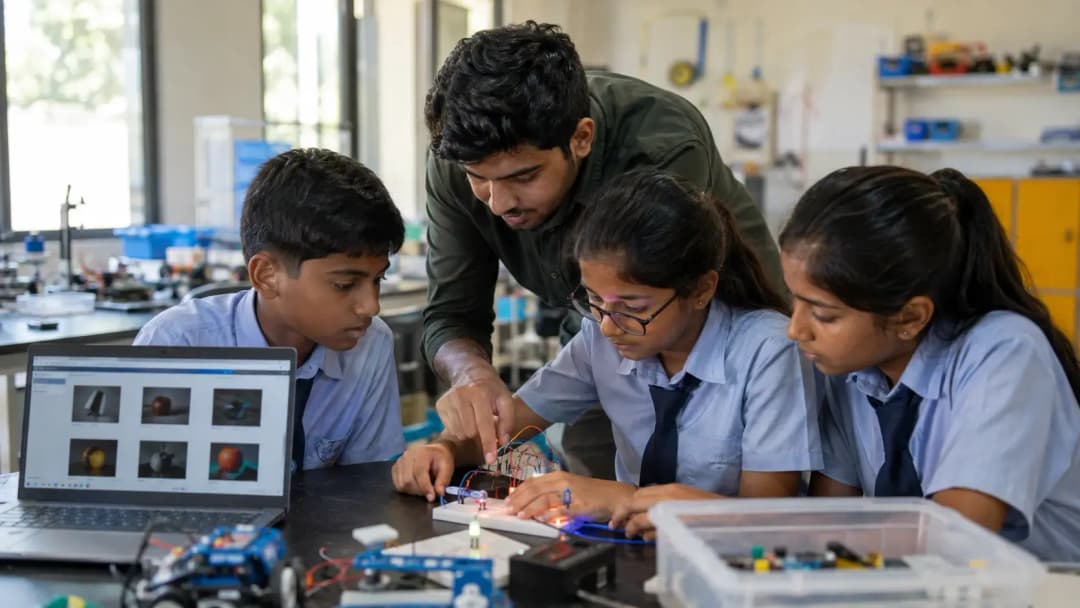
A Class 7 student in a CBSE school in Nashik is supposed to spend part of this term building something that recognizes an object using AI. Not learning about AI. Building with it. That is what the Kaushal Bodh activity book asks for. The coordinator assigned to run the session is the same person who ran pottery and tie-and-dye modules last term.
That mismatch is playing out in staff rooms across the country right now, and 2026-27 is the year it stops being optional to fix.
Why Kaushal Bodh Stopped Being Optional in 2026-27
Kaushal Bodh, NCERT's vocational education programme for Classes 6 to 8, became mandatory from the 2025-26 academic session. This year is the first full session where every CBSE middle school is expected to run it as a real, timetabled subject rather than something bolted on before an inspection. Three projects per grade. 110 hours a year. Three forms of work, each with its own project.
CBSE has been running Capacity Building Programmes for teachers since January 2026, and the pressure is not just about the syllabus. It is about where these projects actually happen. Most schools are pointing Kaushal Bodh straight at their Composite Skill Lab, the same space CBSE has mandated under Circular Skill-13/2026, with a compliance deadline of 22 August 2027. Two separate circulars, one shared piece of real estate.
We've written before about what the 13 sectors of a Composite Skill Lab actually require. This post is about something narrower and, we'd argue, more urgent: one specific domain inside Kaushal Bodh that most schools are quietly getting wrong.
The Three Forms of Work Every Kaushal Bodh Project Falls Into
NCF-SE 2023 splits all productive work into three categories, and Kaushal Bodh's nine projects across Classes 6 to 8 are built directly on top of them.
- Work with Life Forms: kitchen gardens, biodiversity registers, plant nurseries. Low equipment cost. Any science or EVS teacher can run this competently with a weekend of prep.
- Work with Machines and Materials: tools, technology, and digital creation. Home automation, AI applications, animation, game creation. This is where the difficulty concentrates.
- Work in Human Services: health handbooks, community surveys, storytelling projects. People-facing, low-tech, manageable by most existing staff.
Read that middle category again. AI applications and home automation sitting next to tie-and-dye in the same curriculum bucket. On paper it looks like one more craft rotation. In practice it is asking a Class 7 student to build something that actually trains on data or actually automates a physical process, and it is asking a school to find someone who can teach that credibly.
Where Schools Get "Work with Machines and Materials" Wrong
The instinct in most schools is to hand this domain to whoever already runs the computer lab, or to the same skill-education coordinator managing every other module. That works for the Life Forms and Human Services projects. It does not work here, and the gap shows up fast.
A teacher who can competently supervise a biodiversity survey is not automatically equipped to explain why a simple AI model misclassifies an image, or to debug a Class 8 group's home automation circuit when a relay won't trigger. This is not a criticism of the teacher. It is a different job. We see the same pattern in ICSE Computer Studies departments, where teachers trained for typing and office applications are suddenly expected to deliver hands-on AI and robotics with no change in support.
So what actually happens in schools that push through anyway? One of two things. Either the AI and home automation projects quietly get simplified into something closer to a PowerPoint presentation about AI, which technically checks the box and teaches almost nothing. Or the projects run properly for the first few weeks and then stall the moment something breaks, because nobody on staff can troubleshoot a sensor or a training pipeline mid-lesson.
Neither outcome is what CBSE or NCERT intended. And neither survives a serious inspection.
How This Connects to Your Composite Skill Lab Deadline
Here is where the two mandates meet. Kaushal Bodh needs a physical space and working equipment to deliver Machines and Materials projects properly, and CBSE's own guidance points schools toward using their Composite Skill Lab for exactly this. Your CSL's electronics, IT/ITeS, and AI-adjacent sectors are not a separate compliance item from Kaushal Bodh. They are the same infrastructure question asked twice, once by Circular Skill-75/2024 and Skill-13/2026, and once by NCERT's activity books.
That is good news, if you treat it as one problem instead of two. A lab built to properly run AI and machine-automation sessions for Classes 6 to 12 automatically has what a Class 7 Kaushal Bodh group needs for its home automation project. Build it once, staff it right, and it serves the CSL mandate, the Kaushal Bodh mandate, and your broader NEP 2020 experiential learning goals in the same physical room. We've covered how schools can comply without large upfront capital spend if the budget question is what's holding this up.
What doesn't work is treating the lab as a checklist of equipment purchased once and never touched again. CBSE's guidelines specifically ask for AI integration and ongoing use, not a room that looks impressive during the affiliation visit and sits locked the rest of the year.
What an AI-Literacy Project Actually Looks Like on Campus
Take the home automation project a Class 8 batch might run. Done properly, it looks something like this. Students group into teams of four. Each team gets a microcontroller, a relay module, and a simple sensor, say a light-dependent resistor. Over three sessions, they wire a circuit that turns on a lamp automatically when the room gets dark, then extend it so a companion app can override the automation manually.
The AI-literacy project in the same domain might have Class 7 students collecting twenty photos each of two or three object categories on their phones, feeding that dataset into a no-code image classifier, and testing how well it identifies a new photo it hasn't seen. Somewhere in that session, a student is going to ask why the model got confused when the lighting changed. That question is the entire point of the exercise, and answering it well needs someone who actually understands how the model works, not someone reading from a script written by a textbook committee three years ago.
Both projects need working hardware, a debugged setup, and an adult in the room who can answer the follow-up question honestly. That is a specific, teachable skill set. It is also, not coincidentally, exactly what an on-campus engineer does differently from a retrained teacher.
Who Should Actually Run This Domain
We are not suggesting every Kaushal Bodh project needs an outside specialist. Life Forms and Human Services projects are well within reach of your existing staff, and schools should keep running those in-house. Stretching a partnership model across all three domains would be overkill and expensive for no real gain.
Machines and Materials is different. This is the one domain where the gap between "technically covered the syllabus" and "students actually built something that works" is widest, and where a lab partner earns its keep. Our 10-year curriculum across Class 1 to 12 was built by working AI engineers for exactly this kind of hands-on delivery, which means the same on-campus setup that handles your CBSE-affiliated AI lab requirements can absorb Kaushal Bodh's Machines and Materials projects for Classes 6 to 8 without asking your science or IT staff to become AI trainers overnight.
Most vendors will sell you a kit and a laminated instruction sheet for this domain. That gets a project finished. It does not get a student to genuinely understand why the model behaved the way it did, and that difference is what an inspection committee, and frankly a curious 12-year-old, will notice.
Frequently Asked Questions
Is Kaushal Bodh mandatory for all CBSE schools?
Yes. CBSE made Skill Education, delivered through NCERT's Kaushal Bodh activity books, mandatory for Classes 6 to 8 from the 2025-26 academic session. Schools must allocate roughly 110 hours per year and deliver three projects per grade, one from each of the three forms of work.
Does Kaushal Bodh have to run inside the Composite Skill Lab?
CBSE's guidance points schools toward using the Composite Skill Lab for hands-on skill education activities, including Kaushal Bodh's practical projects. There is no rule against running simpler projects like kitchen gardens elsewhere, but the technology-heavy Machines and Materials projects need proper lab infrastructure.
What is the difference between Kaushal Bodh and the CBSE AI and CT curriculum for Classes 3 to 8?
They are separate circulars covering separate ground. Kaushal Bodh is vocational skill education for Classes 6 to 8 across three forms of work, of which AI is one small piece. The CBSE Computational Thinking and AI curriculum is a dedicated subject with its own hour allocation, running from Classes 3 to 8. Many schools end up delivering both in the same lab space.
Can our existing computer teacher run the Machines and Materials domain?
Possibly, but check honestly. Running a home automation build or a hands-on AI classification project well requires comfort with hardware debugging and a real understanding of how the underlying models work, not just familiarity with office software or block coding platforms. If that gap exists, closing it takes either serious dedicated training or bringing in someone who already has that background.
What happens if our Composite Skill Lab isn't ready before the 2027 deadline?
Schools already affiliated with CBSE have until 22 August 2027 to have a functional Composite Skill Lab in place, per Circular Skill-13/2026. Schools risk complications with affiliation renewal if they miss it, and fresh affiliation applicants need the lab in place immediately as part of the process.
How much does it cost to equip the AI and machines domain of a Composite Skill Lab?
Costs vary widely depending on scope and vendor, and most providers quote ₹3 to 6 lakh or more as an indicative range for equipping this domain alone. Scaleopal's model removes that upfront cost entirely; we fund and install the equipment, and the school earns a fixed profit margin through a technology integration fee instead of paying capital expenditure.
Kaushal Bodh's Machines and Materials domain is a small piece of a much bigger picture. Handled well, it is also a preview of what the rest of your Composite Skill Lab could look like: students building things that work, not just completing worksheets about them. The schools that get this domain right this year will not be scrambling in 2027 to explain an empty room to an inspection committee.
If your Class 6 to 8 batches are heading into these projects without someone on staff who can genuinely run them, that is worth solving before the next project deadline, not after.