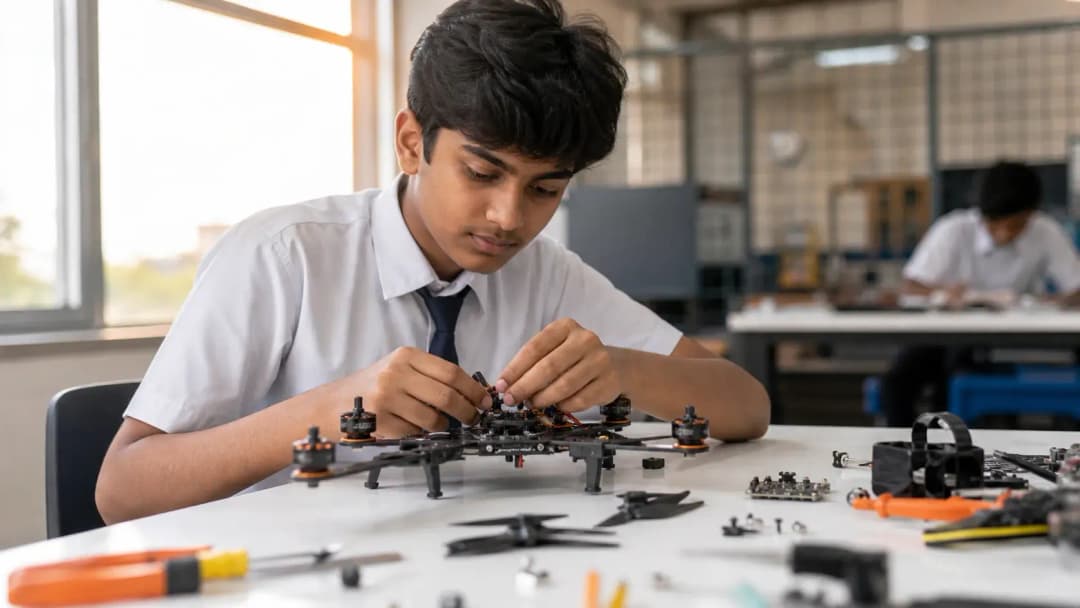
The first time a parent asked Principal Meenakshi Iyer about the drone lab at their school in Nagpur, she wasn't sure what to say. She'd been getting the same question in different forms for two years. "Does your school teach drone technology?" "My neighbour's child's school has drones, do you?" "Are drones part of the curriculum now?"
She knew the question mattered. She just didn't know what a drone lab in a school actually meant, how much it would cost, whether it was safe, or who would run it. So she did what most principals do: she thanked the parent, said she'd look into it, and moved on to the next agenda item.
That conversation is happening in staff rooms and admission queues across India right now. The drone industry here is moving fast. Government policy is moving with it. And parents, far more tech-aware than they were five years ago, are beginning to treat a school's technology infrastructure as a real signal of quality. A drone lab, to them, is not a gimmick. It is evidence that the school is serious about the future.
So let's get into the specifics. What are parents actually asking? What do principals need to know before saying yes or no? And what does a well-run drone lab in an Indian school look like in practice?
Why Drone Labs Are Suddenly a Real Conversation in Indian Schools
India's drone sector is not a distant future. The government's Production-Linked Incentive (PLI) scheme for drones is designed to grow the industry to a ₹15,000 crore market, creating over 1 lakh direct and indirect jobs in the process. The Civil Aviation Ministry has been active in simplifying drone regulations, licensing, and certification frameworks specifically to build out a domestic workforce for this sector.
That workforce has to come from somewhere. And schools are beginning to realise they can be part of the pipeline.
Under NEP 2020, the push for experiential learning, multi-disciplinary education, and real-world skill building is explicit. Drone technology fits this precisely. It is not an elective in the old sense. It is a convergence point for physics, mathematics, coding, electronics, aerodynamics, and data interpretation: all in a single activity. When a student programs an autonomous drone path, they are doing applied Maths. When they troubleshoot a motor control issue, they are doing applied electronics. When they analyse flight telemetry data, they are doing applied statistics.
State boards in Maharashtra, Karnataka, and Telangana have already begun incorporating drone-related modules into vocational and science subjects. CBSE schools that want to stay ahead of the curve (rather than scramble to catch up) are looking at drone programs now. If your school is thinking about this, you are not early. But you are not too late either.
What Parents Are Actually Asking
Most parents asking about drone labs are not engineers. They are not expecting their child to become a UAV pilot. What they are really asking is a smaller, more human question: Is this school preparing my child for the world that actually exists?
Here is how that question shows up in practice.
"Will my child actually learn something useful, or just fly a toy?"
This is the most common concern, and it is a fair one. There is a meaningful difference between a school that buys a consumer drone and puts it in a cupboard for Science Week, and a school with a structured drone curriculum that progresses from aerodynamics theory to coding autonomous missions. Parents can sense the difference, even if they cannot articulate it. The answer a principal should have ready is about the curriculum behind the hardware, not the hardware itself.
A well-designed drone program covers aerodynamics and physics, propulsion systems and motor control, flight programming using Python or block-based logic for younger classes, safety protocols and DGCA-adjacent compliance for older students, and real-world applications: agriculture, mapping, logistics, surveillance. Without that progression, the drone lab is a novelty. With it, it is a genuine technical education.
"Is it safe for school-age children?"
The short answer is yes, when designed correctly. Indoor drone programs for school students use nano and micro drones (small, lightweight quadcopters with propeller guards) in enclosed, netted environments. Students in Classes 6 to 10 typically work with simulation software before touching hardware. Flying happens in designated, bounded zones. Physical crashes are a feature of learning, not a safety crisis. The drones used in school programs are a different category entirely from the commercial UAVs you see on construction sites or farms.
The longer answer is that safety in a school drone program comes entirely from the quality of the on-ground program design. A school that buys kits and hands them to a computer science teacher who has never touched a drone is genuinely taking a risk, not because drones are dangerous, but because poor program design leads to poor safety culture. This is why who runs the program matters enormously.
"Does this lead to anything? Will this help with admissions or careers?"
It does. The Indian drone industry needs pilots, engineers, data analysts, software developers, and entrepreneurs who understand UAV systems. Certified drone operators earn starting salaries of ₹25,000 to ₹80,000 per month. But for most school students, the career value is not "become a drone pilot." It is the underlying competencies: systems thinking, coding, spatial reasoning, and project-based problem solving. These translate across aerospace, defence, agriculture technology, logistics, and AI-enabled hardware industries.
For admissions specifically: students who can demonstrate hands-on engineering projects (not just certificates, but documented work) stand out in applications to IITs, NITs, and international universities. A structured drone project has clear evidence value.
What Principals Need to Know Before Saying Yes
There is a version of a drone lab that makes a school look good in an open house and collects dust by February. Avoiding that requires thinking through a few things clearly before committing.
You need a curriculum, not just hardware.
Every vendor will show you a glossy kit. What matters is the pedagogical structure around it. How does drone education begin in Class 6, and where does it lead by Class 10? What is the learning outcome for a student who completes three years of this program? If a vendor cannot answer that question with specifics, walk away. The equipment is the easy part. The curriculum is the hard part.
Our 7-domain curriculum at Scaleopal Labs includes drone technology as a dedicated domain, progressing from aerodynamics and basic propulsion in middle school to autonomous navigation and flight programming in senior classes. It is built alongside our AI, Robotics, IoT, and EV Technology domains, not as a standalone module, but as part of a coherent 10-year learning path from Class 1 to Class 12.
You need a qualified person running it.
This is where most school drone programs collapse. The science teacher who agrees to "also handle the drone sessions" is not the problem; they are usually enthusiastic and capable. The problem is asking one person to teach a subject while simultaneously learning it, without any structural support. It does not work. The sessions become irregular. Student engagement drops. The hardware sits.
What actually works is having a dedicated professional on campus who runs the sessions, manages the equipment, troubleshoots issues, and tracks student progress. Not a once-a-week visitor. A working professional who is present, accountable, and genuinely skilled. This is what we mean when we talk about our on-campus engineer model, and it applies to drone sessions exactly as much as it applies to our AI and robotics programs.
You need to know what the real cost is.
Traditional drone lab setups require significant upfront investment. A basic drone program costs ₹2 to 5 lakhs for hardware alone. A comprehensive setup with safety netting, charging infrastructure, simulation software, and instructor training runs considerably higher. Then there is maintenance, upgrades, and replacement of damaged components, which in a school setting with students learning to fly, is not a small line item.
This is the point where most principals stall. The proposal goes to the management committee, sits in a drawer, and nothing happens. We have written about why this pattern is so common, and it almost always comes down to the same problem. The risk sits entirely with the school.
There is a different model worth knowing about: the zero setup cost, Lab-as-a-Service approach where Scaleopal funds and deploys the lab: hardware, software, drone kits, safety infrastructure, on-campus engineer. The school converts that into a modest technology integration fee per student. The school collects the fee, keeps a guaranteed profit margin, and Scaleopal earns its operating cost share. The school takes on zero upfront risk. The lab is live in 45 days. If the program does not run well, Scaleopal loses. Which is exactly why it is designed to run well. You can look at how the financial model works here.
Space and safety infrastructure matter, but less than you think.
A question we hear from principals often: "We don't have space for a drone lab." In most cases, this is not actually true. Drone programs for Classes 6 to 10 use micro and nano drones that require an area roughly 10 by 10 feet for initial flying practice. A standard classroom works. Safety netting (the most important physical infrastructure element) can be installed in a single day. We have deployed drone programs in schools in Pune and Nashik where principals initially assumed they did not have space, and found solutions within their existing footprint.
The bigger question is not space. It is readiness: whether the school has a clear plan for how drone education fits into the timetable, which classes are involved, and who the internal coordinator will be.
What a Well-Run School Drone Program Looks Like
To make this concrete: here is what drone education looks like when it is done properly.
In Classes 6 and 7, students start with theory: aerodynamics, lift and thrust, the physics of flight. They build basic models, understand drone anatomy, and learn to use flight simulation software. No physical flying until they can articulate what they are doing and why. This phase builds respect for the equipment and a genuine conceptual foundation.
In Classes 8 and 9, students move to hands-on assembly. They build micro drone kits from components, learn about electronic speed controllers, flight controllers, and battery systems. They begin programming basic autonomous sequences: take off, hover, navigate a waypoint path, land. The coding is in Python or similar. The physics is becoming real to them in a way it simply is not in a textbook.
By Class 10, students are working on applied projects: designing a drone-based solution for a real problem. Agricultural monitoring. Delivery route planning. Infrastructure inspection simulations. These become portfolio projects. They go into university applications. They are the difference between a generic "I did coding" and "I built an autonomous mapping system for this specific use case."
This is the progression that makes drone education worth doing. Not a one-day workshop. Not a Science Day demo. A structured, multi-year curriculum that builds genuine competence.
The One Question Principals Should Be Asking
Schools spend a lot of time asking "can we afford a drone lab?" The better question is: "Can we afford not to have one?"
India is building a drone economy. The government has said so, backed it with policy, and is actively recruiting industries to absorb a generation of UAV-literate engineers and technicians. The schools that create that literacy, at the right time and with the right program design, will be the schools parents seek out. Not because drones are exciting (though they are), but because those schools will have demonstrated that they take future-readiness seriously.
For principals who are tired of vendors who sell hardware and disappear, the alternative is a partner model, where the lab is built, run, maintained, and upgraded by a team that earns only when the lab performs. That is the model we build at Scaleopal. If you want to understand what that looks like for your school specifically, the next step is a conversation. Not a sales pitch. A conversation about your school's needs, your student cohort, your existing infrastructure, and whether this is the right fit.
Frequently Asked Questions
Is drone education safe for school students in India?
Yes, when the program is designed correctly. School drone programs use small indoor micro drones with propeller guards, in enclosed and netted spaces. Students begin with simulation software before handling hardware, and physical sessions are supervised by trained professionals. The DGCA's drone rules in India apply primarily to commercial outdoor flying; indoor school programs using nano and micro drones operate under different practical parameters. The key to safety is not the equipment itself but the quality of the program design and on-ground supervision.
What age or class is appropriate to start drone education?
Most structured school drone programs begin in Class 6, around age 11 to 12. At this stage, students have sufficient grounding in basic physics and Maths to understand the conceptual foundations, and enough fine motor coordination for assembly work. Simulation-based exposure can begin earlier; we introduce drone concepts in our broader curriculum from Class 4 onwards. Hands-on flying with actual hardware is typically introduced from Class 7 or 8.
How much does a drone lab cost to set up in a school in India?
A basic drone program with hardware kits, safety netting, and software costs ₹2 to 5 lakhs upfront under traditional vendor models. A comprehensive setup with multiple drone types, simulation stations, and full curriculum infrastructure runs ₹5 to 10 lakhs or more. Under Scaleopal's Lab-as-a-Service model, schools pay zero upfront. The lab is deployed at no cost to the school and funded through a technology integration fee built into the student fee structure. The school keeps a guaranteed profit margin per student.
Do schools need special permissions or licences to run a drone lab?
For indoor programs using micro and nano drones in enclosed school spaces, no DGCA pilot licence is required for students or teachers. Basic training protocols and safety SOPs are implemented at the program level. For outdoor flying of larger drones, DGCA regulations apply and remote pilot licensing would be required, but standard school lab programs do not operate at that scale. Any school considering an outdoor drone component should seek proper guidance before proceeding.
How does drone education connect to NEP 2020 and CBSE requirements?
NEP 2020 mandates experiential learning, multi-disciplinary education, and real-world skill development across all stages of schooling. Drone education aligns directly with these goals: it integrates physics, electronics, coding, mathematics, and design thinking into a single, project-based activity. While there is no current CBSE mandate specifically for drone labs, drone technology falls within the broader vocational, STEM, and Atal Tinkering Lab frameworks that CBSE promotes. Schools that run structured drone programs are ahead of the compliance curve, not chasing it.