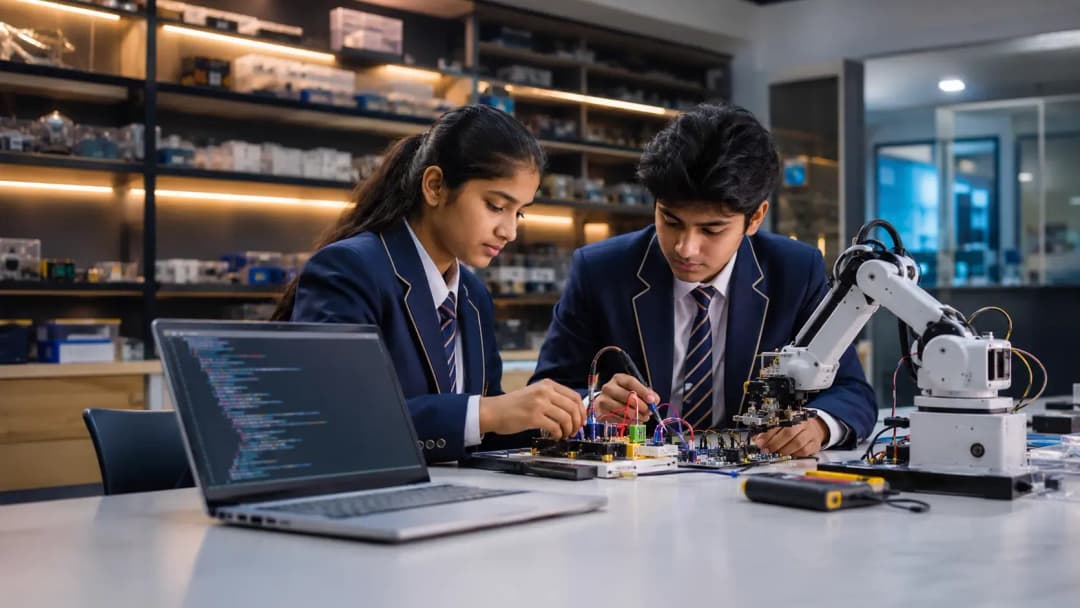
There is a school in Bengaluru. IB World School. MYP in full swing. The academic director is sharp, the faculty is internationally trained, and the school's fee structure reflects all of that. It has smart boards in every classroom. A well-equipped library. A theatre.
And in the corner of the campus sits a room labeled "Innovation Lab." Inside: a few tablets, a projector, some LEGO sets that haven't been opened since the vendor's demo day, and a desktop computer running a 2019 version of Scratch.
This is not an isolated case. It is, quietly, the norm across IB and IGCSE schools in India.
India now has over 255 IB World Schools and more than 550 schools offering the Cambridge IGCSE curriculum. These are not underfunded institutions. They charge fees that range from ₹3 lakh to ₹12 lakh per year. Their parents expect the best. And yet, when it comes to AI and robotics labs, the gap between what the curriculum demands and what the school actually provides is significant. And growing.
What the IB MYP and IGCSE Curricula Actually Require
This is the piece that most lab vendors either don't know or don't bother to explain.
The IB Middle Years Programme (MYP) is built around the Design Cycle. Every unit in MYP Design follows four stages: Inquiring and Analyzing, Developing Ideas, Creating the Solution, and Evaluating. The programme doesn't dictate which technologies a school must use. But it is explicit about the fact that students must create functional, working solutions to real-world problems. A poster. A slide deck. A written report. None of these satisfy "Creating the Solution" in MYP Design. Students have to build something.
So when a school puts a Scratch account on a tablet and calls it an AI lab, that student cannot genuinely complete an MYP Design unit on autonomous systems. Cannot prototype a working IoT device. Cannot demonstrate that they understand how a sensor reads data and triggers a response in a physical system. The curriculum says one thing. The infrastructure says another.
The IGCSE Computer Science curriculum has its own demands. Cambridge expects students in Classes 9 and 10 to understand algorithms, data representation, hardware, logic gates, programming in Python, and increasingly, how machine learning systems make decisions. The theory can be taught in a classroom. But the practical paper—and more importantly, the genuine comprehension—comes from doing. From writing code that actually runs on hardware. From debugging something that doesn't work.
A "smart room" with a projector and a pre-loaded app doesn't cover that. It covers the surface.
The Gap Between "Tech-Forward" Branding and Actual Infrastructure
International schools in India invest heavily in brand positioning. "Future-ready." "21st-century learners." "Innovation at the core." These are on every admissions brochure from Mumbai to Delhi. And parents who pay ₹6 lakh a year in fees believe them.
The problem is that most of this investment goes into the visible layer. Smart boards. iPads. A robotics kit that sits in a cupboard. The school's procurement team bought a "STEM kit" from a vendor in 2022. The vendor ran a two-day workshop, handed over a PDF syllabus, and hasn't been back since. The kit is now used in two periods a week by a Maths teacher who was asked to "manage the lab" because there was nobody else.
This is not a judgment. This is what happens when the vendor model is built on selling hardware, not on running programs. Most vendors in this space—whether it is STEMROBO, Avishkaar, or others—sell equipment and leave. The school gets a one-time installation. What it needs is an ongoing, professionally run program.
And international schools, more than any other segment, cannot afford that gap. Because their parents ask harder questions.
What a Curriculum-Aligned Lab Actually Looks Like
Let's be specific. Because "curriculum-aligned" is a phrase that can mean anything.
For an IB World School running MYP Design, a genuinely aligned lab should enable:
- MYP Design units on Product Design and Digital Design: Students should be able to prototype using microcontrollers (like Arduino or Raspberry Pi), assemble and test circuits, use sensors to build responsive systems, and document the full design cycle with a physical artifact at the end.
- Real AI project work: Not Scratch. Not drag-and-drop block coding. Actual machine learning concepts—training a simple image classifier, building a voice-recognition trigger, understanding how a recommendation system works. These are Class 8 onwards concepts and they require the right software environment and hardware to demonstrate.
- IoT and connected systems: Building a working smart device—a temperature-responsive fan, a proximity alarm, a basic home automation prototype—is a natural MYP Design project. It requires sensors, actuators, microcontrollers, and a working lab bench.
For a Cambridge IGCSE school, the alignment looks slightly different:
- Python programming with real hardware output: IGCSE CS expects students to write programs. Writing programs that control physical devices—an LED, a motor, a sensor array—is far more instructive than writing programs that only run on a screen.
- Algorithm visualisation and tracing: Logic gates, truth tables, and flowcharts make far more sense when students can actually build a simple logic circuit and watch it respond.
- Data and AI literacy: The Cambridge curriculum increasingly touches on how algorithms learn from data. Students who have built a simple classifier understand this at a depth no textbook can give them.
None of this requires a ₹25 lakh investment. But it does require a structured lab program run by someone who actually knows engineering. Not a Maths teacher who was handed a kit.
Why the "Specialist Teacher" Problem Is Worse in International Schools
Here is an irony. International schools, on average, pay higher salaries and attract better faculty. And yet they are often worse-positioned than CBSE schools to actually run an AI and robotics lab.
Why? Because CBSE schools have a defined Computer Science teacher role, a defined syllabus, and a defined exam to prepare for. The teacher knows exactly what to teach. International schools—especially IB schools—operate on inquiry-based learning. The lab is supposed to facilitate open-ended exploration. That requires a very different kind of expertise. Not a teacher who can explain variables and loops. An engineer who can say, "Here's a problem. Let's figure out how to solve it."
Finding that person is hard. Most schools end up with one of two situations: a junior IT teacher doing their best with inadequate training, or an external vendor running once-a-week "enrichment sessions" that feel disconnected from the actual curriculum units.
The specialized teacher shortage in STEM is a real, documented problem across Indian schools—and international schools are not immune. They just tend to paper over it more convincingly.
What the problem actually requires is a working engineer who operates on campus, not a content-delivery person. Someone who can sit with a Class 9 student who is stuck debugging a Python script that should be turning on an LED, and work through it with them the way an engineer would. Not reassign them to a worksheet.
The Financial Case for International Schools
Let's talk about the business side. Because IB and IGCSE school principals and academic directors don't operate in isolation. Their trustees care about numbers.
A typical international school in India with 600 students pays anywhere from ₹8 lakh to ₹18 lakh to set up a STEM or AI lab, depending on the vendor and the scope. That's upfront capital expenditure that depreciates over 5-7 years. Add annual maintenance contracts. Add trainer salaries or freelancer fees. The total cost of ownership over 5 years, for a school that actually tries to run the lab properly, easily crosses ₹40 lakh.
And that is before accounting for the opportunity cost of a poorly run lab. An IB school that has a dead innovation lab is actively hurting its brand value in a segment where parents are discerning, vocal, and paying premium fees.
There is an alternative. Our Lab-as-a-Service model is built around zero setup cost for the school. We fund the hardware, deploy the lab in 45 days, station a working engineer on campus, and maintain everything year-round. The school collects a nominal technology integration fee from parents—a fee that sits alongside their existing activity fee structure—and earns a guaranteed profit margin per student by contract.
For a school of 600 students at a modest fee of ₹3,500 per student per term, that is meaningful revenue flowing in, not money flowing out. The financial model details are transparent and contractually defined. No ambiguity.
And unlike the traditional vendor model, our incentives are aligned with the school's: we only operate well when the lab runs well. If students aren't using the lab, we aren't earning. That's a very different accountability structure from a vendor who has already cashed the cheque.
What This Looks Like Across India's International School Hubs
Mumbai, Bengaluru, Delhi NCR, Hyderabad, Chennai. These five cities account for the majority of IB World Schools in India—roughly 64 schools between them, and that number has been growing steadily. IGCSE schools are even more widely distributed, with many in Tier 2 cities like Chandigarh, Jaipur, and Coimbatore.
The schools in these cities face a specific competitive pressure that CBSE schools don't: comparison to international benchmarks. Parents who choose IB or IGCSE are often making that choice partly because they want their child's education to be globally comparable. When a student from a London or Singapore IB school visits a sister school in Mumbai, the lab they walk into should not look like it was assembled from an Amazon Prime order in 2021.
The gap between what Indian IB schools deliver on paper and what they deliver in the actual innovation lab is real. And increasingly, parents notice. Admission enquiries increasingly include questions about what the lab actually does, not just what it is called.
We built our AI and robotics lab curriculum to be deployable across school boards—but the depth of the 7-domain, Class 1 to 12 pathway maps naturally onto what IB MYP and IGCSE programmes need. The progression from basic circuits and block coding in Class 3-4, to Python and microcontrollers in Class 7-8, to machine learning concepts and full-stack IoT systems in Class 9-10, mirrors the natural progression of both the MYP and the Cambridge curriculum.
This is not coincidence. It is how real engineering skills are built. And we teach them the way we know them: as practicing engineers, not as curriculum consultants.
FAQ
Does an IB school need a separate lab for AI and robotics, or can it be integrated into MYP Design?
Both approaches work, and the right answer depends on the school's timetable and space. Many IB schools run the lab as the practical workspace for MYP Design units, with each unit cycle anchored by a hands-on project done in the lab. Others keep it as a dedicated enrichment period. Either way, what matters is that the lab has the depth to support genuine inquiry-based projects, not just supervised play with kits.
What does a curriculum-aligned AI lab need that a regular computer lab doesn't?
At minimum: hardware for physical computing (microcontrollers, sensors, actuators), a structured progression curriculum that builds skills over years rather than isolated activities, and a qualified person to facilitate engineering-style problem-solving. Software-only labs with pre-loaded apps can support theory. They cannot support the "Creating the Solution" stage of the MYP Design cycle or the practical component of IGCSE Computer Science.
How do IB and IGCSE schools in India typically fund AI lab upgrades?
Most international schools currently fund lab upgrades through capital budgets, which means large one-time approvals from the management committee and ongoing depreciation. A growing number are moving to managed partnership models where a third party funds and runs the lab, and the school earns a per-student revenue share instead of spending capital. This approach is especially relevant for schools that want to upgrade without triggering a multi-lakh procurement discussion with the board.
Is a Lab-as-a-Service model appropriate for high-fee international schools, or is it a budget-school solution?
The Lab-as-a-Service model is not about budget constraints. It is about risk. A school paying ₹20 lakh upfront for lab hardware still faces the same problem: depreciation, unqualified staff, and no guarantee the lab will be used well in year 3. The managed model transfers all of that operational risk to the service provider, and adds a structured curriculum and a qualified on-campus engineer. The question is not whether the school can afford to buy a lab. It is whether buying a lab is the right way to get the outcome.
Can the curriculum be adapted for specific MYP units or IGCSE modules?
Yes. This is one of the advantages of working with an engineering team rather than a kit vendor. We can map our curriculum to specific MYP unit planners, Cambridge module specifications, or the school's existing scheme of work. The technical skills—circuits, Python, sensors, machine learning concepts—remain the same. The context and the project framing adapts to what the school needs.
What cities in India does Scaleopal Labs currently serve?
We are Maharashtra-first in our initial cohort, with active deployments in Pune, Mumbai, Nashik, Nagpur, Thane, and Chhatrapati Sambhajinagar. We are expanding into Delhi NCR, Bengaluru, Hyderabad, Chennai, and Ahmedabad for the 2026-27 academic year. If your school is in any of these cities—or nearby—we would like to have a specific conversation about what the programme would look like on your campus.