Ask most IB continuum schools in India when their AI and robotics program really starts, and the honest answer is Class 6. That is when MYP begins, when Design Cycle becomes a graded, structured part of the timetable, and when the school finally invests in a proper lab.
So what happens to a student for the five years before that? In a lot of schools, not much. A tablet with a coding app. Maybe a robotics elective if the school has one. The PYP years, ages 3 to 12, get treated as a kind of waiting room before the "real" curriculum starts.
That is a genuine gap, and it shows up later. A Class 6 student walking into their first MYP Design unit is expected to inquire, analyse, develop ideas, build a working solution, and evaluate it, all within a defined criteria structure. If that student has never physically built anything before, never debugged something that did not work, never had to explain why their idea failed, the Design Cycle is not a natural next step. It is a cold start.
PYP Does Not Have a Design Cycle, and That Is Fine
Worth being precise here, because a lot of school marketing blurs this. The Design Cycle, with its four stages of Inquiring and Analysing, Developing Ideas, Creating the Solution, and Evaluating, is an MYP framework. PYP does not use it and does not need to. We covered how that MYP structure maps to a real lab program in our guide to curriculum-aligned labs for IB and IGCSE schools, and that post is where the Design Cycle conversation belongs.
PYP runs on something structurally different: a transdisciplinary, inquiry-based framework for ages 3 to 12, organised around Units of Inquiry rather than graded design criteria. And underneath every unit sits the Approaches to Learning skills, five categories the IB uses across its entire continuum: Thinking, Social, Communication, Research, and Self-Management.
Here is the part most schools miss. Those five ATL categories are not abstract soft skills. They are, in practice, exactly what a hands-on AI and robotics program builds, years before a student ever hears the words "Design Cycle."
Where AI and Robotics Actually Fit Inside PYP
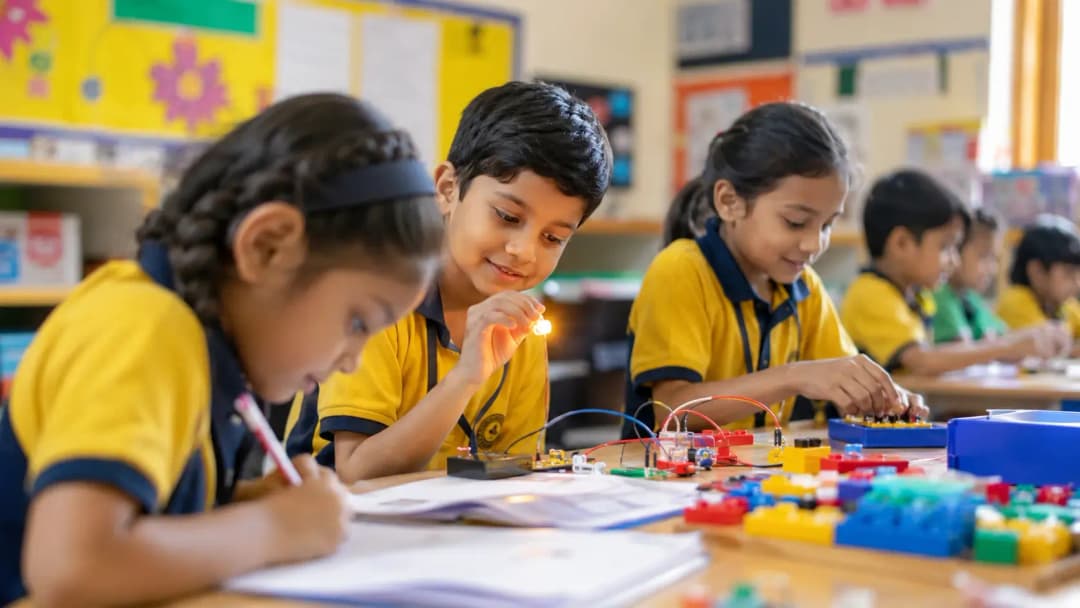
Take Research skills. The IB's own framing explicitly includes applying technology as part of formulating, planning, gathering, and interpreting information. A Class 3 student building a simple circuit to light an LED, testing what happens when a wire is disconnected, and recording what they observe, is doing PYP research skills. Not "prepping for robotics later." Doing it now, in a form that is developmentally right for an 8-year-old.
Thinking skills show up the moment a young student's first attempt at a simple machine does not work and they have to figure out why. Self-Management skills show up when a student has to plan out steps before touching the hardware, then reflect on what they would change. Communication skills show up when a 10-year-old has to explain, in their own words, how a sensor triggers a response.
None of this requires the graded rigor of MYP Design Criteria A through D. It requires age-appropriate hands-on work that a five-category ATL framework already has room for.
What This Actually Looks Like, Year by Year
A Class 1 or 2 student is not ready for Python or circuit boards. They are ready for guided play with cause and effect: simple mechanical builds, basic block-based sequencing, sorting and pattern activities that quietly build the thinking habits a later Design Cycle will lean on.
By Class 3 and 4, real circuits enter the picture. LEDs, simple sensors, basic block coding that controls a physical output rather than just an on-screen character. A student at this stage should be able to build something, watch it work or fail, and explain what happened.
Class 5, often the final PYP year before a school's transition into MYP, is where the gap becomes most visible if a school has not built toward it. This is a natural point for a light introduction to microcontroller-based projects, still playful, still exploratory, but noticeably more structured than what came before. A student who has spent two years building small circuits and one year working with early microcontroller projects walks into Class 6 MYP Design with actual hands, not just curiosity.
Many PYP schools also run a culminating Class 5 Exhibition, a transdisciplinary project where students research and present on a self-directed inquiry. A student with real prior hands-on tech experience has a genuinely different Exhibition available to them than one who has only ever worked on a screen.
Why This Matters More for IB Schools Specifically
A CBSE or ICSE school without a strong Class 1-5 tech program is behind on trend, but not necessarily behind on curriculum, since most board mandates for AI and computational thinking only formally kick in around Class 3 onward and ramp up further from Class 6.
An IB continuum school is different. It has made an explicit promise, PYP through MYP through DP, of continuity. A school marketing itself as an "IB World School" is telling parents that what happens in Class 3 connects meaningfully to what happens in Class 9. If the AI and robotics story only starts in Class 6, that continuity claim has a five-year hole in it, right at the foundation.
And parents evaluating a PYP school for their 5-year-old are increasingly asking what happens years down the line, not just what the Early Years classroom looks like today. A school that can show a genuine Class 1 through 12 pathway, not just a Class 6 onward robotics elective, is answering a question most competitors are not even prepared for, and doing so without the capital outlay that usually comes with building that pathway. Our zero-cost, revenue-sharing model means schools can commit to that full continuum from day one, not just the years a budget happens to cover.
What a Real PYP-Stage Program Requires
This is not about buying a coding app subscription and calling it done. A genuine PYP-stage AI and robotics foundation needs three things most schools underinvest in.
First, age-appropriate hardware. Not the same microcontroller kit used in Class 9, scaled down. Purpose-built, safe, tactile materials designed for small hands and short attention spans, that still teach real cause-and-effect engineering concepts.
Second, someone running it who actually understands both the technical content and how 6 to 10-year-olds learn. A junior IT teacher handed a kit and a free period is not that person. Neither is a robotics engineer with no early-years training. It takes both.
Third, and this is the part schools consistently skip, an explicit connection back to the ATL framework the school is already using. If the tech program is not tagged to Thinking, Research, and Self-Management skills the way every other PYP unit is, it lives in isolation from the rest of the curriculum instead of reinforcing it.
Building the Full Continuum
Our 7-domain, Class 1 to 12 curriculum was built around exactly this continuity problem. The early years focus on circuits, sequencing, and guided building, the middle years bring in real coding and microcontrollers, and by the time a student reaches MYP, they are not encountering hands-on engineering for the first time. They are extending habits they already have.
For schools running the full IB continuum, that also means the AI and robotics story a Class 3 parent hears during admissions is the same story a Class 9 parent hears, just further along the same path. We deploy that pathway at zero setup cost, with an on-campus engineer trained to work across age groups, not just the older grades most vendors default to.
If your school is already running a strong MYP Design lab and wondering what should feed into it, that is the real question. The answer is not "start robotics in Class 6." It is "make sure Class 6 is not where it starts." Let's talk about what the full pathway looks like on your campus.
Frequently Asked Questions
Does the IB PYP require schools to teach AI or robotics?
No. The PYP does not mandate specific technology content the way some national curricula do. But it does emphasise applying technology as part of Research skills within the ATL framework, which gives schools wide latitude to build a genuine hands-on program without violating the transdisciplinary, non-siloed spirit of PYP.
Is it too early to introduce circuits or coding to a 6 or 7-year-old?
Not with age-appropriate materials. The goal at this stage is not technical mastery. It is building comfort with cause and effect, simple troubleshooting, and hands-on building, all of which a well-designed program can deliver safely and playfully for early primary students.
How does a PYP-stage tech program connect to the PYP Exhibition?
Students who have built real projects across their PYP years bring genuine hands-on experience and a working vocabulary for describing engineering problems into their Exhibition research, rather than only presenting information gathered from books or the internet.
Should PYP technology work be graded the way MYP Design is?
No. PYP does not use MYP's Criteria A through D structure, and forcing that level of formal assessment onto 6 to 10-year-olds would work against the developmentally appropriate, inquiry-driven spirit of the programme. Reflection and skill-building within the ATL framework is the right lens, not formal grading.
What happens if a school only starts AI and robotics at MYP?
The program still works, but students arrive without the hands-on habits, comfort with failure, and basic technical vocabulary that a PYP-stage foundation builds. Teachers often end up spending the first term of Class 6 catching students up on fundamentals that could have been built in naturally over the preceding years.
Can a school add a PYP-stage program without disrupting an existing MYP lab setup?
Yes. The two stages use different hardware, different pacing, and different facilitators, so a PYP-stage program is typically additive rather than a redesign of what already exists at the MYP level.