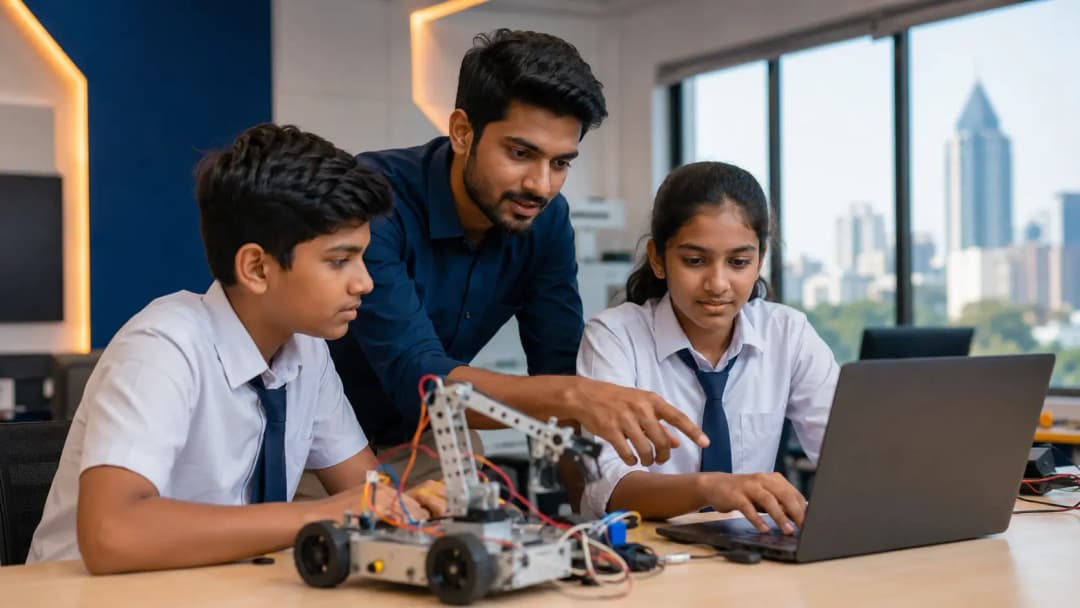
"Does your school have a robotics lab?" That question is now showing up at Mumbai admission desks alongside the usual ones about fee structure and bus routes. Parents in Andheri, Powai, and Bandra are not asking because it is trendy. They are asking because every other school in the shortlist already claims to have one.
Here is the problem most principals looking at an AI lab for their Mumbai school run into next. The moment they start pricing out an actual AI and robotics lab, and not just a room with some kits in a cupboard, the numbers stop making sense for a city where every square foot on campus is already fighting for a purpose.
Why Mumbai's Real Estate Math Breaks the Traditional Lab Model
Land in Mumbai is not like land anywhere else in Maharashtra. Metro land costs can run into ₹15 to 50 crore per acre, and CBSE's own affiliation bye-laws require schools in the four largest metros, Mumbai included, to hold 1,600 to 3,200 square metres of built-up area under Clauses 3.4 to 3.6. Every classroom, lab, and corridor on a Mumbai campus is competing against that valuation.
Now put a traditional vendor proposal next to that. Most lab providers ask schools to pay ₹5 lakh to ₹35 lakh upfront depending on scale, hand over a dedicated room, and commit staff time to a programme the school did not design and cannot easily change. In Pune or Nashik, a trustee might absorb that as a one-time cost. In Mumbai, that same trustee is weighing it against rent the school could be charging for that space, or a renovation that was already on the list for three years.
And there is a second layer to this that most vendor pitches skip entirely. A Mumbai school does not just pay more for the room. It pays more for the risk of that room sitting half-used two years later, which is exactly what happens to a large share of vendor-installed robotics labs across India once the installation team packs up and leaves.
What Mumbai Schools Actually Have on Campus Today
According to UDISE+ 2024-25 data, 73 percent of Mumbai schools already report having a science or computer lab, and 100 percent report internet connectivity. On paper, that looks like readiness. In practice, a computer lab built for typing lessons and spreadsheet basics is not the same infrastructure a CBSE AI and Computational Thinking programme or an ICSE Subject Code 66 course needs.
A "science lab" checkbox on a UDISE+ form does not tell you whether that room has the sensors, robotics kits, and project-based curriculum that a board exam actually tests. It tells you a room with some equipment exists. Those are two very different things, and Mumbai schools are increasingly getting caught in the gap between them during inspections and, more painfully, during admissions conversations with parents who have started asking sharper questions.
What the CBSE and ICSE Mandates Actually Require
Mumbai has a mix of CBSE, ICSE, IB, IGCSE, and Maharashtra State Board schools, and the compliance picture is not identical across all of them. CBSE-affiliated schools in the city are working against the 2026-27 AI and Computational Thinking rollout for Classes 3 to 8. ICSE and ISC schools answer to CISCE, not CBSE, and we have already written in detail about what that mandate actually requires for CISCE-affiliated schools specifically.
What both boards share is this: a subject listed on the timetable is not the same as a programme a school can defend to a parent or an inspector. CISCE's own Robotics and AI syllabus for Classes 9 and 10 weights internal assessment heavily, which means the lab work itself, not just the written exam, decides a meaningful share of a student's grade. A Mumbai school running that subject without proper lab infrastructure is taking on academic risk it may not have fully priced in.
For CBSE schools and ICSE schools alike, the honest starting question is not "do we need a lab." Every board has already answered that. The real question is who pays for it, who runs it, and what happens when the initial excitement fades in year two.
How the Zero-Cost Model Changes the Calculation for Mumbai
This is where the Lab-as-a-Service model changes the equation, particularly for a city where capital and space are both scarce.
Under this model, we fund and deploy the entire AI, robotics, and IoT lab on the school's campus. Hardware, software, curriculum, maintenance, all of it. The school pays ₹0 for setup. A nominal technology integration fee gets added to the existing student fee structure, the school collects that fee from parents, and the school keeps a fixed profit margin per student, guaranteed by contract. Deployment takes 45 days from the day a partnership is confirmed.
For a Mumbai trustee, that reframes the entire decision. This is not a request to find ₹15 lakh in an already tight capital budget. It is a proposal where the lab pays the school back instead of the other way around. You can see the full financial model to work out what that looks like for your own enrolment numbers.
A room that costs the school nothing to build and returns a margin every year is a very different conversation from a room that costs ₹20 lakh and might go quiet by year three.
Space still matters, of course. But the model does not ask a Mumbai school to reserve a purpose-built lab from scratch. Existing computer labs, activity rooms, or underused classrooms can often be reconfigured, which matters enormously in a city where new construction is rarely an option.
Who Actually Runs the Lab
A recurring worry we hear from Mumbai principals is staffing. Who teaches this? The existing computer science teacher, already stretched thin? A freelancer hired on contract who leaves after a term?
Neither. An on-campus engineer, a working professional from an active AI engineering company, conducts every session. Not a teacher retrained over a weekend workshop, not a vendor's rotating trainer. This person is on campus, running sessions, and staying accountable for outcomes because the model only pays out when the lab actually runs well. That accountability is the piece most vendor relationships in Mumbai are missing once the installation invoice is paid.
What Deployment Looks Like on a Mumbai Campus
The process is straightforward once a school decides to move.
- A short site assessment confirms available space and existing infrastructure, often reusing an existing computer lab or activity room
- Curriculum mapping is done against the school's board, whether that is CBSE, ICSE, IB, or IGCSE, and against the specific classes the school wants to start with
- Hardware and software installation happens on-site, with year-round maintenance built in at no additional cost
- The on-campus engineer begins sessions, typically within 45 days of partnership confirmation
Schools do not need to have a fully renovated space ready before starting the conversation. That is usually one of the first things we work through together on our main solutions page.
Frequently Asked Questions
How much does an AI lab cost for a school in Mumbai?
Under a traditional vendor model, schools in Mumbai are typically quoted anywhere from ₹5 lakh to ₹35 lakh depending on scale and grade coverage. Under the zero-cost Lab-as-a-Service model, setup cost is ₹0, and the school earns a profit margin per student instead of paying upfront. You can read more about how traditional lab pricing actually breaks down.
Does the CBSE AI mandate apply to ICSE schools in Mumbai?
No. The CBSE circular binds CBSE-affiliated schools directly. ICSE and ISC schools in Mumbai are governed by CISCE, which has introduced its own Robotics and AI curriculum under Subject Code 66 for Classes 9 to 12 on a separate timeline.
How much campus space does a lab need in Mumbai?
Most schools reuse an existing computer lab, science room, or underused classroom rather than building new space. Given how expensive built-up area is in Mumbai, that reuse is usually the deciding factor in whether a school can move forward without a capital request.
Who teaches the sessions if we do not have a trained AI teacher?
An on-campus engineer, a working professional rather than a retrained classroom teacher, conducts every session. Your existing computer science or IT faculty can stay involved as coordinators without being expected to become AI experts overnight.
How long does setup take once we decide to go ahead?
Deployment takes 45 days from partnership confirmation to the first classroom session, covering site assessment, curriculum mapping, hardware installation, and engineer onboarding.
What happens to the equipment and curriculum if the partnership ends?
Because the school never owns capital-intensive assets it has to depreciate or maintain independently, ending a partnership does not leave a school holding unusable hardware the way a traditional vendor purchase would.
The Real Question for Mumbai Schools
Every school in Mumbai already knows it needs an AI and robotics programme. NEP 2020 has made that clear, CBSE's 2026-27 mandate has made it more concrete, and CISCE's board exams have made it non-negotiable for schools running Subject Code 66. So the debate in most Mumbai boardrooms has quietly shifted. It is no longer whether to build a lab. It is whether to spend crores of rupees worth of space and capital doing it the old way, or to let a partner absorb that risk instead.
If your school is weighing that decision right now, we would rather walk you through the actual numbers for your campus than have you guess. Start the conversation with our team, and we will map out what a zero-cost lab looks like for your enrolment and your space.