A CISCE circular landed in inboxes back in 2023 introducing something called Subject Code 66. Most schools filed it under "things to deal with later." Later has arrived. ISC students in Classes 11 and 12 sit their first Robotics and Artificial Intelligence board exam in 2026, and a good number of principals are only now realizing what the syllabus actually asks of them.
This is not a coding elective bolted onto the timetable. It carries the weight of a full board subject. And the part that catches most schools off guard has nothing to do with the written paper.
What Is ISC Robotics and Artificial Intelligence, Subject Code 66?
CISCE added Robotics and Artificial Intelligence as Subject Code 66 across Classes IX to XII starting in the 2023 academic year, part of a broader push toward AI lab readiness for ICSE and ISC schools. ICSE students (Class 9-10) wrote their first paper in 2025. ISC students (Class 11-12) follow in 2026. The syllabus was developed with input from the I-Hub Foundation for Cobotics at IIT Delhi, and it covers real technical ground: robotic systems and their components, sensors and actuators, cobots, control systems, and a full second half built around Python, data handling with pandas and numpy, and the AI project cycle.
So what does that mean in practice? A Class 11 student is expected to explain the difference between a robot and a cobot, work through control system block diagrams, and later in the year read a CSV file into a pandas DataFrame and build a basic AI project around it. This is closer to a first-year engineering module than a school "computer studies" period, and it needs to be treated that way.
We wrote earlier about how CBSE schools are handling the AI and Computational Thinking mandate for Classes 3-8, and the pattern repeats here. A circular reads simply on paper. The operational reality behind it is a different conversation entirely.
Why the Internal Assessment Is the Part Schools Underestimate
Here is the number that should reset every principal's planning. The ISC Robotics and AI exam carries a written paper worth 100 marks and an internal assessment also worth 100 marks. That is not a small practical component tacked on for good measure. It is half the grade.
And internal assessment does not mean one end-of-year project submitted in a folder. CISCE's own guidelines point to a minimum of around 20 assignments completed through the year, each one evaluated against class design, coding quality and documentation, variable description, and actual program execution. A student is graded on work like building a Buzan-style concept map programmatically, reading and cleaning a dataset, plotting data with different marker styles, and documenting each step properly.
Think about what that requires structurally. Twenty graded assignments cannot happen through occasional lab periods squeezed between other subjects. They need a consistent weekly rhythm, a person qualified to evaluate coding assignments (not just administer them), and a record-keeping system that holds up when CISCE moderators ask to see the internal assessment trail.
Most schools are prepared for the written paper. Almost none have built the operational muscle for continuous, evaluated, hands-on assessment at this depth. That gap is where students lose marks that have nothing to do with how well they understand robotics.
What Hardware and Lab Setup CISCE Actually Expects
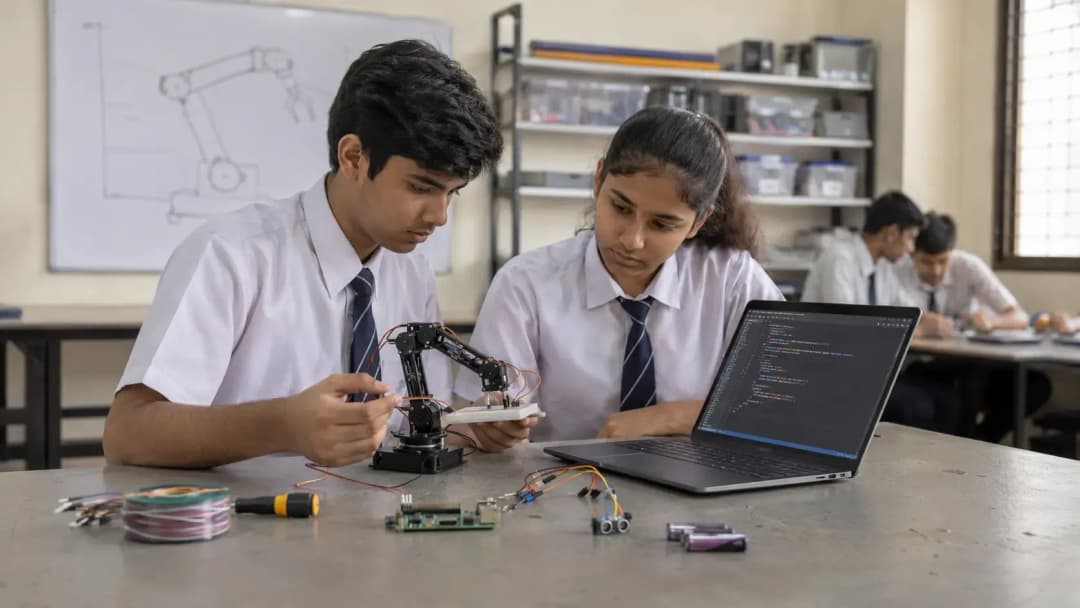
The syllabus is specific about equipment, and vague compliance will not hold up during a practical exam or an internal assessment review. CISCE recommends single-board computers such as Arduino Uno, Arduino Nano BLE Sense, or Raspberry Pi, with roughly 10 sets for a class of 30 students. Alongside that: servo motors, a mix of contact and non-contact sensors, actuators (both linear and rotary), wiring, batteries, and crimping tools.
None of this is exotic. But it is also not equipment that sits comfortably in a general computer lab built for typing and spreadsheets. A school needs a dedicated space, working hardware that survives repeated student handling across a full academic year, and someone who can troubleshoot a faulty sensor mid-class without losing forty minutes of the period.
We have covered this exact failure pattern before in why school robotics labs go dark. Kits get purchased with enthusiasm in April, and by December half the sensors do not respond and nobody on staff knows why. For Subject Code 66, that breakdown does not just mean a disappointing club activity. It directly threatens a graded board subject.
The Staffing Problem Nobody Mentions
Here is the honest question every principal should be asking right now. Who in your school is qualified to teach Python-based AI project work, evaluate 20 coding assignments per student with real rigor, and also explain cobot control systems with technical accuracy?
For most CISCE schools, the answer is nobody, at least not yet. Computer teachers who came up teaching HTML and basic programming logic are being asked to mentor machine learning basics and robotic system design in the same academic year. That is not a criticism of the teachers. It is a mismatch between how fast the syllabus moved and how fast teacher training typically moves.
We wrote a full breakdown of this exact bottleneck for the stem lab teacher training problem in Indian schools, and Subject Code 66 is arguably the sharpest version of it. This is not an enrichment activity where a slightly underprepared facilitator is a manageable risk. It is a board exam. Marks are on the line, and so, eventually, is the school's reputation when results come out.
A one-time faculty development workshop will not close this gap. Neither will a textbook with pre-written answers. What actually closes it is someone qualified sitting in that lab every week, running the assignments, and correcting the work with the depth a board examiner would expect.
How the Zero-Cost Model Fits This Specific Subject
This is exactly the kind of subject the Lab-as-a-Service model was built for. Instead of a school buying Arduino kits, sensors, and single-board computers upfront and then hoping a teacher can be trained fast enough to run 20 internal assessments credibly, Scaleopal Labs deploys the hardware, curriculum, and an on-campus engineer at zero setup cost to the school.
That on-campus engineer is not a visiting trainer who drops in twice a month. They are present on your campus, running the weekly sessions, mentoring the AI project work, and maintaining the assignment and evaluation trail that CISCE's internal assessment structure demands. Hardware maintenance and replacement sensors are included, so a fried Arduino board in October does not become a three-week delay while procurement paperwork moves through committee.
The school adds a modest technology integration fee to its existing fee structure, keeps a guaranteed profit margin, and Scaleopal covers its operating cost through the revenue share. The lab pays for itself instead of sitting on the budget as a line item nobody wants to defend at the next trustee meeting. Compare that against the typical upfront cost of setting up an AI lab in India, and the difference in risk profile becomes obvious fairly quickly. If you want the specifics on how that works across an entire academic year, our curriculum page lays out the full progression from Class 9 through Class 12 for exactly this kind of technical subject.
Deployment for a new lab typically runs 45 days from confirmed partnership. For a school looking at the 2026-27 academic year with ISC exams already on the horizon for its senior batch, that timeline matters more than it might for a general enrichment lab.
What Class 11 Looks Like Month to Month
A well-run Subject Code 66 program does not front-load theory and leave practicals for the final term. It should look closer to this across the year:
- Early terms build foundational robotics concepts (robotic systems, sensors, actuators, control systems) alongside Python basics
- Mid-year work shifts into data handling with pandas and numpy, moving from toy datasets to slightly more realistic ones
- Assignments accumulate steadily, roughly two per month, each documented and evaluated the way CISCE expects
- Later terms move into the full AI project cycle, where students frame a problem, gather data, build a basic model, and present findings
- Revision blocks before the written paper focus on the theory-heavy portions: robot classification, cobots, and control system diagrams
Spacing the assignments this way means a student is not attempting their fifteenth graded submission in the same week they are also revising for the written paper. It also means a moderator reviewing the internal assessment trail sees consistent, credible work spread across the year rather than a cluster of submissions from the last fortnight before results.
Frequently Asked Questions
What is ISC Robotics and Artificial Intelligence Subject Code 66?
It is a CISCE board subject introduced for Classes IX through XII, covering robotic systems, sensors and actuators, control systems, and AI fundamentals including Python programming and data analysis with pandas and numpy. ICSE students first wrote the exam in 2025, and ISC students follow in 2026.
Is Subject Code 66 compulsory for all ISC schools?
CISCE offers it as an elective subject rather than mandating it across every affiliated school. Schools choose to introduce it, but once a batch of students is enrolled in the subject, the full syllabus and assessment structure apply exactly as prescribed.
What is the exam pattern for ISC Robotics and AI?
The assessment has two components. A written paper of two hours carries 100 marks, and an internal assessment also carries 100 marks, based on a minimum of around 20 evaluated assignments completed through the year.
Can our existing computer science teacher deliver this subject?
Some can, particularly if they already have strong Python and data handling skills. Many computer teachers trained on earlier syllabi will need substantial support, especially for the robotics hardware components and the depth of ongoing project evaluation the internal assessment demands.
What hardware do we need for the robotics component?
CISCE recommends single-board computers such as Arduino or Raspberry Pi (around 10 sets for a class of 30), along with servo motors, sensors, actuators, wiring, batteries, and crimping tools.
How long does it take to set up a compliant lab for this subject?
Through the Scaleopal Labs model, a fully equipped lab with an on-campus engineer can be live within 45 days of a confirmed partnership, at zero setup cost to the school.
The Bottom Line
Subject Code 66 is not a subject a school can wing with a workbook and good intentions. Half the grade rides on sustained, evaluated, hands-on work across the year, and that requires a person on campus qualified to run it properly, not just a syllabus PDF and a box of sensors.
Schools that get ahead of this now, before results from the first ISC cohort start shaping how parents and trustees view the program, are the ones who will not be scrambling in Term 2. The rest will be explaining to a management committee why a board subject underperformed for reasons that had nothing to do with student ability.
If you are an ISC school weighing how to deliver this subject properly, start the conversation with our team. We will walk through your existing computer lab setup, your current staffing, and exactly what closing the gap looks like for your specific batch size.