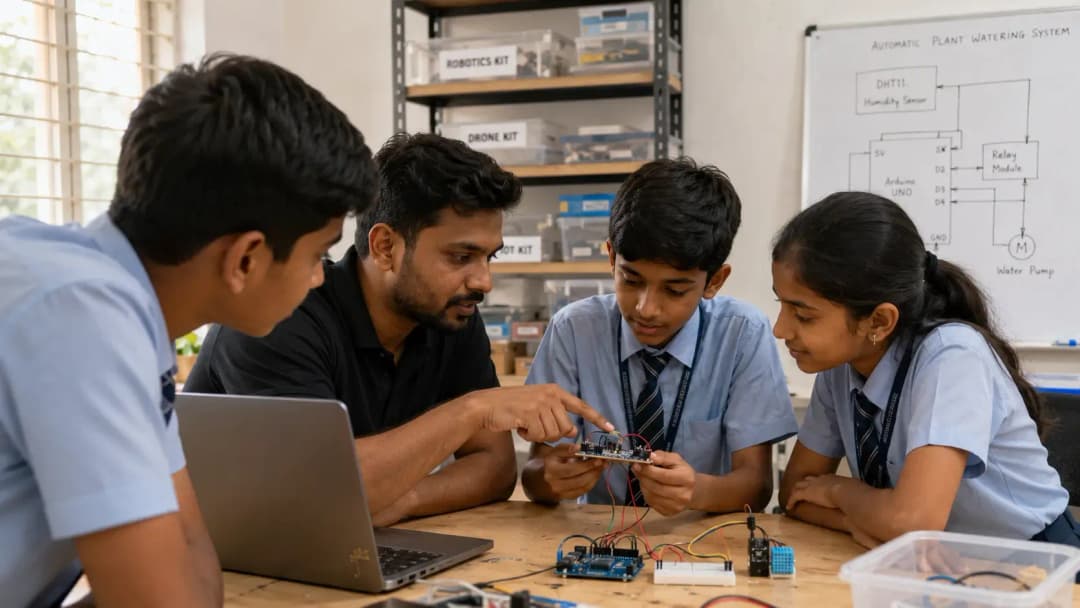
Ask ten principals in Maharashtra what happens in their innovation lab on a Tuesday afternoon, and at least seven of them will pause before answering.
That pause is the problem.
It is not that the lab does not exist. Many of these schools spent ₹15 to 25 lakhs setting one up. The hardware is there. The kits are boxed. The lab has a name and maybe a sign on the door. But the person responsible for making it run - the on-campus lab trainer - is usually someone who was already there, reassigned to a new role they were never trained for.
India faces a shortage of approximately one million qualified teachers, and that gap is most severe in STEM subjects. When the CBSE AI mandate for Class 3 onwards kicks in from 2026-27, that gap becomes a crisis. Schools are scrambling. And most of them are solving it the wrong way.
The Default: Handing the Lab to the Computer Teacher
This is the most common pattern we see. A school invests in an AI or robotics lab. The vendor installs the equipment, runs a 2-day training for the staff, and leaves. The principal looks around and assigns the lab to the computer science teacher because - well, who else?
The computer teacher is usually a capable person. They know their subject. But they were trained to teach MS Office, basic programming, and digital literacy. Asking them to suddenly run sessions on neural networks, autonomous robotics, IoT sensor arrays, or drone flight dynamics is like asking a geography teacher to coach competitive swimming. The subject matter is simply different.
So what actually happens? The lab runs a watered-down version of whatever the teacher is comfortable with. Block coding, mostly. Maybe some basic Python. The kits gather dust because nobody knows how to use them confidently. Within two academic years, the lab quietly becomes a room where the timetable says "Innovation Lab" but the content looks like a slower version of regular computer class.
This is not a failure of the teacher. It is a failure of the model.
What "Settling" Looks Like in Practice
Before we talk about what good looks like, it is worth naming the variations of settling that schools fall into. They come in three forms.
The reassigned teacher. As above - an existing faculty member takes on the lab as an additional responsibility. They are overloaded, undertrained, and unsupported. Lab sessions happen, but without depth. The teacher training problem in STEM education is not new, but it is getting worse as the curriculum requirements grow more demanding.
The outsourced weekend trainer. A vendor or third-party company sends a trainer to the school for a few hours a week. This person has no continuity. They do not know the students' names. They have no visibility into what was covered last week. Each session is effectively a standalone event. Students do not build on each other's work. Projects stay shallow because depth requires knowing where you left off.
The one-time workshop model. Some schools bring in an external company to run a 3-day "AI bootcamp" for students once a term. Students love it. Teachers film reels for social media. The principal adds it to the school prospectus. And then nothing happens for the next three months. It is activity, not education. It produces enthusiasm without capability.
None of these is the same as having a real on-campus lab trainer embedded in the school.
What a Good On-Campus Lab Trainer Actually Does
The role is not teaching in the traditional sense. It is closer to what happens inside an engineering firm - where a senior colleague works alongside junior ones, building something real while transferring knowledge in the process.
Here is what that looks like on the ground.
They run the session, not just the room. A good on-campus trainer arrives with a session plan that connects to what students built last week and sets up what they will tackle next week. They know that a Class 7 batch in a CBSE school in Nashik is currently learning about sensor thresholds in their IoT module, and today's session will extend that into a live humidity monitoring circuit. The lesson is part of a sequence. It goes somewhere.
They know the difference between the curriculum and the kit. Most lab vendors supply kits with a PDF manual. A trained educator reads the manual. An on-campus engineer understands the underlying concepts well enough to explain why the kit works the way it does, troubleshoot it when it breaks, and extend the project beyond the manual's last page. When a student in Class 9 asks why their servo motor is responding erratically, the answer is not "read page 14." The answer is a real explanation of PWM signals, with the student building the fix themselves under guidance.
They adapt to the room. A batch of 28 students is never uniform. Some are three weeks ahead of the curriculum because they experiment at home. Some are struggling with the fundamentals. A good on-campus trainer reads the room - differentiates the project brief on the spot, pairs students strategically, and gives the advanced ones a challenge that keeps them engaged while the rest catch up. This is not something you can outsource to a weekend visitor.
They maintain the lab. Hardware breaks. Sensors stop responding. A drone motor burns out. In schools where the trainer is a visiting freelancer, a broken kit is a broken kit until the next visit. In schools with an embedded on-campus trainer, the hardware is checked before every session, faulty components are flagged and replaced, and the lab is always operational. This matters more than most principals realise - because one cancelled session due to a broken kit becomes two missed sessions becomes a quarter of lost learning.
They connect what students build to what the world needs. The most important thing a good trainer does is not teach robotics or AI as abstract subjects. They make the connection: "This sensor array you are building is the same kind of system that controls air quality monitoring in a smart city. This classification algorithm is how hospital labs flag abnormal test results." That connection is what separates a lab that produces students who love learning from a lab that produces students who passed a module.
A good on-campus lab trainer is not a teacher who knows some robotics. They are a practitioner who knows how to teach.
This distinction sounds small. It is not. It is the reason some labs produce students who go on to win national competitions, build real projects in Class 11, and enter engineering programs with a head start - while other labs produce students who once built a blinking LED circuit in Class 6 and remember it fondly.
The 10 Million Teacher Problem
The government's own data makes this uncomfortable. India needs to train over 10 million teachers to deliver the AI curriculum mandate. That number is not a projection. It is an acknowledgement that the current teaching workforce was not built for what the mandate requires.
Even with NISHTHA training programs and video-based modules, the gap between a "trained" teacher and a capable AI educator remains wide. A 40-hour certification does not make someone equipped to guide a Class 8 student through a machine learning classification model. It gives them a certificate.
This is why the teacher enablement model for AI programs matters so much - and why the right solution is not to keep trying to train existing teachers into something they were not hired to be. The right solution is to bring in people who are already what you need.
For schools with the resources to hire a dedicated STEM specialist, that is one path. But a full-time robotics-and-AI educator commands a salary of ₹35,000 to ₹55,000 per month at a minimum, and the competition for those people is fierce. They get hired by EdTech companies, training institutes, and colleges - not typically by individual schools in Pune or Nagpur or Nashik.
So most schools cannot hire one. And most of the alternatives they settle for - as described above - do not work well enough to justify the lab investment.
Why the Trainer's Background Matters More Than Their Certification
There is a specific detail that does not get discussed enough: where the trainer comes from matters enormously.
A trainer who has worked in an engineering environment, built real systems, debugged real hardware, and shipped real software brings something into the classroom that no amount of pedagogy training can replicate. They bring current knowledge.
The AI curriculum a Class 9 student should be learning in 2026 is not the same AI curriculum that was being taught in 2020. Large language models, agentic systems, computer vision, and embedded AI are not fringe topics anymore. They are the industry. A trainer who was last exposed to the field during their own engineering degree five years ago - and has been teaching ever since - is not equipped to bridge the gap between the classroom and where the technology actually is.
This is why we built the Scaleopal Labs model around on-campus engineers from an active AI engineering company, not former teachers who have been retrained. Our team builds RAG pipelines, LLM fine-tuning systems, and AI automation for enterprise clients. That work does not stop when our engineers walk into a school. It informs every session.
When a Class 10 student asks one of our on-campus engineers what ChatGPT actually does under the hood, they get a real answer. Not a simplified metaphor from a textbook chapter written three years ago.
What Good Looks Like: A Typical Week
Let us make this concrete. Here is what a week looks like when the on-campus trainer model works the way it should, using a composite picture of how our sessions run in partner schools.
Monday: Class 6 IoT session. Students are building a temperature and humidity sensor that logs to a cloud dashboard. The trainer set up the cloud endpoint over the weekend so students spend the session on the hardware and logic, not setup troubleshooting. By the end of the period, every student has a live graph on a shared screen showing their sensor's readings.
Wednesday: Class 9 AI module. The batch is mid-way through a computer vision project - a basic object classifier trained on student-collected images. Two students are ahead and have started testing edge cases. The trainer gives them a prompt to try adversarial inputs. The rest of the batch finishes labelling their dataset and begins training. The session ends with a short group discussion on why training data quality matters.
Friday: Class 11 advanced robotics. Five students are building an autonomous navigation robot for a state-level competition in eight weeks. The trainer reviews the sensor fusion code written since Wednesday, finds a logic error in the obstacle detection routine, and turns it into a teaching moment - debugging as a skill, not a failure. They end the session with a revised component test plan.
Between sessions: The trainer has flagged that two drone kits need a motor replacement before next fortnight's Class 8 session. The order is placed. The lab is ready when the students arrive.
This is what "managed" actually means. Not managed hardware. Managed learning.
The Question to Ask Any Lab Provider
When a school is evaluating an AI and robotics lab setup, the question to ask is not just "what hardware do you provide?" The more important question is: who runs the sessions, and what is their background?
Ask for specifics. Ask whether the trainer is employed directly by the vendor or is a freelancer sourced per school. Ask how many schools they are simultaneously assigned to. Ask whether they have industry experience outside of education. Ask what happens when the trainer is sick or leaves the company.
If the answers are vague, that is the answer.
The right lab partner is not the one with the most impressive kit catalogue. It is the one whose engineer you would trust to run a session in your school on any given Tuesday afternoon - and who would do it just as well in January as they did in June.
Because the lab is only as good as the person who brings it to life every week.
Frequently Asked Questions
What qualifications should a school AI lab trainer have?
A qualified on-campus lab trainer for an AI or robotics lab should have an engineering background in a relevant field - computer science, electronics, or a related discipline - and, ideally, active industry experience. Certifications in specific platforms or curricula help, but they are not a substitute for practical knowledge of the field. The trainer should be able to answer students' questions about real-world applications, not just the lesson plan in front of them.
Can a regular computer science teacher run an AI or robotics lab?
In some cases, with significant additional training and ongoing support, yes. But most computer science teachers in Indian schools were trained for a curriculum that predates modern AI and robotics by several years. Asking them to suddenly run sessions on neural networks, embedded systems, or autonomous robotics without dedicated upskilling is setting both the teacher and the students up to get less than the lab is capable of delivering. The teacher shortage in STEM subjects makes this structural problem harder, not easier, to solve through training alone.
How many schools can one on-campus trainer effectively cover?
This depends on session frequency and travel time, but as a general rule, a trainer assigned to more than two or three schools simultaneously is spread too thin to deliver consistent quality. The value of an on-campus model comes from continuity - the trainer knowing individual students, tracking project progress, and maintaining the lab between sessions. That continuity breaks down when one person is covering five or six schools across a city.
What happens when an on-campus trainer leaves or is unavailable?
This is one of the most important questions a school should ask any lab partner. In a well-run managed lab model, the provider should have a coverage protocol - a backup trainer who is briefed on the curriculum and can step in without the session going dark. The ongoing challenge of school labs going unused often starts with a personnel change that was never properly managed.
Is it better to hire a dedicated in-house lab trainer or use a managed lab partner?
Hiring in-house gives the school maximum control, but qualified candidates are expensive and hard to retain - they are in high demand across the EdTech industry. A managed lab partnership, where the provider employs and manages the trainer, shifts that responsibility off the school. The school gets the continuity and quality of a dedicated trainer without the hiring risk. For most private schools in India that are not operating at the scale of a large school chain, the managed model is significantly more practical. See how the partnership model works for more detail.
What is the difference between a lab trainer and an on-campus engineer?
A lab trainer is typically someone trained to deliver a curriculum - they know the material and can teach it. An on-campus engineer is an active working professional from an engineering or technology company who brings current, real-world expertise into the classroom alongside pedagogical skill. The distinction matters because technology moves fast. An engineer who is actively building AI systems today teaches very differently from someone who last worked in the field five years ago.