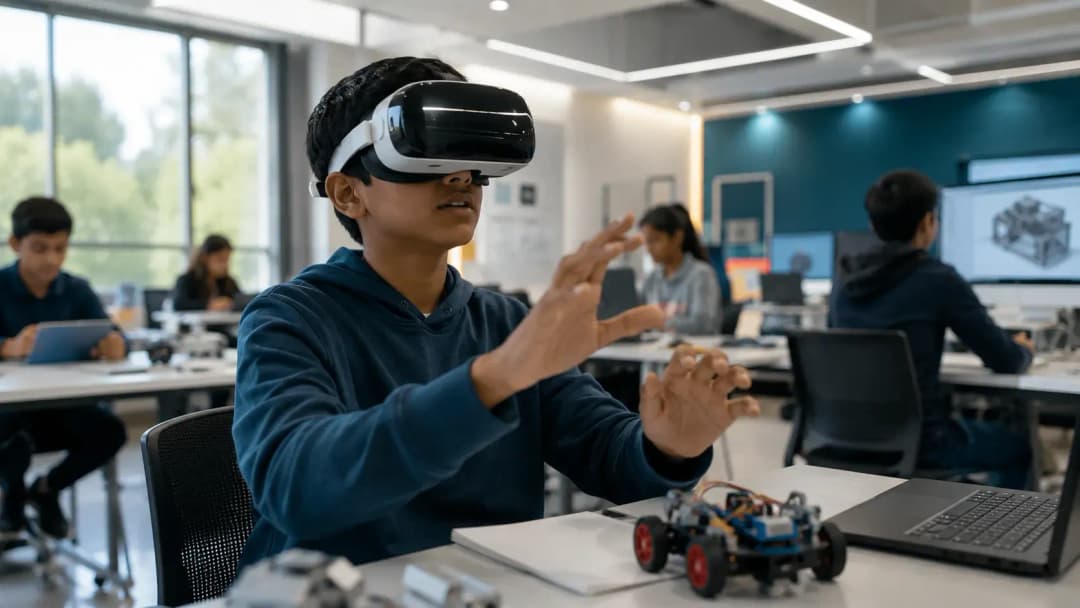
There is a particular kind of photo that every AR/VR lab vendor uses in their brochure.
A student, headset on, arms slightly outstretched, expression of pure wonder on their face. The classroom behind them is bright and clean. The shot is taken on launch day, or close to it. The principal is somewhere nearby, smiling.
Three months later, in a lot of schools, those headsets are sitting in a cupboard.
Not because AR and VR are useless in a classroom. They are not. The research is clear: immersive learning can improve concept retention by over 30% compared to textbook-only instruction, and VR adoption in Indian high schools has grown from under 10% in 2021 to nearly 40% today. But most schools that invest in AR/VR gear never build a working program around it. They get hardware. They do not get a curriculum. They get a demo. They do not get an on-campus engineer who runs sessions every week.
So what does a school AR/VR lab actually look like when it is working? Not on launch day. On a regular Tuesday afternoon in November.
That is what this post is about.
What Most Schools Actually Get When They Set Up an AR/VR Lab
Here is the standard vendor story: pay ₹8 to 15 lakhs upfront, get a set of VR headsets, an AR kit, some pre-loaded content modules, a two-day teacher training session, and a PDF syllabus. The vendor leaves. The computer science teacher (who was not hired to run a VR programme) is now responsible for making it work.
This is not a Scaleopal criticism of competitors. It is just a description of how most school technology contracts operate in India. Hardware procurement plus a brief handover is treated as a complete solution.
But it is not.
The problem is not the technology. VR headsets from major manufacturers are reasonably reliable. AR software for education has improved dramatically. The problem is the layer between the hardware and the student. Who is running the session? What is the student actually doing? What does a Class 7 student in Bengaluru build in their first three months inside an AR/VR lab, and what have they built by Class 10?
Without answers to those questions, the hardware is decoration.
What a Real AR/VR Session Looks Like, Class by Class
Let us get specific. Because specific is the only thing that matters here.
A working AR/VR programme in a K-12 school is not one experience. It is a progression. A Class 5 student and a Class 9 student are not doing the same thing in the lab. What they do should reflect where they are in a 10-year learning arc. Here is what that looks like, roughly:
Class 3 to Class 5: First contact with immersive environments
At this level, the goal is simple: show students that learning is not confined to a textbook. A Class 4 student in Chennai might use an AR application to watch a water cycle animation overlay on their notebook, in real time. Or explore a 3D model of a plant cell that they can rotate and zoom into with their fingers. The technology is mobile-first here (phones or tablets, not headsets) because seven-year-olds and heavy VR headsets are not a good combination, practically or ergonomically.
Sessions at this level are 30 to 40 minutes. They are structured around existing NCERT Science and Maths concepts. The AR content is aligned to what students are already studying. The on-campus engineer runs the session as a guided exploration, not a free-for-all.
Class 6 to Class 8: Building inside the immersive environment
This is where things get more interesting. Students in Class 6 start shifting from consuming 3D content to creating it. A Class 7 cohort in Hyderabad might spend a month learning the basics of 3D environment design: how space, scale, and perspective work differently in virtual environments versus physical ones. By the end of that month, they are building simple virtual rooms: placing objects, setting lighting conditions, and testing how the experience feels from inside the headset.
It is not polished. It should not be. A 12-year-old building a virtual classroom for the first time is going to make something that looks rough. But the decisions they are making (what goes where, what scale feels right, what the user experience is like from inside the environment) are the same design decisions professional XR developers make. Just at a different scale.
And the skills stack. A student who spent Class 6 exploring 3D space is much better positioned in Class 7 to start thinking about narrative inside virtual environments. How do you guide someone through a VR experience? What do you put in their line of sight first?
Class 9 to Class 10: End-to-end project development
By Class 9, a student with three or four years of consistent AR/VR exposure is ready to build something real. Not something that will be shipped to a client tomorrow. But something that solves a real problem, for a real audience, with a real brief.
A Class 10 group in Jaipur might build a virtual science lab experience for Class 6 students at their own school, specifically designed to let younger students run chemistry experiments that are too dangerous to do physically. The project involves 3D modeling, spatial design, content writing, and user testing. It goes through at least two rounds of feedback before the final version is presented.
That is not a STEM activity. That is a product development cycle.
AR vs VR: Which One Belongs in a School, and When?
People treat AR and VR as interchangeable. They are not. Knowing when to use which one matters a lot for schools that want to build programmes that actually run day to day.
Augmented Reality (AR) overlays digital content on the real world. Your phone camera shows you the classroom, and the software puts a 3D butterfly, a molecular model, or a historical monument on top of it. AR works on smartphones and tablets. It is affordable, low-barrier, and easy to integrate into regular class sessions. A Class 5 science lesson on ecosystems can use AR without disrupting the timetable.
But AR has limits. The immersion is partial. The student is still very much in the physical world, looking at a screen. For concepts that need full environmental immersion (deep-sea biology, historical reconstructions, architectural walkthroughs): AR is not enough.
Virtual Reality (VR) puts the student inside a simulated environment completely. With a headset on, a student in Delhi NCR can stand on the surface of Mars, inside a beating heart, or at the edge of the Grand Canyon. The immersion drives deeper emotional connection to the content, and emotional connection is one of the strongest predictors of long-term memory retention.
The trade-off is cost and logistics. Headsets are more expensive than tablets. Sessions need more setup time. Students need to be physically oriented before putting them on. And schools need to think seriously about session duration: extended VR use is not appropriate for children under 9 or 10 years old.
So: AR is your daily curriculum tool. VR is your deep-learning anchor for specific concepts. A good school lab programme uses both, sequenced intentionally, not randomly.
In a well-designed programme, AR handles the breadth, running alongside daily lessons. VR delivers the depth: two to four immersive experiences per term that stick with students for years.
The Three Things That Make or Break an AR/VR Lab
Schools that build successful AR/VR programmes share three things. Schools where the headsets end up in the cupboard are almost always missing one of them.
1. A qualified person running the sessions
This is the single biggest gap in school AR/VR adoption across India. AR and VR tools are not plug-and-play in a classroom. Someone needs to calibrate headsets, manage content, troubleshoot technical issues mid-session, and, more importantly, know enough about the technology to teach it properly. That person is not a Computer Science teacher who attended a two-day training workshop in July.
The reason most school innovation labs go dark within two years is not hardware failure. It is human failure. Not the fault of the teacher; they were set up to fail. The fault is a model that treats the lab as an infrastructure purchase rather than a living programme.
This is why we build on-campus engineers into the Scaleopal Labs model. Not training your existing teachers and leaving. An active professional from our engineering team, stationed at your school, running every session. If there is a technical issue mid-period, it gets fixed in that period. Not in three days when the vendor responds to an email.
2. Curriculum that progresses year over year
Most AR/VR content for schools in India is topic-based. Students explore the solar system. Students walk through a historical site. Students watch a biology simulation. These are fine experiences. But they are individual lessons, not a curriculum.
A real curriculum has a spine. Class 5 builds toward Class 6. Class 6 builds toward Class 7. By Class 10, a student who has been in the programme since Class 5 has five years of progressive skill development: from 3D exploration to environment design, to project-based VR development. The breadth of what they have built is visible and verifiable.
Without that spine, schools end up with a collection of interesting one-off sessions. And interesting one-off sessions do not build the skills that university admissions officers, engineering colleges, or future employers are looking for.
3. Integration with the rest of the school's innovation programme
AR and VR do not exist in isolation. Inside Scaleopal Labs' Cognitive AI and Advanced Robotics tier, immersive tech is one of seven curriculum domains. Students who are learning to build 3D virtual environments also understand how sensors work, because they have been building IoT projects in the same lab. Students who design AR experiences in Class 8 have already been thinking about user interaction since Class 6, when they first started working with robotics and basic automation.
The schools that get the most out of AR/VR are the ones where it connects upward and sideward. Upward into a progression arc. Sideward into the broader innovation ecosystem.
This is also what makes the drone lab and IoT lab experiences so much richer when they exist in the same space, and students bring spatial thinking and 3D reasoning from their AR/VR work into everything else they build.
The Honest Conversation About Hardware
We should say this plainly because not enough vendors do.
High-end VR headsets are expensive. A set of quality headsets for a school cohort of 25 to 30 students, with replacement parts and warranty coverage, is a significant investment. Schools that buy them outright are making a ₹5 to 10 lakh hardware commitment that will depreciate over three to four years, with no guarantee of utilisation.
This is exactly why the zero-cost lab model matters for AR/VR specifically. When Scaleopal deploys an immersive tech lab, the school does not purchase the hardware. We bring it, maintain it, and upgrade it as part of the operating partnership. When headset technology improves (and it will, significantly, over the next five years) the school does not carry the cost of replacement.
Schools that lock themselves into a hardware purchase in 2026 may find themselves running 2026 equipment in 2030. Schools in a Lab-as-a-Service model get the equipment refresh as standard. No additional outlay. No depreciation risk.
How AR/VR Fits Into the Larger Innovation Lab Picture
Here is something worth saying directly: AR/VR alone is not a complete school innovation programme. It is one domain in a broader ecosystem.
The students who benefit most from immersive technology are the ones who also understand physical systems. A student who has spent two years building robots understands physical space intuitively. When they move into VR environment design, they bring that spatial reasoning with them. A student who has been building IoT sensors understands how the physical world generates data. When they build AR overlays that display real-time sensor data, the concept clicks immediately because they understand both ends.
This is the logic behind a multi-domain lab structure. AR/VR is most powerful not as a standalone experience, but as a layer inside a richer learning environment that includes AI and coding, robotics, and electronics.
The schools that get this right do not say "we are setting up an AR/VR lab." They say "we are building an innovation programme, and immersive tech is one part of it."
That is a very different conversation. And it leads to very different student outcomes.
Frequently Asked Questions
What is the difference between an AR lab and a VR lab for schools?
AR (Augmented Reality) overlays digital content onto the real world through smartphones or tablets. VR (Virtual Reality) places students inside a completely simulated environment using headsets. AR is better for daily curriculum integration; VR is better for deep, immersive learning experiences. A good school programme uses both, at appropriate class levels and for appropriate subjects.
At what class level should a school introduce AR/VR?
AR can be introduced from Class 3 onward using mobile devices, aligned with existing Science and Maths content. VR headsets are better suited from Class 6 upward, when students can engage with immersive environments more meaningfully and sustain longer focused sessions. Schools introducing headsets to Class 3 students often see management challenges and limited learning payoff.
How much does it cost to set up an AR/VR lab in a school in India?
A self-funded AR/VR lab with quality headsets and software for a class of 25 to 30 students typically costs ₹5 to 12 lakhs, depending on equipment grade, content licences, and infrastructure. Under a Lab-as-a-Service model like Scaleopal's, the school pays ₹0 in setup costs; the hardware, software, and on-campus engineer are included in the operating partnership.
Do teachers need special training to run an AR/VR lab?
In most school setups, yes; and that is precisely where most schools struggle. Running immersive tech sessions well requires technical confidence and content knowledge that standard teacher training does not provide. In Scaleopal's model, a professional on-campus engineer runs all lab sessions. Your teachers are not expected to become AR/VR experts overnight.
Is AR/VR part of the NEP 2020 curriculum?
CBSE introduced AR/VR as a skill module for Classes 6 to 8 in the academic year 2022-23. Under NEP 2020, schools are encouraged to include experiential and immersive learning as part of the broader push away from rote-only education. A well-structured AR/VR programme supports NEP compliance and goes well beyond it.
How long before students start building things in a school AR/VR lab?
In a programme structured for progression, students from Class 6 onward start creating simple 3D environments within the first two terms. By Class 8, most students are working on full project briefs, designing immersive experiences for a specific audience and purpose. The key is a curriculum with a clear spine, not a collection of individual content modules.