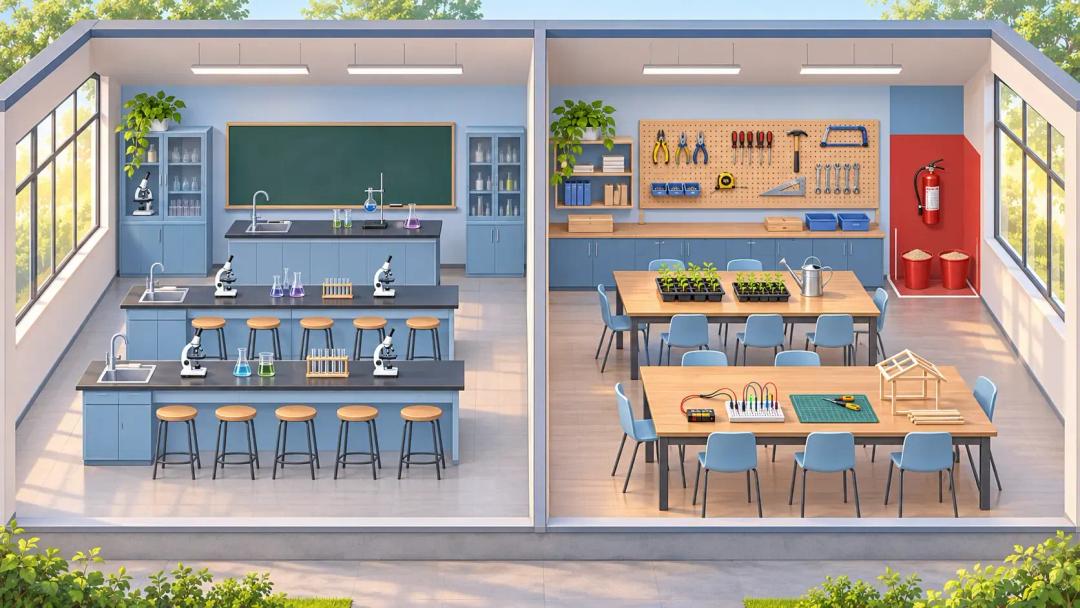
The composite science lab vs composite skill lab question tends to arrive the same way. A principal opens the school's infrastructure list, finds a 600 sq ft room already marked "Composite Science Lab", then reads CBSE's Composite Skill Lab circular and spots another 600 sq ft requirement. Surely one room can cover both?
It's a fair thought. It's also a risky one. Nobody at CBSE has said yes, and the two rooms are built for very different work. Here is what the documents actually say, where the gaps are, and how we would plan around them.
Is a Composite Science Lab the same as a Composite Skill Lab?
No. They come from different documents, serve different purposes, and sit in different parts of your affiliation paperwork.
The Composite Science Lab has been part of CBSE's affiliation norms for several years. It has its own Standard Operating Procedure, and the school disclosure form marks it as mandatory at both the secondary and senior secondary level. Its job is science practicals: observing, experimenting, measuring, recording.
The Composite Skill Lab is newer. CBSE introduced it through Circular Skill-75/2024 and reinforced it with Circular Skill-13/2026 on 20 March 2026. Schools can set up one 600 sq ft lab for Classes VI to XII, or two 400 sq ft labs, one for Classes VI to X and one for XI to XII. Already-affiliated schools have until 22 August 2027. Its job is practical skill education across three forms of work: life forms, machines and materials, and human services. Our page on Composite Skill Lab setup for CBSE schools walks through the full requirement.
The confusion is understandable. Both rooms are called "composite", both mention 600 sq ft, and some vendor pages use the two phrases almost interchangeably. But the overlap ends at the name and the floor area.
What does CBSE's Composite Science Lab SOP actually require?
Think of it as a room built around water, flame, glass and chemicals. For a batch of 40 students, the SOP asks for:
- A minimum room size of 600 sq ft, with 40 lab stools
- A demonstration table with its own sink, plus 8 sinks with water supply for students
- Two exhaust fans and two first aid kits
- A heating facility, with a gas pipeline and 2 burners preferred
- Lockable storage for consumables and non-consumables
- Around 10 assembled microscopes and 80 permanent slides
- A chemicals list that includes dilute and concentrated hydrochloric acid, copper sulphate and sodium hydroxide pellets
- Safety provisions such as two wide exit doors, a fume hood, goggles and gloves
Read that list again and picture the room. Students sit at allotted stools, face a demonstration table, and repeat the same experiment together. That is exactly what a good science lab should be.
What does a Composite Skill Lab need instead?
CBSE's Composite Skill Lab guidelines booklet describes a very different space. It plans for a batch of 25 to 40 students working in small groups, not sitting in rows. Among its requirements:
- Windows and exhaust fans, plus at least two clear walls for peg boards and displays
- A mix of 15-ampere and 5-ampere sockets, preferably on every wall, to run machines and tools
- Concrete flooring or rubber mats, with a warning against vitrified tiles and stone because heavy tools wear them down
- Sturdy work tables, 5 or 6 feet by 4 feet, that groups of students can gather around
- A sink only if the chosen skill subjects need running water
- A safety corner with a 2 kg CO2 fire extinguisher, two sand buckets and a first aid box
- A modular layout that can change as the school changes its skill subjects
Then comes the equipment. CBSE's tool lists run from bench vises, hacksaws and hand grinders to soldering kits, soil test kits and CPR mannequins. Which of those your school needs depends on the six skill subjects you pick across the three forms of work. Our guide to CBSE's 13 Composite Skill Lab sectors explains how to choose them.
CBSE itself puts the cost of setting up a Composite Skill Lab at about ₹3 to 6 lakh, depending on subjects, room size and furniture. It calls that figure only suggestive.
Composite science lab vs composite skill lab: where the two rooms actually differ
Side by side, the contrast is hard to miss.
- Purpose: The science lab runs experiments. The skill lab runs projects across three forms of work.
- Source: The science lab sits under CBSE's affiliation SOPs. The skill lab comes from Circulars Skill-75/2024 and Skill-13/2026.
- Water and fixtures: The science lab expects a demonstration sink, 8 student sinks and a preferred gas line. The skill lab asks for a sink only where the skill subjects call for one.
- Floor and power: The skill lab wants concrete or rubber flooring and sockets on every wall. The science SOP does not specify either.
- Seating: Science works at 40 fixed stools. Skill work happens at group tables for 25 to 40 students.
- Hazards: Chemicals, open flame and glass in one room. Sharp tools, dust, soldering and electrical load in the other.
- Time on the timetable: In the middle stage, CBSE's booklet shows 160 hours a year for Science and 110 for Vocational Education. Both need a room that is free at the right time.
Can one 600 sq ft room serve as both?
Here is the honest answer: CBSE hasn't said.
We read both documents closely. Nothing in them says a Composite Science Lab can be counted as a Composite Skill Lab. And nothing says it can't. The booklet does include a section on using existing spaces, and it names the garden, the Atal Tinkering Lab, the IT lab, the makers space, the Home Science lab and single-sector skill labs. The Composite Science Lab isn't on that list.
Silence isn't permission. So we would plan for two rooms.
Picture a CBSE school with 900 students (an illustrative example, not a client). It has a 640 sq ft science lab that runs a full timetable from Monday to Saturday, and an unused 620 sq ft hall on the ground floor. The hall is the Composite Skill Lab candidate. The science lab stays a science lab.
Here is why we lean that way:
First, the fittings pull in opposite directions. A room built for 40 fixed stools, 8 sinks and a gas line can't also host 6-foot work tables, bench vises and sockets on every wall without losing something.
Second, the timetable. Both rooms need to be open for the same set of sections during the same school week. One room means one class at a time.
Third, the inspection. Whoever checks your science lab will check it against its SOP. Burners, microscope sets and chemical storage need to sit where the SOP expects them. A soldering station and a carpentry bench in the middle of that makes for an awkward conversation.
None of this is CBSE's ruling. It is our reading, as a team that plans these labs with schools. So before you decide, write to your CBSE regional office and get the answer on file. A written reply beats a vendor's assurance every time.
And what if the reply says no in June 2027, two months before the deadline? Then you have lost the one resource you can't buy back: time.
Which of your existing labs can you build on?
The booklet is clear that the Composite Skill Lab requirement remains even when a school uses its existing spaces. It does, however, recognise that some of them can carry part of the load:
- An open garden can host agriculture and gardening activities, though the tools still need housing in the lab
- An Atal Tinkering Lab can deliver electronics or mechatronics, but it can't be converted into a Composite Skill Lab
- An IT lab can run coding, AI, finance or design subjects, but it can't be converted either
- A Home Science lab can support food production if equipped, but it can't be converted
- A makers space is the closest match and can be converted if it meets the specifications
We have covered the Atal Tinkering Lab question in detail in Atal Tinkering Lab vs Composite Skill Lab, and the IT and AI lab question in Does Your Existing AI Lab Already Count as Your CBSE Composite Skill Lab?. If an AI lab is already part of your plan, our page on AI labs for CBSE schools shows how the two fit together.
What should you check before 22 August 2027?
Start with a floor plan and a pen. Then work through these steps:
- List every room of 600 sq ft or more in your affiliation disclosure, and mark which one is the Composite Science Lab
- Find a separate room with windows, exhaust fans, a hard floor, decent electrical load and, ideally, water access
- Write to your CBSE regional office about sharing a room, and keep the reply on file
- Choose six skill subjects across the three forms of work, based on your locality and what you can staff
- Budget against CBSE's ₹3 to 6 lakh guide figure, then compare it with real quotes using our Composite Skill Lab cost and ROI page
- Work backwards from the deadline with our Composite Skill Lab compliance checklist
Opening a brand new school, or applying for fresh affiliation? The timeline is tighter, and we explain why in New CBSE School? You Can't Get Affiliated Without a Composite Skill Lab Anymore.
If the room is the easy part and everything inside it isn't, that's where we come in. Our Composite Skill Lab programme for Classes 6 to 10 brings the curriculum, agreed equipment and project kits, safety provisions and initial teacher training. Room setup and a dedicated trainer are separately scoped. You can read how Scaleopal Labs works with schools, or talk to our team. And if you are still weighing a skill lab against an AI lab, our Composite Skill Lab vs AI Lab comparison will save you a meeting.
Frequently Asked Questions
Is a Composite Science Lab mandatory for CBSE schools?
Yes. CBSE's school disclosure form marks the Composite Science Lab as mandatory for both secondary and senior secondary schools. It has its own SOP, separate from the Composite Skill Lab guidelines.
Can I use my science lab as a Composite Skill Lab?
CBSE has not said you can. Neither the Composite Skill Lab circular nor the guidelines booklet lists the Composite Science Lab among the existing spaces a school may use. Ask your regional office in writing before you plan around it.
Do both labs need to be 600 sq ft?
The Composite Science Lab SOP sets a minimum of 600 sq ft. The Composite Skill Lab can be one 600 sq ft room for Classes VI to XII, or two 400 sq ft rooms, one for Classes VI to X and one for XI to XII.
Can an Atal Tinkering Lab or IT lab become a Composite Skill Lab?
No. CBSE's booklet says neither can be converted, though both can deliver some skill subjects. A makers space is the one existing lab it says may be converted, provided it meets the specifications.
How much does a Composite Skill Lab cost?
CBSE's booklet suggests about ₹3 to 6 lakh, depending on skill subjects, room size and furniture. It describes the figure as only indicative. Our Composite Skill Lab cost and ROI page breaks down what drives it.
One last look at that floor plan
Go back to the principal with two 600 sq ft rooms on one sheet of paper. The sensible move isn't to hope one tick covers both. It is to treat the Composite Science Lab as what it is, a science room, and find the second space for skill education while there are still nine months to do it.
The deadline is fixed. The room question can be settled this month. And if you would like a second pair of eyes on your floor plan, we are happy to look at it with you.