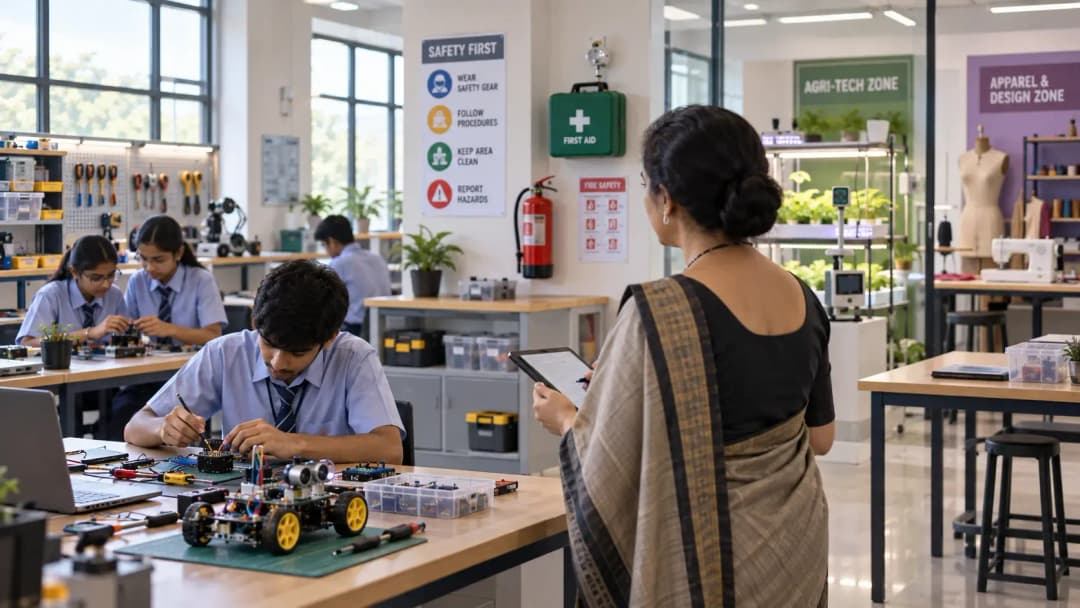
Ask ten CBSE principals whether their school has a Composite Skill Lab, and most will say yes. Ask them whether it would pass an actual review against CBSE's own guidelines, and the confidence usually drops.
That gap matters more with each passing month. CBSE's affiliated schools have until 22 August 2027 to establish a compliant lab, a deadline the board reiterated again through its Skill-13/2026 circular, and we've covered the full mandate and timeline here. New applicants seeking fresh CBSE affiliation face an even tighter bar, since their lab has to be compliant before affiliation is granted at all. But the deadline is only half the story. CBSE has also published a detailed guidelines document for setting up these labs, and it goes well beyond "buy some equipment and put it in a room." It checks space, sector spread, safety, AI integration, and paperwork, separately.
Here is what each of those categories actually requires, and where most schools are quietly falling short.
Space and Infrastructure: The Exact Numbers CBSE Specifies
This part is usually done correctly, because it is the easiest to measure. CBSE requires either one composite lab of 600 sq. ft. covering Classes 6 to 12, or two separate labs of 400 sq. ft. each, one for Classes 6 to 10 and one for Classes 11 and 12.
But the number on a floor plan is not the whole requirement. The space also needs to be well-ventilated, with adequate electrical points for the equipment being used and reliable network connectivity, since several of the mandated sectors now assume some level of digital or AI-linked work. A converted storeroom with two power sockets technically has 400 square feet in it. It does not meet the spirit, or in some cases the letter, of what CBSE is asking for.
Sector Coverage: Why One Sector Is Never Enough
Here is where a surprising number of schools trip up. CBSE's guidelines are explicit that a Composite Skill Lab has to span what the board calls the three "forms of work": Work with Life Forms, Work with Machines and Materials, and Work on Providing Human Services. A lab built entirely around robotics kits, however impressive, sits inside just one of those three categories.
A school in Pune that has invested heavily in a robotics corner as part of an AI and robotics lab setup but has nothing covering agriculture, healthcare, or human-services-oriented skills has a strong single-sector setup, not a compliant composite one. CBSE's sector list spans Electronics, Healthcare, Agriculture, Apparel, Food Production, IT/ITeS, Artificial Intelligence, and Media and Entertainment, among others. The lab does not need every sector under one roof. But it does need genuine coverage across all three forms of work, not depth in one and absence everywhere else.
Safety: The Section Most Schools Treat as an Afterthought
CBSE's guidelines devote an entire section to safety, and it is far more specific than a fire extinguisher and a first-aid box. It covers safety tools appropriate to the equipment in use, a dedicated safety corner in the lab itself, visible safety posters and instructional visuals, scheduled safety drills, and safety provisions that are meant to be built in at the time of installation, not added afterward as a compliance patch.
That last point is worth sitting with. Retrofitting safety measures onto an already-installed lab is possible, but it is rarely done well. A wiring layout designed with safety in mind from day one looks nothing like one where trunking and cutoffs get bolted on after an inspection flags a gap.
If your safety plan exists only as a document in the principal's office and not as something visible on the lab wall, it will not survive a real walk-through.
AI Integration: Not Optional, Not a Separate Box
CBSE's guidelines give artificial intelligence its own dedicated section, distinct from the sector list. That is a signal worth reading correctly. AI is not meant to sit in its own corner as a standalone module. It is meant to be woven through how the lab teaches across sectors, whether that is using AI tools to analyse agriculture data, running computer vision projects inside electronics, or applying basic machine learning concepts to a human-services project.
Schools that treat AI as a separate 45-minute period, disconnected from everything else happening in the lab, are technically offering it. They are not integrating it the way CBSE's guidelines actually describe.
The Paperwork Layer: OASIS and Documentation Gaps
A compliant physical lab still needs to be reflected correctly in CBSE's records. Schools introducing skill subjects or modules are expected to report the details through CBSE's OASIS portal, covering which subjects and modules are being offered at which class levels. This is the part that tends to lag furthest behind the physical build, because it sits with the administrative office rather than whoever oversaw the lab construction.
So a school can have a genuinely strong lab on the ground and still show up as non-compliant on paper, simply because the OASIS filing was never updated after the last equipment addition. And a reviewer working from CBSE's own records will trust the filing before they trust a walk-through.
The Composite Skill Lab Compliance Checklist
Pull all five categories together, and here is what to physically verify on your own campus before anyone else does.
- Measure your lab space against the exact 600 sq. ft. single-lab or 400 sq. ft. dual-lab requirement, not an approximate figure
- Confirm ventilation, electrical point capacity, and network connectivity match what the equipment in the lab actually needs
- Map your current sectors against all three forms of work: Life Forms, Machines and Materials, and Human Services, not just the sector you invested in first
- Walk the lab and physically locate the safety corner, the safety posters, and the safety tools relevant to your equipment
- Confirm safety drills are actually scheduled and run, not just written into a policy document
- Check whether AI concepts appear across multiple sector activities, or only inside one isolated module
- Cross-check your OASIS portal filings against what is physically running in the lab today
- Assign one person, not a committee, to own compliance across all five categories going forward
None of these individually take long to check. But most schools have never walked through all five in one sitting, which is exactly why gaps survive year after year.
Frequently Asked Questions
What is the minimum space required for a CBSE Composite Skill Lab?
CBSE requires either one composite lab of 600 sq. ft. for Classes 6 to 12, or two separate labs of 400 sq. ft. each, split between Classes 6 to 10 and Classes 11 to 12. The space also needs adequate ventilation, electrical points, and network connectivity.
Does a Composite Skill Lab need to cover every CBSE skill sector?
No. It needs genuine coverage across all three "forms of work" that CBSE defines, Work with Life Forms, Work with Machines and Materials, and Work on Providing Human Services, but schools can choose which specific sectors within each category best fit their students and local context.
What safety measures does CBSE actually require in a Composite Skill Lab?
CBSE's guidelines call for dedicated safety tools matched to the equipment in use, a visible safety corner within the lab, safety posters and instructional visuals, scheduled safety drills, and safety provisions built in at the time of installation rather than added afterward.
Is AI a separate requirement from the Composite Skill Lab sectors?
Not exactly. CBSE's guidelines give AI its own dedicated section, but the intent is for AI concepts to be integrated across sector activities, not delivered as an isolated standalone module disconnected from the rest of the lab.
What happens if our lab is physically ready but not reflected in OASIS?
Administrative records matter as much as the physical build during a compliance review. Schools should ensure their OASIS filings for skill subjects and modules are updated whenever the lab's offerings change, since a review will often start from those records before a physical walk-through happens.
Do we need to complete all of this before the 2027 deadline, or can it be phased?
Existing CBSE-affiliated schools have until 22 August 2027 to establish a compliant lab, which does allow for phased progress. But new affiliation applicants need a fully compliant lab before affiliation is even granted, so the phasing option only exists for schools that are already affiliated.
Where Most Schools Actually Stand
Most of the CBSE schools we talk to have made real progress on at least one or two of these five categories, usually space and one strong sector. Almost none have all five locked down at the same time, and that is the actual bar CBSE's guidelines set.
This is also exactly where we've seen the teacher-training gap compound the compliance gap. A school can build the room and buy the equipment, but without someone on campus who understands sector spread, safety protocol, and AI integration well enough to run all three consistently, compliance drifts within a year of the ribbon-cutting. We've written separately about what changes in how skill subjects get assessed from 2026-27, which raises the stakes on getting this right even further.
If you would rather walk through your own lab against this checklist with someone who builds these for a living, or want to see how a 10-year curriculum built across these sectors actually looks in practice, that conversation is worth having now, while there is still runway before the 2027 deadline, not six months before it.