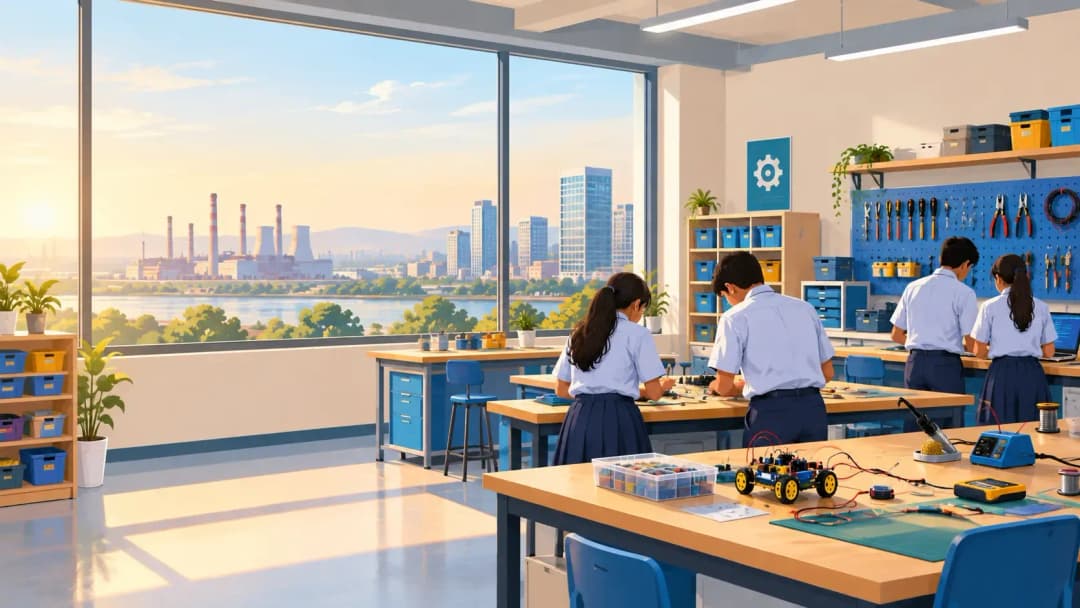
Picture two CBSE principals in Pune. One runs a school in Chakan, a short drive from the auto plants. The other runs a school near Kharadi, where banks and fintech firms keep their offices. Both open the same CBSE booklet on Composite Skill Labs, and both read the same advice: choose skill subjects that suit your local context.
So they should end up with different labs. Most schools won't. A composite skill lab for CBSE schools in Pune should never be a copy-paste job, yet the easy path is to copy whatever the school down the road installed. That is how a Chakan school ends up with a beauty corner and a Kharadi school ends up with a hydraulic car ramp.
Does a CBSE School in Pune Have to Set Up a Composite Skill Lab, and by When?
Yes, if it is already affiliated. CBSE's Circular Skill-75/2024, dated 23 August 2024, told affiliated schools to set up a lab with all necessary equipment, and the three-year window closes on 22 August 2027. Schools applying for fresh affiliation need one from day one, as we explained in our post on new CBSE affiliation. CBSE followed up on 20 March 2026 with Circular Skill-13/2026, titled Guidelines for Establishment of Composite Skill Labs, and we covered what changed.
The crowd matters here. Pune district has 354 CBSE-affiliated schools, according to RAYSolute's count from the CBSE affiliation list. That is 354 principals reading the same booklet and shopping for the same rooms, tools and trainers in the same ten months. Our month-by-month deadline plan covers the calendar. This post covers what the calendar skips: what goes inside the room, and why it should differ from school to school.
How Many Skill Subjects Does a Pune School Need, and Who Decides?
The school decides. CBSE's guidelines say the lab should be able to deliver six skill subjects over two years, covering all three forms of work: life forms, machines and materials, and human services. Schools also need to fit 110 hours of skill education a year into the timetable for Classes 6 to 10.
The booklet gives three tests for choosing those subjects:
- Local context: what do the jobs and businesses around your school actually look like?
- Resources: can you get the tools, raw materials and a qualified trainer for this subject?
- Workplace access: can students visit, shadow or hear from a real employer nearby?
Schools tend to skip the third test. It is the one that matters most. The booklet expects students to see real workplaces, and it names local industries, service centres and software companies as places for internships. A skill subject with no employer within reach is a hobby, not a skill subject.
On the resources test, CBSE is realistic. It accepts that many schools will not have a trained vocational teacher, so locally experienced resource trainers can teach while regular teachers coordinate. We looked at the staffing side in our post on the CSL teacher training gap.
Which CSL Sectors Make Sense for Pune Schools?
Pune hands principals unusually good local evidence. Use it. Here is how we would map CBSE's sector list to the city's economy; for the full list of 13 sectors, see our sector guide.
- Automotive and Electronics/Mechatronics, for schools near Chakan, Talegaon and Pimpri-Chinchwad. A 2022 Business Today report counted around 750 auto manufacturing units in the Chakan cluster, employing close to 250,000 people. In July 2026, Sona Comstar and Tata STRIVE opened a joint skills centre in Chakan covering EV training, CNC operations and electrical maintenance. That is a clear signal of what local employers want, and our EV lab guide shows how schools can teach it.
- IT/ITeS, for schools within reach of Hinjewadi. Hinjewadi is Pune's largest IT corridor, with 300-plus companies. CBSE says an existing IT lab with at least 20 working computers can deliver these subjects, which we unpack in our post on existing labs and CSL compliance.
- BFSI, for schools on the Kharadi side. By the same count, Kharadi has around 150 companies, skewing fintech and product. CBSE's booklet says this sector needs no special tools, just computers or smartphones, which makes it the cheapest subject on the list. We wrote about it in our entrepreneurship and financial literacy post.
- Healthcare. Taggd's 2026 report lists the Pune Biotech Park and the Maharashtra Medical Devices Park among the investments reshaping the city's job market. CBSE's healthcare tool list is modest: a blood pressure machine, a pulse oximeter, a glucometer and a CPR mannequin.
- Life-forms subjects (Agriculture and Gardening, or Food Production). We found no reliable Pune-wide data to guide this choice, so let the campus decide. CBSE prefers the lab near an open area for gardening, and a Home Science lab can deliver Food Production if it has the equipment.
One rule of thumb: pick two subjects per form of work, and be able to name an employer, a visit and a trainer for each. If you cannot, pick again.
To make that concrete, here is one possible six for a school near the auto belt: Agriculture and Gardening and Food Production for life forms; Automotive and Electronics/Mechatronics for machines and materials; Healthcare and Retail for human services. A school near Kharadi might keep the life-forms pair, put IT/ITeS beside Electronics/Mechatronics, and choose BFSI and Retail for human services. Both lists are valid, and neither is the only answer.
What Space Does a Composite Skill Lab Need?
The room test is stricter than it looks. CBSE wants one room of at least 600 sq ft for Classes 6 to 12, or two rooms of at least 400 sq ft, one for Classes 6 to 10 and one for Classes 11 and 12. Its sample lab measures 30 ft by 20 ft and is sized for batches of 25 to 40 students. Then come the details principals tend to discover late. Two clear walls for pegboards. Windows and exhaust fans. Wiring with both 15-ampere and 5-ampere sockets. A sink with drainage if your subjects need running water. And concrete or rubber-matted flooring, since the booklet warns that vitrified tiles and stone may not endure heavy tools. Safety adds two wide exit doors and fire extinguishers near the lab.
Schools that already have labs get a surprise. CBSE says an Atal Tinkering Lab and an IT lab cannot be converted into a CSL, though both can deliver some subjects, and a Makers Space can be converted if it meets the specifications. Our post on ATL versus CSL goes deeper.
So where does the room come from? In a school where every square foot already has a timetable, that is usually the real question, not the equipment.
What Does a Composite Skill Lab Cost, and How Long Does It Take?
CBSE's own suggestive estimate is about ₹3-6 lakh, depending on the subjects chosen, the size of the lab and the furniture. The tool lists are written for a class of 40, so bigger batches need more. The booklet also lists AI-ready machines in a separate section (three to five desktops or laptops with 16 GB of RAM and 1 TB of storage), so ask every quote whether they are in or out.
If upfront cost is what worries your trustees, we wrote about meeting the requirement without large upfront CapEx. Our financial model shows how a Lab-as-a-Service partnership can pay the school back instead of draining it.
Time is the part with no flexibility. From today to 22 August 2027, a Pune school has about ten months. Work backwards in three steps: lock the six subjects, lock the room, then install, train and run a first batch before the academic year ends. Our deadline plan puts dates against each step.
Frequently Asked Questions About Composite Skill Labs in Pune
How big does a composite skill lab need to be?
One room of at least 600 sq ft for Classes 6 to 12, or two rooms of at least 400 sq ft. CBSE's sample lab is 30 ft by 20 ft and suits batches of 25 to 40 students.
Can my Atal Tinkering Lab or IT lab count as the CSL?
No. CBSE says neither can be converted into a Composite Skill Lab, though both can deliver some skill subjects, such as electronics or IT. A Makers Space can be converted if it meets the specifications.
Which skill subjects should a Pune school choose?
Choose six across the three forms of work, guided by local context, available resources and nearby employers. In practice that points schools near Chakan toward automotive and electronics, schools near Hinjewadi toward IT, and schools near Kharadi toward BFSI.
How much does a composite skill lab cost?
CBSE's suggestive estimate is about ₹3-6 lakh, depending on subjects, room size and furniture. The AI-ready machines it recommends are listed separately, so confirm whether a quote includes them.
Do CBSE schools outside Pune city have to comply too?
Yes. The mandate applies to every CBSE-affiliated school, including the schools across Pune district. Distance from the city does not change the 22 August 2027 deadline.
Start With the Map, Not the Catalogue
Go back to our two principals. The Chakan principal walks into a lab with electronics benches, an automotive corner and the name of someone at a local plant to call about visits. The Kharadi principal's lab is mostly screens and a finance project, and it costs far less. Same booklet. Different labs. Both compliant, both useful.
That is the whole idea. Start from the employers around your school, then work back to the six subjects, the room and the budget. If you want a second pair of eyes on your sectors and your space, start the conversation, or see how the model works first.