A Class 9 student in a CBSE school somewhere in Maharashtra sits through one hour of theory on Generative AI. She learns what a GAN is. She plays a quick game guessing which images are AI-generated and which are real. She gets a completion certificate. Then the syllabus moves on to data literacy and ethics, and Generative AI does not come up again until university, if it comes up at all.
That is not a criticism of CBSE. The Class 9 AI subject, Code 417, was a genuine step forward when it introduced Generative AI as a formal topic. Most school syllabi in this country still do not mention it at all. But one theory hour, however well designed, was never going to be enough. Not for a technology that is already rewriting how software gets built, how research gets done, and how work itself gets organised.
So here is the real question for academic directors and curriculum heads right now. If Generative AI already needs more room than one hour, what happens when Agentic AI, the next layer up, becomes just as unavoidable? Because it already is.
What CBSE's Generative AI Unit Actually Covers (And Where It Stops)
The Class 9 AI curriculum gives students a conceptual introduction. They learn the difference between discriminative and generative models. They hear terms like GANs, VAEs, and RNNs at a definitional level. They complete a practical file with roughly fifteen small programs, mostly built in gamified, block-based environments like CodeCombat that strip out the intimidation of raw syntax.
This is useful. It is just not sufficient on its own, and the gap is structural, not a matter of teaching quality.
- It is theoretical, not applied. Students learn what Generative AI is. They rarely build anything that uses it to solve an actual problem.
- It stops at generation. The syllabus covers models that create content. It does not touch what happens when an AI system starts taking actions on its own, which is exactly where the industry has moved.
- It is a single-year touchpoint. One unit in Class 9, then nothing formal until college. No reinforcement, no progression, no compounding skill.
Ask any school running a computer lab today and you will hear a version of the same complaint: the syllabus is a checklist, not a skill. Students tick the box, pass the practical file, and walk away with vocabulary instead of capability.
Generative AI vs Agentic AI: The Distinction Most School Syllabi Skip Entirely
Here is the part almost no Indian school curriculum addresses yet, and it matters more than the Generative AI unit itself.
Generative AI creates. Give it a prompt, and it produces text, an image, code, a summary. It is reactive. It waits for you to ask.
Agentic AI acts. It plans a sequence of steps, calls tools and APIs, checks its own output, and adjusts course without a human approving every move. It is the difference between asking an AI to draft an email and asking an AI to research a topic, draft the email, check three sources for accuracy, and schedule the send, entirely on its own.
This is not a distant, futuristic distinction. Our parent company builds these systems for enterprise clients right now, orchestrating multi-agent workflows, retrieval pipelines, and autonomous task execution for companies who need real production systems, not classroom demos. When we say the industry has moved past static Generative AI use cases into agentic workflows, we are describing our own engineering team's daily work, not a trend we read about.
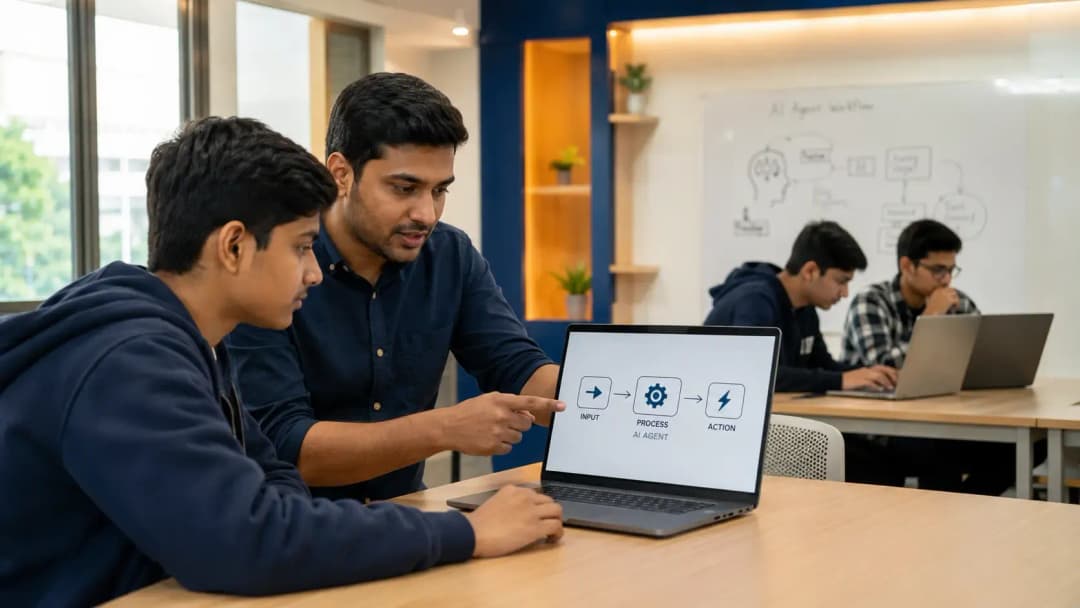
And that is precisely the gap. A student who finishes Class 9 knowing what a GAN is has vocabulary. A student who has actually built even a simple agent, one that reads a data file, makes a decision, and takes an action, has a mental model that transfers to almost anything they do next, in any field.
What a Real Ten-Year Progression Looks Like
A single unit cannot fix this. A pathway can. Here is roughly how it should be structured across Class 1 to 12, and how we have built it into our own curriculum.
Class 1 to 4: Logic before language. No code yet. Sequencing, pattern recognition, if-then reasoning through physical and visual activities. This is the foundation everything else sits on.
Class 5 to 8: Building blocks. Block-based coding gives way to real logic structures. Students start working with simple sensors and data, understanding inputs and outputs, and get their first exposure to what a trained model actually does, not just what it is called.
Class 9 to 10: Generative AI, applied. This is where CBSE's own syllabus starts, and where it should go further. Instead of stopping at theory, students build small generative projects. A text summariser. A basic image classifier. Something they can point to and say, I made this work.
Class 11 to 12: Agentic systems. Students design and build a simple autonomous agent. Something that takes a goal, breaks it into steps, calls an external tool or API, and reports back. This is not abstract. It mirrors, at a beginner's scale, exactly what production AI teams build for a living.
Notice what is missing from this list: memorising definitions. Every stage after Class 4 involves building something. That is the whole point.
Why One Hour of Theory Does Not Build the Skill Industry Actually Hires For
Nobody hires a fresh graduate because they can define a transformer model. Companies hire for the ability to reason through a problem, break it into steps, and get a working system out the other end, even an imperfect one. That is an agentic skill, not a definitional one, and it has to be built the same way any skill is built. Through repetition, feedback, and real projects, not a single practical file submitted once and forgotten.
This is also where most vendor-supplied labs fall short. A robotics kit with a fixed instruction manual teaches a student to follow steps someone else designed. It does not teach them to design the steps themselves. If your school's AI lab still runs on fixed-manual kits, this is worth an honest look, because the gap between "followed instructions" and "built something" is exactly where real learning happens.
We have written before about what actually needs to happen when CBSE's CT and AI curriculum rolls out for Classes 3 to 8. The short version applies here too. A mandate creates the opportunity. What a school does with the hours is what determines whether students leave with a checkbox or a capability.
What This Looks Like Inside a Scaleopal Lab Session
Take a Class 10 batch in one of our partner schools. Instead of a one-hour theory unit on Generative AI, students spend a full term building a small text-based tool: a study-notes summariser that takes a chapter of text and produces a structured summary with key terms flagged. They are not writing the underlying model. They are learning how to structure a prompt, evaluate whether the output is actually useful, and refine it when it is not.
By Class 11, the same cohort moves into a light agentic project. A simple research assistant that takes a topic, searches a limited, curated set of sources, pulls relevant facts, and compiles a draft outline on its own. Students watch it fail the first few times. They debug why. That failure and correction cycle is, frankly, where most of the real learning happens, and it is exactly what a one-hour syllabus unit cannot deliver.
Every session is run by an on-campus engineer, not a certified trainer working from a manual, someone who builds these systems professionally and can answer the question a curious 16-year-old actually asks: "but how would you use this at your job?" That answer changes constantly as the field moves. A fixed syllabus cannot keep up with that. A person who works in the field every week can.
A Word on Timing
CBSE's Class 3 AI mandate for the 2026-27 academic year is already reshaping how schools think about AI infrastructure from the ground up. Schools that are only now building out their AI lab plans have an opening here that will not stay open forever: build the full ten-year pathway from the start, rather than bolting on a Generative AI unit later because the board added it to the syllabus. It is considerably harder to retrofit depth into a programme that was designed as a checklist.
Frequently Asked Questions
Is Generative AI part of the CBSE syllabus?
Yes. CBSE introduced a formal Generative AI unit within the Class 9 AI subject (Code 417), covering GANs, VAEs, and RNNs at a conceptual level, along with a practical component using gamified coding platforms. It is currently a single unit rather than a multi-year progression.
What is Agentic AI, explained simply for students?
Agentic AI refers to systems that do not just respond to a prompt but plan a sequence of actions, use tools, and adjust their own approach to reach a goal. If Generative AI is a system that answers a question, Agentic AI is a system that goes and figures out the answer on its own, then acts on it.
At what age or class should students start learning about AI agents?
Formal, hands-on exposure works best from Class 9 or 10 onward, once students have foundational logic and basic coding experience. Simpler concepts, like sequencing and decision trees, can and should start much earlier, from Class 5 onward, to build the reasoning muscle that agentic thinking depends on.
Does a school need expensive hardware to teach Agentic AI concepts?
No. Most agentic AI projects at the school level run on laptops using cloud-based tools and APIs. The investment that actually matters is in qualified, on-campus mentorship, not specialised hardware.
How is this different from what a robotics kit already teaches?
A robotics kit, especially one with a fixed instruction manual, teaches students to execute a pre-designed sequence. A Generative and Agentic AI curriculum teaches students to design the sequence themselves and evaluate whether it worked. Both matter. But only one builds the kind of reasoning skill that transfers outside the specific kit.
Can this be taught without a dedicated AI teacher on staff?
It should not be attempted without one. This is exactly the problem an on-campus engineer model is built to solve: a working AI professional runs the sessions, so the school does not need to hire, train, or retain a specialised AI faculty member on its own payroll.
Where This Leaves Your School
The one-hour Generative AI unit inside CBSE's syllabus is not the finish line. It is closer to a table of contents for a subject that deserves an entire book. Schools that treat it as complete will produce students who can define an AI model. Schools that build the fuller pathway, from foundational logic through applied Generative AI to genuine agentic systems, will produce students who can build one.
That is not a small difference. It is the difference between a student who studied AI and a student who can actually work with it, on day one of whatever comes next for them.
If your school is mapping out its AI and robotics lab setup for the year ahead, this is the moment to ask whether the curriculum plan goes far enough, or whether it quietly stops where the mandate does.