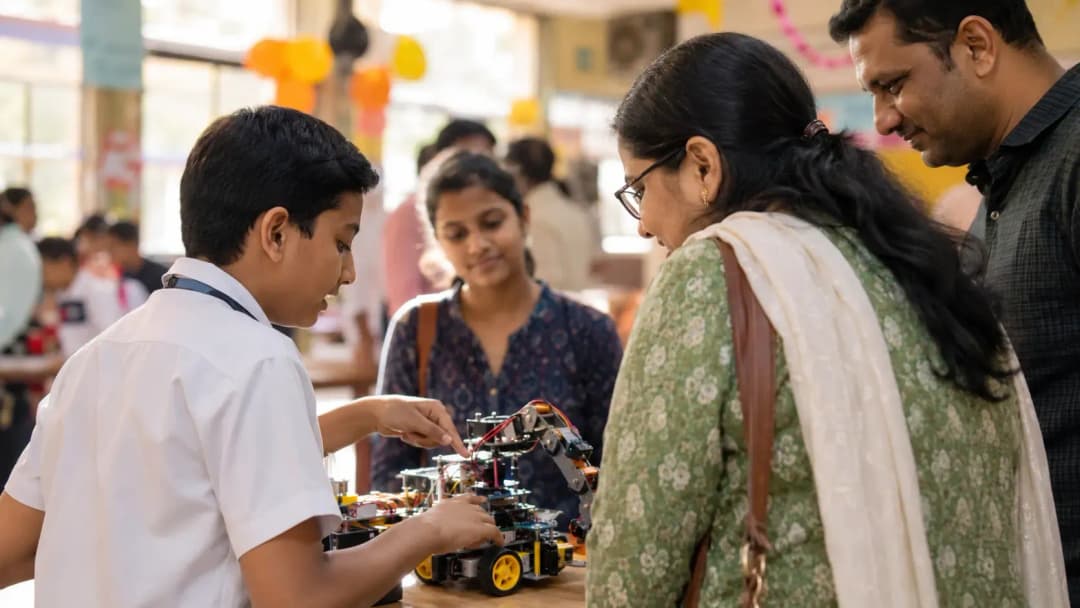
Two schools with nearly identical AI labs can produce completely different open house outcomes. Same kits, same curriculum, same engineer running sessions. The difference is almost never the lab. It is what happens in the fifteen minutes a parent spends standing in that room.
We have watched this go wrong in a very specific, very fixable way. A coordinator walks the family in, and immediately starts talking. About the curriculum framework. About NEP alignment. About the number of hours per week. So the parent nods politely, takes a photo of the equipment, and moves on to the next room. Nothing about that fifteen minutes made them feel anything.
Here is what actually works instead, and why most schools accidentally avoid doing it.
The One Rule: The Room Should Talk, Not You
The biggest mistake in open house walkthroughs is treating the lab like a sales floor. A parent who feels pitched to gets defensive, even briefly, even subconsciously. A parent who watches a 10-year-old explain their own project gets curious. Those are two completely different emotional states, and only one of them leads to an enrollment.
So the actual goal of the fifteen minutes is not to explain the lab. It is to get out of the way and let a student explain it. Your job shifts from presenter to host.
Before the Open House: What to Brief Your Students On
This only works if a student is actually ready to talk, and most schools skip this step entirely, assuming a bright kid will improvise well under pressure. Some will. Most will freeze or default to reciting facts about the kit instead of their own project.
Ten minutes with each demo student, a day or two before the event, covers what is needed:
- What they built, in one sentence. Not "an IoT project." Something like "I made a system that turns on a fan automatically when the room gets hot."
- One thing that went wrong, and how they fixed it. This is the detail that makes a demo feel real instead of rehearsed. Parents remember the failure-and-fix story more than the finished product.
- One question they can ask the visiting family back. "Do you have any gadgets at home that you wish worked automatically?" turns a monologue into a conversation, and conversations are what parents actually remember afterward.
Pick two or three students per grade band who are comfortable talking to adults, not necessarily your top performers academically. But confidence in the room matters more than the complexity of the build, and it is worth reading how we think about preparing teachers and staff for lab-related moments more broadly, since the same principle applies well beyond open house day.
The Room Flow That Works
Walk the family in and stop talking within the first ten seconds. Let the assigned student greet them and start their one-sentence pitch. Your role at this point is to stand slightly back, make eye contact with the parent, not the child, and let the exchange happen.
Only step in for three things: to add context the student would not know to mention (how the curriculum builds toward this project over multiple years, for instance), to answer a compliance or mandate question a parent asks directly, or to gently rescue the student if they visibly freeze. Otherwise, stay quiet longer than feels comfortable. Silence while a parent watches a robot move is doing more work than any sentence you could say over it.
If you have the on-campus engineer available during the event, position them near the more advanced projects, not at the entrance. Parents who want deeper technical detail will find them naturally. Parents who do not want that level of detail should not be forced through it.
What Not to Say
A few phrases quietly undo the effect of a good demo, even when well-intentioned.
Avoid opening with statistics ("we have invested ₹X in this lab" or "this covers 7 domains across 10 years"). It is true and it belongs somewhere in your prospectus, but leading with it turns the room into a pitch before the parent has felt anything.
Avoid comparing your school directly to competitors in the room ("most schools in the area don't have anything like this"). Parents already sense the comparison. Saying it out loud makes it sound insecure rather than confident.
Avoid hovering while the student talks. A principal or coordinator standing directly behind a student while they demo makes the moment feel supervised rather than authentic, and parents can tell the difference.
Handling the Questions That Actually Come Up
Three questions surface at almost every open house once the lab visit is over, and having calm, specific answers ready matters more than having impressive ones.
"Is this optional, or does every student go through it?" Be direct about how the program is structured into the timetable, and for which grades. Vague answers here read as the program being an add-on rather than a real academic track.
"What happens if my child isn't naturally into this kind of thing?" This is really a question about pressure, not aptitude. The honest answer, if true, is that the curriculum is built for a full grade cohort, not just students who self-select into robotics clubs, and that the early years focus on building comfort and curiosity, not competitive performance.
"Is there an additional fee for this?" Answer plainly and early if asked. Parents in this segment are used to activity and technology fees on the statement already. What erodes trust is vagueness, not the existence of a fee.
After the Open House
The walkthrough is not the only touchpoint. A short follow-up, a photo from the day, a one-line note about the student who did the demo, sent within 48 hours to families who visited, reinforces the moment while it is still fresh. This is a small operational habit most schools skip, and it costs almost nothing to do consistently.
If your school runs multiple open house sessions across an admission season, rotate demo students rather than relying on the same two children every time. It keeps the moment feeling genuine rather than performed, and it spreads the confidence-building experience across more of your student body.
Why This Only Works if the Lab Is Actually Running Well
None of this script works if there is nothing real happening in the lab most weeks. A student cannot tell a genuine failure-and-fix story about a project they built two years ago in a demo kit that has not been touched since. This is the honest dependency behind every open house walkthrough: the presentation only works when the underlying program actually runs consistently enough to produce fresh, real student work every term.
We covered the broader admissions case for why a lab matters in the first place, and the numbers behind it, in our guide to AI labs and enrollment. This piece is meant to sit next to that one: the strategic case for having the lab, and the practical playbook for the fifteen minutes that actually convert a visit into an application.
For schools weighing this as part of a broader admissions strategy, the open house moment is one of the most consequential parts of the funnel, precisely because it is where a claim on a brochure either gets proven or exposed, in real time, in front of the family deciding.
Frequently Asked Questions
How many demo stations should a school set up for an open house?
Two or three is usually enough for most walkthrough group sizes. More than that and families start moving through too quickly for any single demo to land. Fewer, well-briefed demos beat a lab full of unattended kits every time.
Should younger students (Class 1-3) also do open house demos?
Yes, but scale the complexity to age. A Class 2 student showing a simple circuit they built and explaining what happens when a wire disconnects is just as effective, in its own way, as an older student's more advanced project. It also signals that the program genuinely starts early, not just from Class 6.
What if a student freezes or forgets what to say during a demo?
Have a quiet rescue line ready as the adult in the room: a simple prompting question like "tell them what happens when you press this button" gets most students back on track without taking the moment away from them entirely.
Should the school principal be present during lab walkthroughs?
A brief appearance to welcome the family works well, but the principal does not need to stay for the full demo. Families often feel more comfortable asking candid questions once the most senior person in the room has moved on to the next family.
How is this different from a scripted sales demo?
A scripted sales demo is built around what the school wants to say. This approach is built around what the student actually did, in their own words, with room for the conversation to go somewhere unplanned. That difference is what parents can feel, even if they could not explain it themselves.