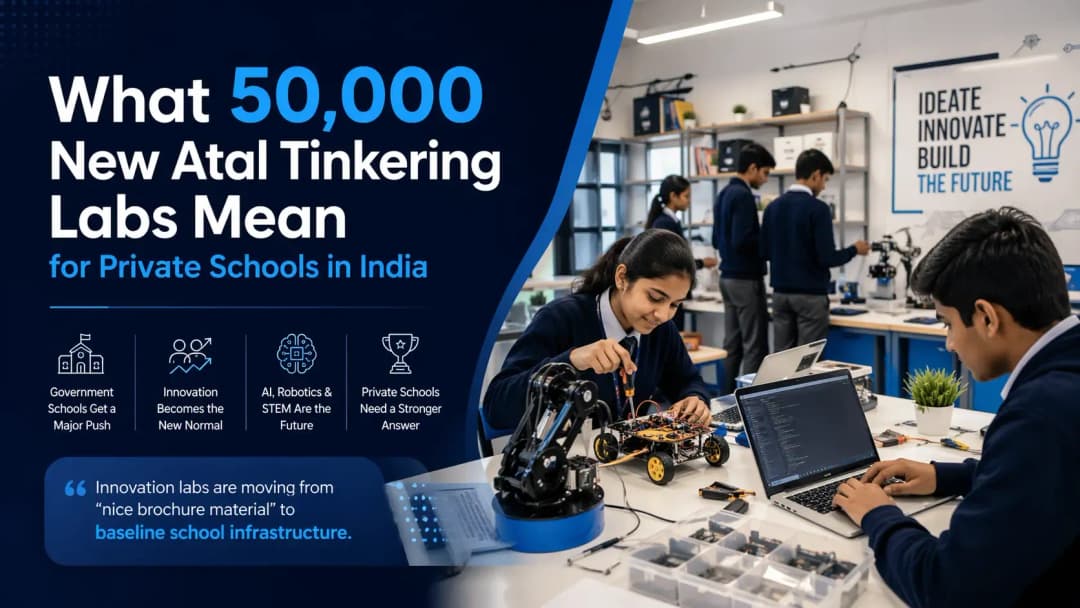
On February 1, 2025, the Union Budget announced 50,000 new Atal Tinkering Labs in government schools over the next five years. That sounds like government-school news. But the strategic question it creates is much bigger: what does an Atal Tinkering Lab for private schools look like when the entire market is being pushed toward hands-on innovation, AI exposure, and real project-based learning?
For a private school principal or trustee, this is not just a policy headline. It is a competitive signal. It tells you that innovation labs are moving from "nice brochure material" to baseline school infrastructure.
And once that shift starts, parent expectations do not wait politely.
What Did the Government Actually Announce?
The Budget 2025-26 announcement was specific: 50,000 Atal Tinkering Labs will be set up in government schools over five years. Later, on December 5, 2025, the Press Information Bureau said there were already 10,000 Atal Tinkering Labs established, with more than 1.1 crore students engaged and 16 lakh+ innovation projects created across the country. That is not a pilot anymore. That is scale. Real scale.
You can read the official references here:
- Union Budget 2025-26 announcement coverage from PIB
- PIB education update on ATL impact, December 5, 2025
- Atal Innovation Mission ATL overview
So what is the takeaway for private schools?
It is simple. The government has effectively told the market that tinkering, prototyping, design thinking, and applied STEM are now part of mainstream school development. If you run a private school in Pune, Mumbai, Nashik, Bengaluru, or Jaipur, your parents may not quote PIB documents in the admission office. But they will absolutely compare what your school offers against what other schools are starting to showcase.
Is an Atal Tinkering Lab for Private Schools Even Possible?
Yes, but this is where schools need to read carefully.
The current 50,000 ATL rollout announced in the Budget is aimed at government schools. Private schools should not assume they are automatically included in that expansion. But AIM's published ATL FAQs and earlier application guidelines have historically said that government and private schools running Classes 6 to 12 with a valid U-DISE code could apply in open ATL rounds, subject to infrastructure and compliance requirements.
That means two things can be true at the same time:
- The current expansion headline is government-school focused
- Private schools have still been part of the broader ATL ecosystem and eligibility framework in other phases
Here are the official documents behind that distinction:
- ATL FAQs PDF
- ATL application guidelines PDF
- PFMS guidance that includes private school registration types
So if you are a private school leader, the wrong question is, "Will we get this exact grant?"
The better question is, "What is our answer if innovation labs become the new normal before we are ready?"
Why This Matters Even If Your School Never Gets an ATL Grant
A grant is one path. Expectation is another.
Once tens of thousands of new labs enter public conversation, three things happen fast.
- Parents begin to ask sharper questions during admissions: "What do students actually build here?"
- Trustees start hearing from peers who are adding robotics, AI, and prototyping spaces to campus plans
- Schools that already had a weak "coding lab" pitch suddenly look dated
A parent in Baner or Thane may not know the full difference between an ATL, a robotics lab, and an AI and robotics lab for schools. But they can tell the difference between a school that offers real projects and a school that offers a poster on the noticeboard.
That is the real effect of this announcement. It changes the comparison set.
And once that happens, private schools cannot rely on generic future-ready language anymore. They need visible, operational proof.
What Parents and Trustees Will Expect Next
For trustees, the pressure will be practical. They will ask whether the school needs a capital-heavy lab proposal on the table this year. They will worry, correctly, about spending ₹15-25 lakhs on equipment that feels outdated in three years. They will want a business case, not just an academic one.
For principals, the pressure will be more immediate. Admission teams need sharper answers. Teachers need support. The school website cannot keep saying "we prepare students for the future" while nearby campuses are showing students building drones, circuits, AI models, and assistive devices.
For parents, the expectation is surprisingly concrete now. They want to know:
- Will my child build real things or just watch demos?
- Who is teaching this?
- Is this only for senior classes or part of a real pathway?
- Does this lead to actual skills, or just one annual exhibition?
That is why the conversation has to move beyond hardware. A room with kits is not enough. A locked lab photographs well for one year. After that, it becomes a question nobody in management wants to answer.
We wrote about that failure pattern in detail here: Why Most School Robotics Labs Go Dark Within 18 Months.
Why an ATL-Style Lab Still Fails If Nobody Runs It Properly
This is the part many schools miss.
The ATL model created national excitement because it made tinkering visible. That matters. But visibility alone does not solve operations. A lab only works if someone owns the timetable, the curriculum, the maintenance, the student progression, the project quality, and the teacher support week after week.
Most private schools do not fail at vision. They fail at continuity.
A school in Nashik may set up a lab room, buy electronics kits, and run a strong launch month. Then the computer teacher gets pulled into exam duty. A component fails. The part-time trainer leaves. The kits are not restocked. The lab survives on enthusiasm for a term and then starts slipping. Quietly.
So when private schools respond to the ATL wave, they need to think like operators, not buyers.
Equipment starts the story. Operations decide whether the story still exists in Year 3.
If your school is looking at this through the lens of long-term viability, the more useful comparison is not "ATL or no ATL." It is "managed lab or unmanaged lab."
What Private Schools Can Do Instead of Waiting
Waiting for a perfect government window is rarely a strategy.
Private schools have a better option: build the outcome they want without building their internal operations team from scratch. That means choosing a model that covers:
- curriculum across multiple years, not one workshop cycle
- an adult on campus who can actually run the sessions
- maintenance and upgrades without repeated committee approvals
- a fee structure parents can understand
- clear positioning for the admissions team
That is exactly why schools evaluating AI lab setup for schools in India or broader school curriculum planning should not stop at equipment lists. They should ask what the school is buying operationally.
And if the answer is "hardware, a PDF syllabus, and a trainer visit twice a month," that is not a serious response to the market shift we are now seeing.
How a Zero Cost AI and Robotics Lab Changes the Decision
This is where Scaleopal's model is structurally different.
Instead of asking the trust to approve a large upfront purchase, we set up the lab at zero setup cost. The school adds a technology integration fee to its existing fee structure. We deploy the hardware, provide the curriculum, and place an on-campus engineer to run sessions. Maintenance and upgrades are included because they are part of the operating model, not an afterthought.
That matters more after the ATL expansion, not less.
Why? Because the market signal from ATLs is pushing more schools to say, "We need something in this category." The danger is that schools respond with a rushed capital purchase and call it innovation. The better move is choosing a model where the lab still works after the launch photographs are forgotten.
If you want to see how the full school partnership model works, start there first. If you want to understand the operating partnership in financial terms, go deeper here: how the school financial model works. If you want the broader context of why schools are shifting from vendor relationships to operating partnerships, this post connects the dots: The Zero-Cost AI Lab: Turning NEP Compliance into a School Revenue Stream.
For a private school in Maharashtra, that can mean moving faster without taking on the usual capex risk. For a school elsewhere in India, it means the innovation-lab conversation does not have to wait for a grant cycle to become practical.
So What Should a Private School Do Now?
Not panic. Not rush into a shiny vendor deck. And not dismiss the ATL expansion as someone else's story.
The smart move is to treat the 50,000-lab announcement as a market signal and ask four hard questions:
- What will parents expect from us over the next two admission cycles?
- Who will actually run this lab every week?
- Can we justify a large upfront purchase when technology changes this quickly?
- Are we looking for a room full of equipment, or a program that still works in 2028?
Schools that answer those honestly will make better decisions than schools that chase headlines.
Private schools do not need to copy the ATL model line by line. But they do need a credible answer to the same underlying demand: students need spaces where they can build, test, break, rethink, and build again.
And that answer has to be operational. Otherwise it is just furniture.
Frequently Asked Questions
Does the 50,000 ATL announcement include private schools?
The Budget 2025-26 announcement specifically referred to government schools. Private schools should not assume they are part of that exact rollout. But AIM's broader ATL guidelines and FAQs have historically included eligible private schools in application frameworks during open phases, subject to U-DISE, class-level, and infrastructure requirements.
Can private schools apply for an Atal Tinkering Lab?
Historically, AIM guidance has said private schools running Classes 6 to 12 with a valid U-DISE code can be eligible in ATL application rounds. The important caveat is timing: application portals are not always open, and each round can have its own rules. So schools should verify the current status on the official AIM website before planning around grant funding.
What is the real difference between an ATL and a private school AI lab?
An ATL is part of a government-backed innovation initiative with its own framework and grant logic. A private school AI lab or innovation lab is the school's own operating decision. The deeper question is not the label on the door. It is whether the school has the curriculum, staffing, maintenance, and long-term ownership to make the lab useful every week.
Should private schools wait for grants before setting up an innovation lab?
Usually, no. If the school's strategic need is real, waiting for a grant can delay admissions positioning, curriculum upgrades, and parent communication by a full academic cycle. Many schools are better served by choosing a model that works now and does not depend on uncertain grant timing.
What should trustees evaluate before approving a lab proposal?
Trustees should look beyond setup cost. They should ask who runs the lab in Year 2, who replaces failed components, how the school explains the fee structure to parents, and whether the model creates value over multiple years. A cheaper quote can become expensive very quickly if operations are weak.
The biggest mistake private schools can make here is reading the ATL expansion as distant policy noise.
It is not noise. It is a signal that innovation infrastructure is becoming part of the education baseline in India. The schools that move well will not be the ones with the flashiest launch. They will be the ones with a model that actually runs.
If your leadership team is weighing that decision right now, start the conversation with us. We are happy to walk through the model honestly, including where it fits well and where it does not.