CISCE announced in January that entrepreneurship will become a formal ISC elective from the 2028 exam cycle, open to science, commerce, and humanities students alike, not just commerce. Schools that want to offer it from the start need to begin teaching it in the current 2026-27 session. Boardrooms across the country are treating this as good news. It is. But it is also a preview of a mistake schools are about to repeat.
Here is the pattern. A board announces a new subject. Schools scramble to introduce it in Class 11, hire someone to teach the textbook version, and call it done. That is exactly what happened with AI as a CBSE elective in 2019, and most schools are only now, seven years later, admitting that a Class 9 elective without proper lab infrastructure barely moved the needle. Entrepreneurship is heading toward the same outcome unless schools start earlier and treat it as a skill built through practice, not a subject read from a textbook two years before a board exam.
What Tech Entrepreneurship Actually Means at the School Level
Forget the MBA version of this word. Nobody is asking a twelve-year-old to write a business plan or model a discounted cash flow. Tech entrepreneurship at the school level means three concrete things: sizing up whether a problem is worth solving, pitching an idea clearly to people who were not in the room when you built it, and leading a small team through disagreement toward a working prototype.
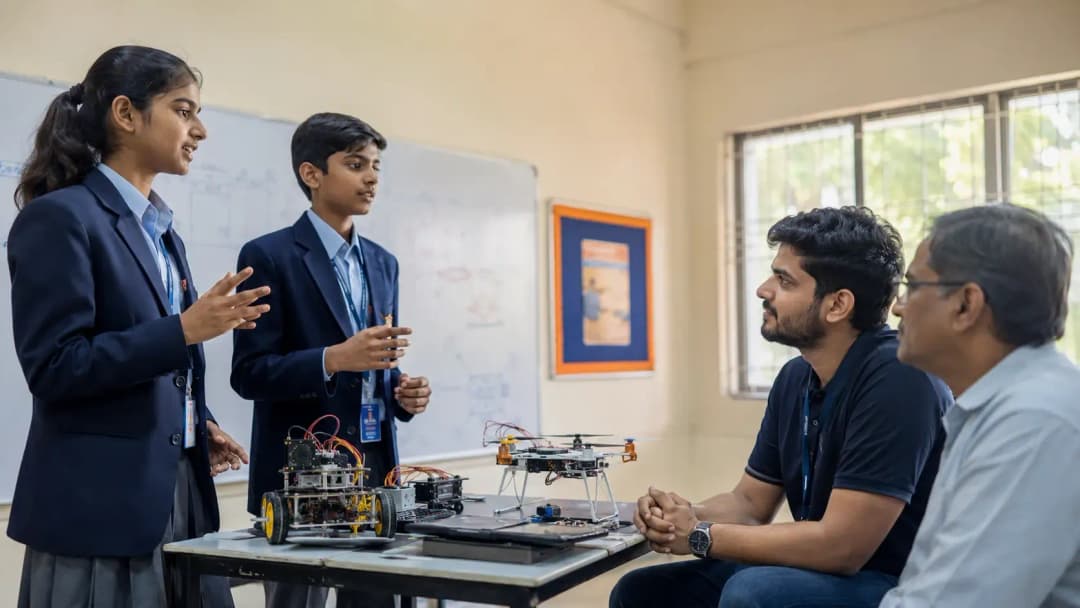
Those are learnable skills. And they are far easier to build inside a lab that is already generating real projects, robots that navigate a maze, an IoT sensor that tracks classroom air quality, a drone that maps a school garden, than to introduce cold as a standalone subject in Class 11 with no prior practice.
A CBSE school in Pune running an AI and robotics lab already has forty student projects a year sitting in a cupboard somewhere. Almost none of those students have ever been asked to explain why their project matters to someone outside the classroom, or to defend it against a tough question. That is the gap.
Why Class 11 Is Too Late to Start
Think about what CISCE's own new elective is asking of Class 11 and 12 students: understand a market, structure an idea, present it credibly. Those muscles do not appear the year a subject shows up on the timetable. They get built the way any skill does, through repeated, low-stakes practice over years.
This is the same argument we made in our piece on why IB schools should build the AI and robotics foundation before MYP begins. Skills that show up as a formal subject in the senior years need years of informal practice underneath them. Waiting until the subject exists on paper to start teaching it backwards is how schools end up with students who can recite the theory of a pitch but freeze the first time they have to give one.
A student who has pitched a robotics project to their classmates six times by Class 8 walks into a Class 11 entrepreneurship elective already halfway competent. A student who hasn't is starting from zero at the worst possible time, right before board exams begin to matter.
So what does building this early actually look like in practice? Not a separate weekly period called "Entrepreneurship." It looks like structuring the existing lab work differently.
How This Fits Into a 10-Year Lab Curriculum
Our seventh curriculum domain, Tech Entrepreneurship, runs alongside AI, Robotics, IoT, Drones, EV Technology, and AR/VR rather than sitting apart from them. Here is roughly how it scales by class band:
- Classes 1 to 4: Students explain, in their own words, what their simple robot or coding project does and why they built it that way. This is presentation practice disguised as show and tell.
- Classes 5 to 8: Students work in small teams, assign roles, and pitch a completed IoT or robotics project to a panel of peers or teachers, including answering follow-up questions.
- Classes 9 and 10: Students take a project through a rough market-sizing exercise. Who would actually use this? What does a school, a hospital, or a local business already do instead? This is where CISCE's Subject Code 66 project cycle and entrepreneurial thinking start to overlap directly.
- Classes 11 and 12: Students build a fuller pitch deck around an AI, drone, or EV project, present to outside evaluators where possible, and lead a team through the full build cycle from idea to working demo.
By the time a school's own Class 11 students sit for CISCE's entrepreneurship elective, or simply walk into a college interview, they are not encountering pitching and team leadership for the first time. They have four to seven years of practice behind them. That difference shows up immediately, and it is the kind of outcome that is much harder for a competing school to claim if their lab only covers coding and circuits.
Why This Matters for Admissions Conversations Too
Parents evaluating schools have gotten sharper about spotting the difference between a real project and a certificate that means nothing. We wrote about that gap in more detail in our guide on AI and coding for ICSE Classes 1 to 8. A student who can walk a visiting parent through what they built and why, confidently, without a script, is a far stronger admissions story than a wall of participation certificates.
This is also where the "taught by engineers" model earns its keep. An on-campus engineer who has actually pitched work to clients, because that is the day job at Scaleopal's parent company, coaches differently than a teacher reading a rubric off a CISCE circular. Real practitioner feedback on a twelve-year-old's pitch is not something most schools can hire for on their own, and it is not something a textbook-based elective can replicate either.
There is a school-marketing angle here too, and it is worth naming plainly. Every school with an AI and robotics lab can now claim experiential learning and NEP 2020 alignment. Far fewer can point to a specific student who pitched a working drone or IoT project to a panel of adults and defended it under questioning. That specificity is what actually moves a parent sitting across the table during an admissions interview, far more than another line about "future-ready skills" on a prospectus.
For ICSE and ISC schools specifically, this domain also has a direct line to board outcomes. Half the grade in the ISC Robotics and AI subject comes from internal assessment and project work, not the written paper. A student who has already spent years explaining and defending their own projects walks into that internal assessment with a real advantage over one who has only ever answered multiple-choice questions about robotics theory.
Frequently Asked Questions
Is tech entrepreneurship the same as CISCE's new entrepreneurship elective?
Not exactly. CISCE's elective is a formal academic subject for Classes 11 and 12 starting the 2026-27 session, ahead of the 2028 exam cycle. Scaleopal's Tech Entrepreneurship domain is a project-based skill track that runs across Classes 1 to 12, building the same pitching and problem-framing muscles years before students ever sit for a board subject.
Do we need a separate class period for this, or does it fit inside the existing lab schedule?
It fits inside the existing AI, robotics, IoT, drone, and EV lab sessions. Students present and defend the projects they are already building rather than attending an additional standalone class.
What age should schools start introducing entrepreneurship skills?
As early as Class 1, in the form of simple presentation and explanation practice. The complexity of what students pitch, and how rigorously, scales up through the class bands rather than starting from scratch in the senior years.
Does this only apply to ISC or CBSE schools?
No. The underlying skills, market sizing, pitching, team leadership, are useful regardless of board. IB and IGCSE schools benefit from the same early-start logic even though neither board has announced a dedicated entrepreneurship subject yet.
Who actually evaluates or coaches the student pitches?
The on-campus engineer running lab sessions leads this coaching, often bringing in outside evaluators such as school leadership or, for senior students, external mentors for higher-stakes pitch sessions.
Does this replace business studies or commerce as a subject?
No. It sits inside the innovation lab and complements whatever business or commerce subjects a school already offers. The goal is practical skill building through real technology projects, not a substitute for classroom economics or accounting content.
The Real Lesson From CISCE's Move
Every time a board formalises a skill as a subject, it is really telling schools that the skill has become important enough to test. That happened with AI in 2019. It is happening with entrepreneurship now. Schools that treat the announcement as the starting gun will spend the next two years scrambling to catch students up before their first board exam. Schools that have already been building the skill quietly inside their lab work will simply keep doing what they were already doing, and their students will walk in ahead.
If you want to see exactly where a tech entrepreneurship track fits inside a full AI and robotics lab curriculum, look at the complete Class 1 to 12 pathway, or start the conversation with our team about what this looks like on your campus.