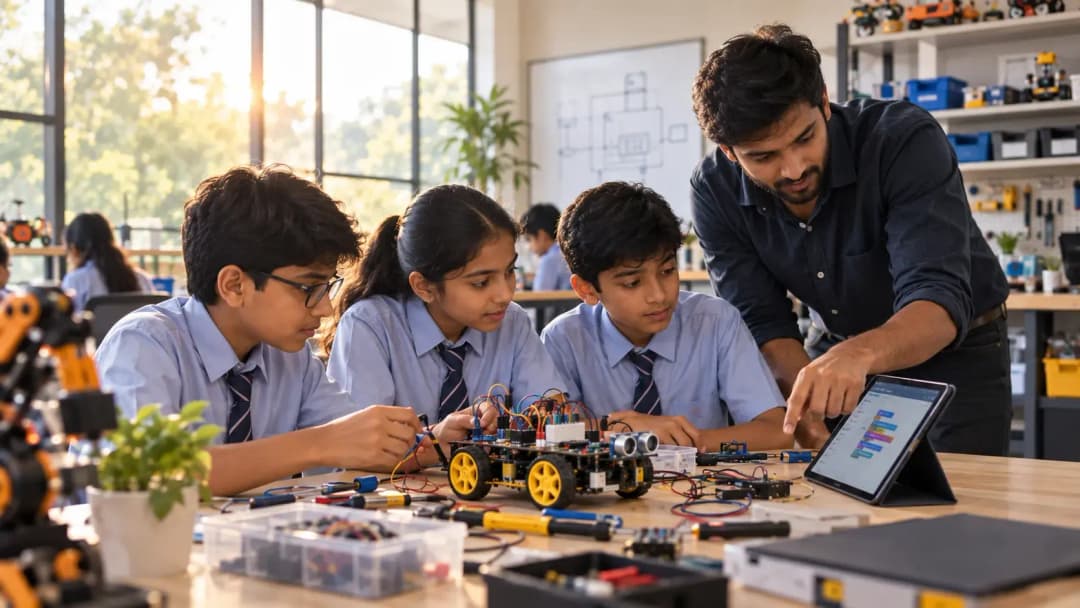
In June last year, a school on Wardha Road in Nagpur got very lucky. GlobalLogic, the IT services company, picked C. P. Berar High School for its CSR project and built a full STEM innovation lab there, robotics kits, AI modules, electronics, the works. About 400 students got access to hands-on tech education they would otherwise never have seen.
Good for that school. But what about the other 800-odd CBSE, ICSE, and State Board schools across Nagpur and the wider Vidarbha region who did not get picked?
They are still waiting. And waiting for a corporate CSR budget to notice your school is not a strategy. It is a lottery.
This is the real story behind AI lab setup for schools in Nagpur right now: a handful of lucky institutions get equipped through donations, while the rest either overpay to build one themselves or quietly give up on the idea.
Why Nagpur Is Behind on AI and Robotics Labs, and Why That Is Not the School's Fault
Nagpur has a genuine STEM education gap. It is India's third-largest city in Maharashtra, home to some of the state's most respected schools in Dharampeth, Civil Lines, and Sadar, and yet very few of them have a functioning AI or robotics lab that goes beyond a computer room with extra wiring.
This is not because Nagpur's schools do not want one. Talk to any principal in the city and you will hear the same three reasons, over and over:
- A proper AI and robotics lab costs anywhere from ₹15 lakhs to ₹28 lakhs to set up on their own, money that most trusts simply do not have sitting around.
- Even if the budget existed, finding a qualified engineer willing to relocate to Nagpur and teach full-time in a school is close to impossible.
- Trustees remember the last "smart classroom" vendor who sold ₹8 lakhs of hardware and vanished within eighteen months, leaving behind a locked room nobody knew how to use.
So schools do one of two things. They wait for a CSR sponsor, the way C. P. Berar High School did. Or they give up on the idea entirely and put "AI-integrated curriculum" on their admission brochure without actually building anything behind it.
Neither option scales. And with CBSE's Composite Skill Lab mandate now applying to every affiliated school, and NEP 2020 pushing experiential, technology-based learning from Class 6 onward, "we're waiting for a sponsor" is starting to look less like patience and more like risk.
The gap isn't limited to Nagpur city limits either. Schools in Wardha, Chandrapur, and Amravati face the exact same three problems, only worse, because CSR programmes and EdTech vendors both concentrate their attention on metro cities first and treat Vidarbha as an afterthought. A trust running two or three schools across the region cannot simply wait for Mumbai-based decision-makers to notice them.
What a Zero-Cost AI Lab Looks Like When It Isn't Tied to a Donor
Here is the thing about CSR-funded labs. They are wonderful while the funding lasts, but they depend entirely on one company's goodwill, one budget cycle, one CSR officer's priorities for the year. If GlobalLogic redirects its education spending to a different city next year, that is that. The lab stays, but the ongoing support, the teacher refreshers, the hardware upgrades, may not.
A Lab-as-a-Service partnership works differently, because nobody is donating anything.
Here is how it actually works. Scaleopal funds and installs the entire AI and robotics lab on your campus: hardware, software, robotics kits, curriculum, everything. The school pays ₹0 for setup. A modest technology integration fee gets added to the existing student fee structure, alongside tuition and activity fees the school already collects. The school keeps a fixed profit margin per student, guaranteed by contract, and Scaleopal earns an operating cost share. An on-campus engineer, not a computer teacher stretched thin across five subjects, runs every single session.
You can read the full mechanics of how the partnership model works if the trustees want the complete picture before the first conversation happens.
Why does this matter more in a market like Nagpur than in Mumbai or Pune? Because Vidarbha schools rarely have the parent-fee ceiling or the trustee appetite for a ₹20 lakh upfront gamble that Tier-1 city schools sometimes do. A model where the lab pays the school back, rather than the other way around, removes the exact objection that has been holding Nagpur back for years.
The lab is not a cost centre waiting to be justified at the next trustee meeting. It is a revenue line that starts contributing from month one.
Deployment takes 45 days from the day a partnership is confirmed. No waiting for a CSR calendar. No waiting for a grant cycle. No competing with 200 other applicant schools for one company's attention.
The Real Cost Comparison: DIY vs. Sponsor-Dependent vs. Partnership
Let's put real numbers next to each other, because vague promises of "affordable" and "innovative" don't help a trustee make a decision.
Option 1: Build it yourself. A functional AI and robotics lab for a mid-sized Nagpur school (500 to 1,000 students) typically runs ₹15 lakhs to ₹28 lakhs upfront, per the cost estimates most vendors quote for a full setup. Add annual maintenance, hardware refreshes every two to three years, and the ongoing challenge of finding a teacher who can actually run it.
Option 2: Wait for a CSR grant. Free, when it happens. But it happens to a tiny fraction of schools, usually government or low-fee institutions that CSR committees prioritise for optics, and it comes with zero guarantee of renewal, upgrades, or long-term support once the sponsor's photo-op is done.
Option 3: Zero-cost partnership. ₹0 upfront. The school earns a per-student margin from month one. Hardware, software, and the on-campus engineer are all included, along with year-round maintenance and upgrades, for as long as the partnership runs.
Only one of these three options is available to every school in Nagpur, right now, without waiting in line.
Curriculum Depth Matters As Much As Cost
A lab is only as good as what happens inside it. Scaleopal's curriculum runs across seven domains, AI, Advanced Robotics, IoT and Electronics, Drone Technology, EV Technology, AR/VR, and Tech Entrepreneurship, mapped progressively from Class 1 to Class 12. That is a very different proposition from a one-time robotics kit donation that a school outgrows within two years.
For a school considering how this fits against CBSE compliance specifically, our piece on how the composite skill lab mandate applies to schools walks through the deadline and what counts as compliant infrastructure, and our dedicated page on AI labs for CBSE schools covers board-specific requirements in more depth. And if the school is still comparing lab types before committing to one, AI lab vs. robotics lab for schools is worth reading first.
A school in Mumbai went through this exact decision process last year. The reasoning holds for Nagpur just as well: setting up a zero-cost AI lab is less about the city and more about whether a trust is willing to trade a small per-student fee share for a facility it never has to fund upfront.
Why This Matters for Admission Season in Nagpur
Parents in Nagpur, particularly in the CBSE segment competing for admissions in Dharampeth and Civil Lines, are asking sharper questions than they did five years ago. "Does the school have a coding lab" has become "what exactly do students build, and who teaches it." A locked room with a plaque isn't going to satisfy that question for much longer.
Schools that can show a functioning, engineer-led lab, not a photograph from an inauguration ceremony two years ago, have a genuine edge going into the next admission cycle. That is a fact worth putting in the same brochure as your board results.
Think about the conversation a front-office coordinator has with a prospective parent in November, right when most Nagpur schools finalise their admission material for the following academic year. "We have a coding lab" used to close that conversation. It no longer does. Parents want to know who runs the sessions, what students actually build by Class 8, and whether the lab still works three years after it opened. A vendor-installed room with no ongoing support cannot answer any of those honestly.
Frequently Asked Questions
How much does it cost to set up an AI lab in a Nagpur school?
Setting up an AI and robotics lab independently typically costs ₹15 lakhs to ₹28 lakhs, depending on the number of technology domains covered and the size of the school. Under a zero-cost Lab-as-a-Service partnership, the setup cost to the school is ₹0, funded entirely by the partner.
Do we need to hire a new teacher to run the lab?
No. Under Scaleopal's model, an on-campus engineer, a working technology professional rather than a classroom teacher, runs every session. The school only needs to provide space and a coordinating point of contact.
How long does it take to set up a lab once we decide to go ahead?
Deployment takes 45 days from partnership confirmation to a fully functional lab on campus, covering installation, curriculum onboarding, and engineer placement.
Does this satisfy the CBSE Composite Skill Lab requirement?
Yes. The curriculum domains, particularly AI, Robotics, and IoT, map directly onto CBSE's technology-focused Composite Skill Lab sectors. Schools should still confirm specific compliance details against their own affiliation status.
Is this only for CBSE schools, or does it work for ICSE and State Board schools in Nagpur too?
The model works across CBSE, ICSE, IB, IGCSE, and Maharashtra State Board schools. The curriculum is adapted to each board's academic calendar and existing timetable structure.
What does the school actually earn from this?
The school collects the technology integration fee from parents as part of the regular fee structure and keeps a fixed profit margin per student, guaranteed by contract. Scaleopal receives an operating cost share for running the lab.
The Waiting Game Doesn't Have to Continue
Nagpur has waited long enough for someone else to decide which schools deserve a technology lab. One school got lucky this year. The next one doesn't have to depend on luck at all.
A zero-cost, revenue-generating AI lab is not a favour some company extends when its CSR budget allows for it. It is a partnership any school in the city can start on its own terms, on its own timeline.