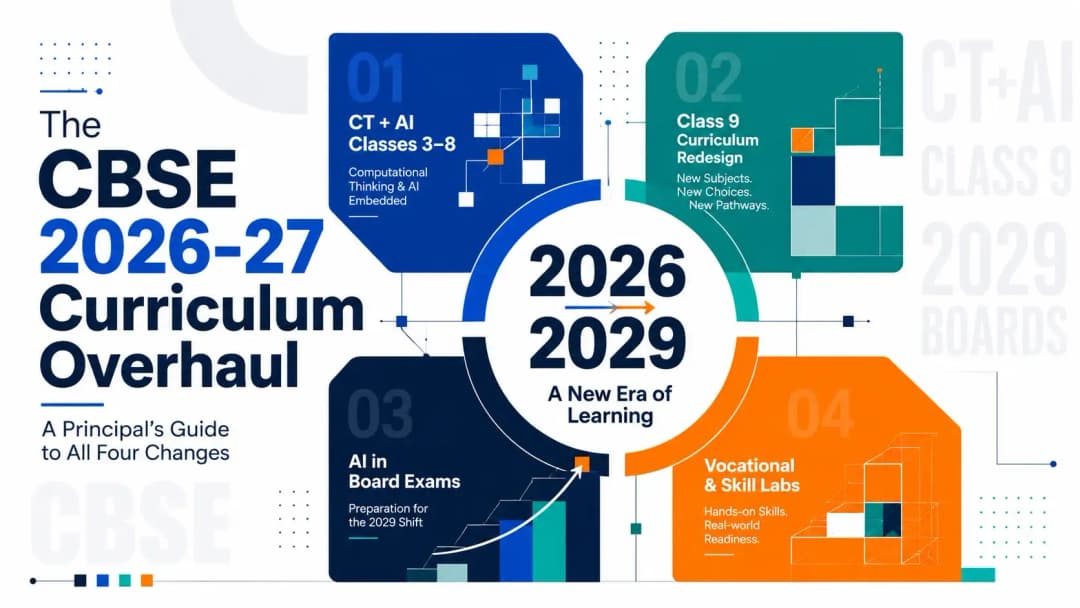
In early April 2026, CBSE released four separate curriculum reform packages within the span of two days. Four. Not one update with minor tweaks. Four distinct structural changes, each with its own implementation timeline, each requiring its own set of decisions from school leadership.
And most principals, in the middle of April's predictable chaos (sports day wrap-ups, summer camp announcements, fee revision discussions), caught the headlines but not the details.
This post is for principals who want the details. We'll walk through each change, what it asks of your school right now, and where the CBSE 2026-27 curriculum overhaul connects directly to your lab and innovation infrastructure decisions.
Four Packages, Two Days, One Major Restructuring
On April 1, 2026, Education Minister Dharmendra Pradhan launched the CBSE Computational Thinking and AI curriculum for Classes 3 to 8 under Circular Acad-15/2026. Also on April 1, Classes 11 and 12 received a revised curriculum under the NCF-SE 2023 framework. On April 2, the revised curriculum for Classes 9 and 10 dropped. The same week, CBSE ran a webinar specifically for school leaders explaining the new scheme of studies and transition plan.
Taken together, these changes are the most significant restructuring of CBSE schooling since NEP 2020 was announced in 2020. Some of the exam-related shifts phase in at 2028 and 2029. But the curriculum and timetable changes are live right now, this academic session.
Here is the quick-reference picture before we go deeper.
| Change | Effective From | First Board Exam Impact | |---|---|---| | CT+AI curriculum, Classes 3-8 | 2026-27 session (now) | Internal assessment; no board exam yet | | CT+AI as compulsory module, Classes 9-10 | 2026-27 session (now) | Board examination from 2029 | | Optional Advanced Maths/Science, Class 9 | 2026-27 session (now) | Marksheet notation from 2028 | | Vocational, Art, PE mandatory, Classes 9-10 | 2026-27 session (now) | Vocational board exam from 2027-28 |
The Composite Skill Lab deadline (August 22, 2027) sits underneath all of this as the infrastructure mandate that makes delivery possible. We'll come back to that.
Change 1: The CBSE CT+AI Mandate for Classes 3-8 Has Already Started
CBSE Circular Acad-15/2026 is not a proposal. It is a directive. And Circular Acad-18/2026, issued nine days later on April 9, confirmed that the Student and Teacher Resource Books are live on cbseacademic.nic.in.
The scope is substantial. Classes 3, 4, and 5 need 50 hours per year of CT and AI content. Classes 6, 7, and 8 need 100 hours. This is not a standalone subject sitting at the edge of the timetable. CBSE has designed it to run across Maths, Science, and other subjects as an integrated strand.
What does that mean on the ground? Your timetable needs restructuring. Your Computer teacher needs specific preparation for AI Literacy delivery, which is very different from teaching MS Office or basic digital skills. And if your Classes 3-8 students are two months into the session without any structured CT and AI activity, you're already running behind.
The most common mistake we're seeing: schools assuming their existing computer lab covers this. It does not. CBSE's curriculum explicitly requires AI tools, data interpretation activities, pattern recognition exercises, and interdisciplinary project work. A typing class is not CT and AI education.
So who exactly runs 50 to 100 hours of structured CT and AI delivery per class per year? If your answer is "the Computer teacher will figure it out," that is not a plan. That is a gap that will become visible in the first CBSE inspection cycle.
We've already written a detailed explainer of what this mandate specifically asks from your school's infrastructure and teachers, including the formal CPD pathway for teachers through District Level Deliberations. Read the full CT+AI implementation guide for Classes 3-8 before you plan your next staff training day.
Change 2: Class 9 Gets a Full Rebuild. Not Just an AI Addition.
The April 2 release was the one that surprised most principals. CT+AI as a compulsory module for Class 9 is the headline. But the structural reorganisation runs much deeper.
The Class 9 curriculum is now split into three parts: Language Core, Academic Core, and a Cross-Curricular block. That third block is where the real change sits.
Maths Basic is gone from this session onwards. All Class 9 students take a single standard Maths paper. Students who want more can attempt the optional Advanced paper, 25 marks and one hour. It does not get added to the overall aggregate. Students scoring 50% or above get a separate notation on their marksheet. There is no penalty for attempting it and not qualifying.
So that's the Maths restructuring. But the cross-curricular block is what school operations teams haven't fully processed yet. Four areas are now compulsory for every Class 9 student this year: Vocational Education, Art Education, Physical Education and Wellbeing, and a brand-new interdisciplinary subject called "Individuals in Society."
That is a meaningful timetable and space allocation change for most schools. A CBSE school in Pune or Nagpur that has been running Class 9 primarily as a board-prep pathway, with slim extracurricular room and no structured vocational delivery, will need to make real adjustments.
Change 3: The 2029 AI Board Exam Is Closer Than It Looks
This is the change that most principals have parked for later. That instinct is understandable. And it's a mistake.
Here is the timeline, clearly: CT and AI are compulsory modules for Classes 9 and 10 starting now, but as internal assessments. Structured CT+AI modules for Classes 9-12 roll out from 2027-28. AI and Computational Thinking enter the formal CBSE board examination in 2029.
Three years sounds comfortable. But look at it from the student's perspective. Class 8 students in your school right now will be sitting for their Class 10 board exams in 2029 as the first batch where AI is a formally examined subject. Your current Class 9 students will be the first cohort to take board exams under the new scheme in 2028, with CT+AI already embedded in their curriculum from day one of Class 9.
The schools that will be genuinely ready for 2029 are building real AI delivery infrastructure now, in 2026. Not in 2028 when every CBSE school in India simultaneously realises the urgency and every lab vendor has a 12-month waiting list.
What "ready" looks like: a school that sets up a structured AI and Robotics lab with a qualified person running progressive sessions from Class 3 upwards will have, by 2029, three full years of layered AI literacy built into its student body. A school that waits until 2028 gets one year, at best, of cramming definitions into students who've never actually built anything with AI.
That's not preparation. That's managed failure.
The difference in student outcomes between those two schools is not small. Universities, competitive entrance exams, and employers are already shifting their expectations. A student from a school with genuine AI competency, not just an AI classroom with a sign on the door, will be visibly different from one who memorised the right keywords the semester before boards.
You can explore what a real 10-year progression looks like in our full curriculum, from foundational Computational Thinking in Class 3 to Agentic AI and autonomous systems by Class 12.
Change 4: Vocational Education Is Now Core, and August 2027 Is Getting Very Close
This one connects to a CBSE circular that many schools have been slow-walking since 2024.
The new Class 9 curriculum makes Vocational Education a compulsory cross-curricular subject with a board examination component from 2027-28. That's this time next year. And it sits directly alongside the Composite Skill Lab mandate under Circular Skill-13/2026, which requires all CBSE-affiliated schools to have a functioning, fully equipped lab by August 22, 2027.
The Composite Skill Lab is not just a room. The 64-page CBSE guidelines booklet specifies space requirements (minimum 600 sq. ft for a combined Classes 6-12 lab), tool categories, safety norms, and timetable integration standards. For schools applying for new CBSE affiliation, it's already mandatory before you submit the application.
So the picture for Class 9 in 2026-27 is this: Vocational subjects are on the timetable now. The infrastructure to deliver them (the CSL) must be ready by August 2027. The board examination component for vocational subjects begins in 2027-28.
Schools that haven't started planning are 14 months from a hard affiliation risk, with a cohort of students who need structured vocational delivery starting this term.
We've laid out exactly how schools can meet this compliance requirement without a ₹15-20 lakh upfront spend: How to comply with the CBSE Composite Skill Lab mandate without capex. That post covers the zero setup cost model in detail and is worth reading before your next management committee meeting.
And if you want the full mandate breakdown, the CBSE Composite Skill Lab mandate post has the infrastructure checklist, sector requirements, and deadline specifics.
What All Four CBSE Changes Mean for Your Lab Strategy
None of these changes lives in isolation. Read them together and a clear strategic picture emerges.
CBSE is building a curriculum where AI literacy runs from Class 3 to Class 12 as a continuous, assessed thread. Vocational and practical skills run parallel. Maths and Science are being deepened for students who want to push further. And the board examination structure itself is shifting from recall-based testing to application and reasoning.
That is a fundamentally different kind of school than most CBSE-affiliated institutions have been running.
A school in Nashik with 1,100 students across Classes 3 to 10 has, by our estimate, roughly 700 students who will be directly affected by at least one of these four changes within the next 24 months. Addressing that with a monthly workshop or a once-a-week "AI period" stretched across an already tired Computer teacher is not a plan. It's a gap with a government deadline attached.
What works is the model we described in why the standard STEM lab teacher training approach fails Indian schools: a qualified, on-campus professional who runs structured sessions every week, with a curriculum built for progressive mastery rather than one-time exposure. The on-campus engineer model is designed exactly for this. Not a visiting trainer who shows up twice a term. Not a Teacher Development Programme that runs for two days and ends. Someone who is present, consistent, and accountable to the programme.
Schools that want to get ahead of all four changes can explore what a founding partnership with Scaleopal Labs looks like. We deploy in 45 days. And we bring the curriculum, the engineer, and the infrastructure in one package, at zero setup cost for the school.
Frequently Asked Questions
What exactly changed in CBSE's curriculum for the 2026-27 academic year?
CBSE released four reform packages in April 2026. CT+AI became mandatory for Classes 3-8 starting this session. Class 9 got a full curriculum rebuild including mandatory Vocational, Art, and Physical Education, plus CT+AI modules. Optional Advanced papers in Maths and Science were introduced for Class 9. And the Composite Skill Lab deadline for CBSE affiliation compliance was confirmed as August 22, 2027. Classes 11 and 12 also received a revised curriculum under NCF-SE 2023 on April 1.
Does my CBSE school need a dedicated AI lab to deliver the CT+AI curriculum for Classes 3-8?
Not in a strict standalone-room sense, but your school does need a functioning computer lab with AI tools, a structured delivery programme, and trained staff who can run the curriculum. CBSE explicitly requires AI tools, interdisciplinary project work, and pattern recognition activities. The existing IT infrastructure most schools have, built around typing and MS Office, does not meet this standard. Schools that want a proper programme without building it from scratch can look at a managed lab model where the curriculum and the trainer both come as part of the setup.
When will AI become a formal board examination subject under CBSE?
AI and Computational Thinking enter the formal CBSE board examination framework in 2029. Structured modules for Classes 9-12 roll out from 2027-28. Students currently in Class 8 will be among the first to face AI as a board-examined subject when they appear for their Class 10 boards in 2029.
Maths Basic has been discontinued. What does that mean for Class 9 students entering in 2026?
From the 2026-27 session, all Class 9 students take a single standard Maths paper. The two-track Maths Basic versus Maths Standard structure is gone for this cohort. Students who want additional challenge can attempt an optional Advanced paper worth 25 marks. That paper's marks are not added to the overall aggregate but earn a separate marksheet notation for students who score 50% or above. Students currently in Class 10 sitting for board exams in 2026-27 are not affected by this change.
What happens if our school misses the Composite Skill Lab deadline of August 2027?
Schools that fail to establish a Composite Skill Lab by August 22, 2027 face affiliation downgrade or non-renewal of CBSE affiliation during routine inspection cycles. New schools applying for CBSE affiliation must already have the lab in place before submitting their application. The CBSE Circular Skill-13/2026 is unambiguous about both the deadline and the consequences. Starting the infrastructure planning process now, rather than in early 2027, is the practical path.