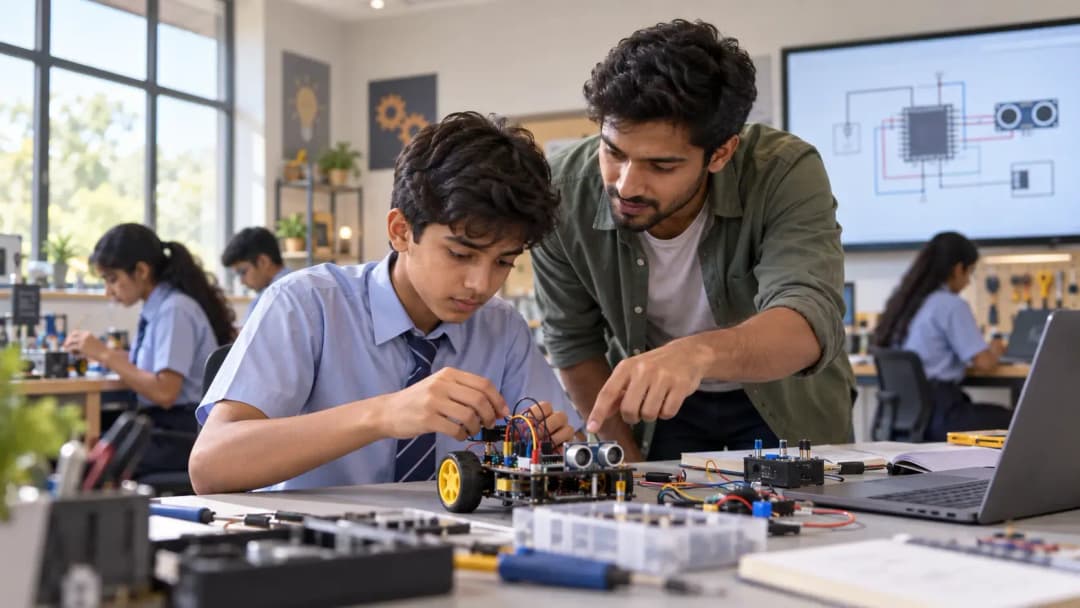
In 2024-25, more than 17 lakh Class 10 students across nearly 24,000 CBSE schools were already enrolled in skill subjects. Add in over 2.5 lakh Class 12 students from more than 8,500 schools, and skill education stopped being a side offering years ago. It became mainstream CBSE curriculum.
Now two more changes are landing at once, and most schools have not fully clocked either of them. First, CBSE's governing body has approved handing over assessment of skill and vocational subjects, for Classes 6 to 10, to an external, independent agency with vocational-education expertise. Second, in line with NCF-SE 2023's "no hard separation" principle, a skill subject becomes compulsory for every Class 9 student starting the 2026-27 academic session. Not an elective. Not something a computer science teacher squeezes in during a free period. Compulsory, for every student in the class.
If your school is still treating skill subjects as a compliance checkbox, this is the moment that stops working.
What CBSE Actually Changed: External Assessment and a Curriculum Rewrite
Here is the plain version. CBSE's governing body has approved bringing in an outside agency, one with genuine industry and vocational-training expertise, to assess skill and vocational subjects for Classes 6 to 10. The board is also revising and rationalising the entire skill/vocational curriculum, with the changes taking effect from the 2026-27 session.
Why does this matter? Because until now, skill subjects were largely assessed in-house, through a mix of internal project work and school-level evaluation. CBSE's own reasoning is direct: given the technical, practical nature of vocational education, an unbiased and standardised process needs someone outside the school checking the work. But that also means the days of a generous internal grade covering for thin delivery are ending. Assessment will combine formative and summative components, project-based work, practical exams, and skills demonstrations.
Read that list again. Practical exams. Skills demonstrations. Not multiple-choice papers a student can cram for the night before.
Class 9 Skill Subject: From an Elective Line Item to a Compulsory Subject
This is the part that will catch more schools off guard. CBSE has confirmed, in its notifications on the Kaushal Vikas rollout, that every school must offer a skill subject to every student in Class 9, effective from the 2026-27 academic session.
Until recently, Class 9 sat in a slightly softer zone. Skill modules for Classes 6 to 8 could run through hobby clubs or self-paced online learning. Class 9 and 10 already had a formal skill subject structure with 22 subjects to choose from, spanning fields like AI, robotics, retail, IT/ITeS, healthcare, and agriculture, each mapped to National Skills Qualification Framework levels. But schools had more room to decide how seriously to take it.
That room is closing. A school with 800 students in Class 9, say a CBSE school in Nashik, cannot quietly opt a handful of interested students into a skill subject anymore. Every single one of those 800 students now needs a genuine skill subject, delivered well enough to survive an external assessor's practical exam.
This is not a paperwork mandate. It is a delivery mandate. CBSE is telling schools: teach it properly, because someone outside your walls is going to check.
Why This Is Landing at the Same Time as the Composite Skill Lab Deadline
None of this is happening in isolation. CBSE reissued its Composite Skill Lab circular in a 2026 notification (Skill-13/2026), reconfirming that every already-affiliated school must have a compliant lab by 22 August 2027, while new affiliation applicants need one before approval. We've covered what that deadline actually requires in detail.
Put the two mandates side by side and the picture gets clearer. CBSE is not just asking schools to build a 600 sq. ft. room with equipment in it. It is asking schools to run compulsory skill education, for an entire Class 9 cohort, inside that space, well enough for an external agency to sign off on it. The infrastructure deadline and the assessment overhaul are two halves of the same push, and they are arriving in the same academic window.
This also connects to the broader curriculum shifts CBSE has planned for 2026-27, which we broke down in our guide to the CBSE 2026-27 curriculum overhaul. Skill education is not a footnote in that overhaul. It is one of its central pillars.
What "External, Independent Assessment" Really Means for How You Teach
So what does this actually change in a classroom, or a lab, day to day?
An in-house assessment can survive weak delivery. A teacher who knows the syllabus loosely can still mark a project generously. An external, independent agency evaluating practical exams and skills demonstrations cannot be talked around the same way. It is looking for evidence: Can this student actually do the thing? Did they build something? Can they explain how it works?
That is a hard ask for schools that were counting on Kaushal Bodh-style Capacity Building Programmes to solve the delivery gap by themselves. CBSE has run dozens of these sessions across states through 2026, and they genuinely help. But a one or two-day CBP for teachers is not the same as sustained, hands-on delivery capacity for 40 weeks of the year, and we've written before about why that teacher-training gap keeps showing up even after the training calendar fills up.
This is exactly where a lab built around project outcomes, rather than a syllabus PDF and a teacher figuring it out on the fly, earns its keep. When students are building actual robots, writing actual code, or running actual AI models throughout the year, an external assessor walking in to check their skills has something real to look at. That is not a lucky side effect. It is the entire point of a curriculum designed by people who build this technology for a living, not just teach around it.
A Pre-2026-27 Checklist for Principals and Academic Directors
Before the new session starts, it is worth walking through this list with your academic team.
- Confirm which skill subject(s) your school is offering to Class 9, and whether every student is actually enrolled, not just a self-selected group
- Check your Composite Skill Lab status against the 2027 deadline, and whether it can realistically support daily, hands-on Class 9 delivery, not just occasional sessions
- Ask your current skill-subject teachers whether they feel ready to prepare students for a practical exam set by an outside agency, not just an internal review
- Map your existing curriculum against NSQF job roles so the subject connects to something students can point to beyond a mark sheet
- Review your timetable. Compulsory, for-everyone skill education needs real weekly hours, not leftover periods
- Decide now whether you are building this delivery capacity in-house or bringing in a partner who already runs it elsewhere
None of these are complicated on their own. But stacked together, with a compulsory rollout and an external evaluator both arriving in the same academic year, most schools are underestimating the timeline.
Frequently Asked Questions
Is a skill subject compulsory for Class 9 in CBSE schools from 2026-27?
Yes. CBSE has confirmed that every school must offer a skill subject to every Class 9 student starting the 2026-27 academic session, in line with NCF-SE 2023's push to integrate skill education into mainstream schooling rather than treating it as optional.
Who assesses CBSE skill and vocational subjects now?
CBSE's governing body has approved bringing in an external, independent agency with vocational and industry expertise to assess skill and vocational subjects for Classes 6 to 10. Assessment will combine formative and summative evaluation, including project-based work, practical exams, and skills demonstrations.
How is this related to the Composite Skill Lab mandate?
They are connected but separate requirements. The Composite Skill Lab mandate covers the physical infrastructure schools need by 22 August 2027. The assessment and Class 9 changes cover what happens inside that infrastructure, how skill education is delivered and graded. A compliant lab with weak delivery will struggle just as much under external assessment as no lab at all.
Which skill subjects can a school choose for Class 9 and 10?
CBSE currently offers 22 skill subjects for Classes 9 and 10, spanning sectors like AI, robotics, IT/ITeS, retail, healthcare, and agriculture, each mapped to National Skills Qualification Framework job roles. Schools should choose subjects that match locally available delivery expertise and the sectors their students are genuinely likely to pursue.
What happens if a school is not ready by the 2026-27 session?
CBSE has not published a specific penalty structure for delivery quality, but affiliation compliance more broadly is tied to meeting these mandates. More practically, a school whose students cannot perform in front of an external assessor risks a poor showing that parents and future affiliation reviews will both notice.
Does this affect ICSE or state board schools too?
No, these specific changes (external agency assessment and the Class 9 compulsory mandate) are CBSE-specific. ICSE and Maharashtra state board schools have their own, separate skill and vocational education requirements, though the broader NEP 2020 push toward experiential learning applies across boards.
Where This Leaves CBSE Schools
CBSE is not being subtle about where it wants skill education to go. It wants it compulsory, it wants it demonstrable, and it wants an outside pair of eyes confirming that what schools report is what actually happened in the classroom. That is a reasonable ask for a subject that touches over 17 lakh students already. But it is also a real shift in what "having a skill subject" needs to mean by 2026-27.
Schools that treat this as a curriculum footnote will find out the hard way when an external assessor asks a Class 9 student to demonstrate a skill they never actually practised. Schools that treat it as what it is, a compulsory, evaluated subject that needs real infrastructure and real delivery, will walk into next year's affiliation reviews with something solid to show. And that difference will show up long before any audit, in whether a Class 9 student can actually explain their own project.
If you want to see what a curriculum built for exactly this kind of practical evidence looks like, or want to talk through where your CBSE school currently stands against both mandates, start that conversation with our team before the session begins, not after the first external audit.