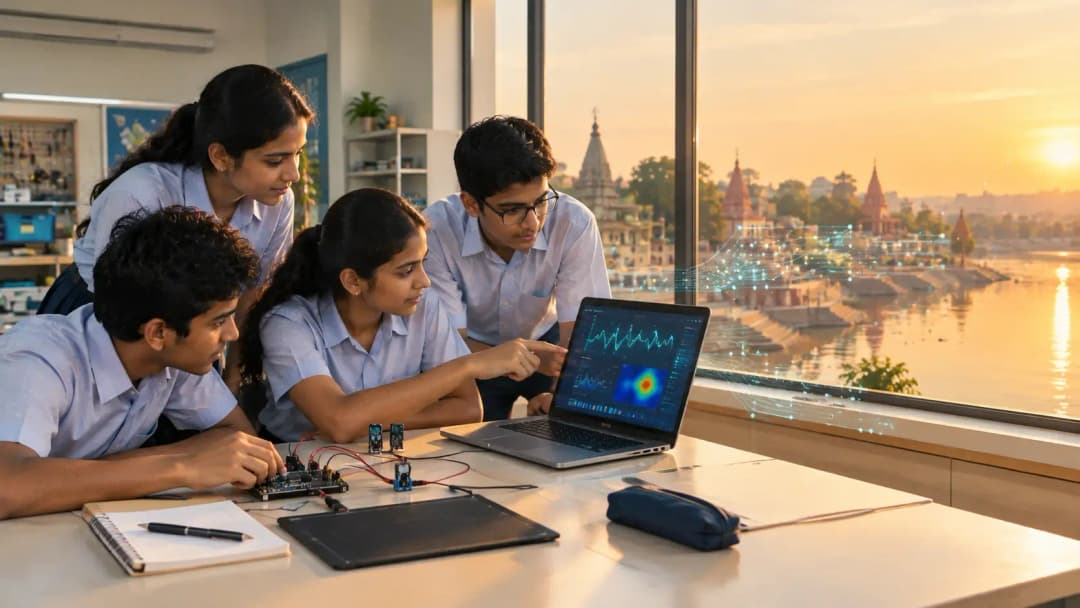
In 2015, a teenager from Nashik laid pressure mats at five points around the Kumbh Mela. By his own account, they counted more than half a million people in 18 hours and were built to warn officials when a crowd grew too dense. He was still in school. He had been spotted at a screening for an MIT Media Lab programme.
Eleven years on, Nashik is preparing to watch the Kumbh with AI. So what should an AI lab for schools in Nashik teach, and who builds the next version of that mat?
How Is AI Being Used at the Nashik Kumbh Mela?
The Simhastha Kumbh opens on 31 October 2026 with a flag-hoisting ceremony and runs until 24 July 2028. That is 21 months, among the longest Kumbh Melas in its history. The first Amrut Snan falls on 2 August 2027. Crowd estimates vary by report, from 6 to 7 crore pilgrims in one to more than 12 crore in another, with a peak day estimated at 2.25 to 2.5 crore.
The surveillance plan, as Maha News reported in February 2026, covers 4,011 cameras: 3,000 across Nashik city, 700 in Trimbakeshwar, and the rest at parking areas and likely choke points. Add 18 drones and roughly ₹300 crore. Live feeds go to a central command centre, where software flags events such as fire, smoke and unauthorised entry, and officials can broadcast announcements for one specific area.
ThePrint reported that the Kumbh Mela Commissioner described a Kumbh AI Stack, designed to combine CCTV, sensor inputs and telecom signals to spot abnormal crowd density and movement. A proposed Kumbh AI Sandbox would rehearse crowd surges, traffic jams, medical emergencies and extreme weather before the real thing.
These are announced plans, not an inventory. Check with the Nashik-Trimbakeshwar Kumbh Mela Authority for what is actually installed before you quote a number in your own school communication.
What Did a Nashik Teenager's Crowd Counter Do at the 2015 Kumbh?
The 2015 Kumbh came with a lab attached. MIT Media Lab ran Kumbhathon with local organisations, drawing in Nashik entrepreneurs, engineers and students to work on crowd management, food distribution and public health. One of its screenings was held at Purushottam High School, and that is where the teenager was spotted.
The device was simple. Pressure mats at checkpoints counted footsteps and made the numbers available in real time. Five went into the 2015 Kumbh. If flow slowed or density crossed a set threshold, officials could be warned. The half-million count comes from his own TED talk, so treat it as his account. But the AP separately reported a crowd-counting idea from a 15-year-old Nashik boy, so the broad story stands on independent coverage.
What stands out is not the hardware. It is the setup: a real problem, mentoring through the MIT programme, and a deadline nobody could move. Does a worksheet give a student any of that?
No. But a lab with a working engineer can give them a small, safe version of it.
What Can Students Learn From a Live AI System?
A crowd-monitoring system is a ready-made teaching ladder, and every rung connects to something students already meet in CBSE's Computational Thinking and AI framework.
- Sensing. Cameras, drones, mats, gate counters. This is IoT, and it is the part students can hold in their hands.
- Counting. Turning video into people per square metre. This is computer vision.
- Thresholds. Deciding when crowded becomes too crowded. Officials at Prayagraj told AFP that their alarm point sits higher than in systems abroad, because ideas of personal space differ. It is a real example of calibration and bias.
- Failure. An early January 2025 summary of the Prayagraj set-up put AI on about 160 of 1,800 cameras and noted that weak connectivity left gaps in the models. Later reports cited more than 2,700 cameras. The lesson stands: not every camera is smart, and not every smart camera has a signal.
- Decisions. Who gets the alert, what do they do, and who checks that the system was right?
In Classes 3 to 5, this looks like unplugged queue and flow puzzles, since CBSE builds computational thinking through Maths at that stage. In Classes 6 to 8, students add data, patterns and project work; the framework suggests 40 of the year's 100 hours go to interdisciplinary projects. By Classes 9 to 12 they can build the sensor themselves. That path runs through the AI, IoT and Drone domains of our 10-year curriculum, and it sits comfortably beside the CT and AI curriculum CBSE launched for Classes 3 to 8 in the 2026-27 session.
Should Schools Teach the Ethics of AI Surveillance?
The Nashik plan covers more than headcounts. The February report lists facial recognition and suspicious-activity detection among the system's features.
We are not here to tell you whether that is right. Governments weigh safety against privacy for a living, and reasonable people land in different places. But a school that teaches students to build the counter and never asks who watches the data has taught half the subject.
CBSE's framework asks for ethical and responsible use of AI. The Kumbh hands every Nashik school a local case study. Put these on the classroom board:
Who decides the alarm threshold, and how would you test that it is fair?
What should happen to the footage once the Kumbh ends?
Name one thing a camera should never record, and defend your answer.
Students should leave able to argue either side with evidence. That is a better result than a poster that says AI is good.
What Should an AI Lab for Schools in Nashik Build First?
Not a crowd of 2.5 crore. A crowd of 1,100 on annual day.
- Corridor footfall counter (Classes 6 to 8). Two infrared sensors and a microcontroller count students through the main corridor and send the numbers to a dashboard. Students discover why one sensor double-counts. It runs in our STEM and AI Foundation Lab.
- Hall density estimate (Classes 9 to 12). An overhead camera estimates how many students stand in each zone of the assembly hall. One hard rule: no faces stored, and every frame deleted after counting. The rule is part of the project, not an afterthought.
- Campus exit map from a drone (Classes 9 to 12). A drone flown indoors or in a netted area maps the grounds, and students plan exit routes for a big event. This needs the Cognitive AI and Advanced Robotics Lab tier, and it follows the safety rules that apply to drones.
Our IoT lab explainer and drone lab guide for principals go deeper on both.
None of this is a toy. It is the same loop the Kumbh control room runs (sense, count, decide, check) at a scale where students can break it and fix it.
Why Does a Nashik School Need a Lab and an Engineer for This?
Picture a principal off Gangapur Road with 1,100 students. A vendor quotes ₹15 to 28 lakh for a robotics and AI lab. The trustees hesitate, as they should. Say they approve it anyway. The kits arrive, a trainer visits twice, and by the next timetable cycle nobody can explain why a sensor reads zero.
Most vendors sell hardware and leave. That is not a partnership. That is a transaction.
Our model flips it. Under Lab-as-a-Service, we fund and deploy the lab on your campus at zero setup cost, so the school pays ₹0 to start. A technology integration fee is added to your existing student fee structure, and the school keeps a fixed profit margin per student, guaranteed by contract. An on-campus engineer, a working professional and not a visiting trainer, runs every session. Maintenance and hardware upgrades are included, and deployment takes 45 days from partnership confirmation. You can see how it works on our schools page and the numbers in the financial model.
Our engineers build AI systems for enterprise clients. So when a student asks why a threshold fired at 2:00 and not 2:05, someone in the room can answer.
We are early, and we are not hiding it. Nashik is one of our focus cities in Maharashtra, and founding partner schools get direct access to our engineering team and room to shape the curriculum. If you are weighing cities, our piece on how industry pipelines in Marathwada skip schools asks the same question from another region.
Frequently Asked Questions
How is AI used in Kumbh Mela crowd management?
Cameras and drones feed video to software that estimates crowd density and flags unusual movement, and a control room acts on the alerts. At Prayagraj in 2025, officials said footage was cross-checked against railway and bus data to estimate total crowd size. Nashik's plan adds a proposed simulation environment to rehearse surges before they happen.
Can school students really build crowd-counting projects?
Yes, at school scale. A footfall counter built from two infrared sensors and a microcontroller suits Classes 6 to 8, and camera-based density estimation suits Classes 9 to 12. The 2015 Nashik Kumbh itself featured a crowd-counting idea from a school-age innovator, according to the AP.
Is AI compulsory in CBSE schools in Nashik?
CBSE launched its Computational Thinking and AI curriculum for Classes 3 to 8 through Circular Acad-15/2026 on 1 April 2026, for the 2026-27 session. The circular advises schools to take steps for implementation, and the hours for Classes 6 to 8 are described as suggested and flexible. So treat it as a clear expectation with room to design your own delivery. Our page on AI labs for CBSE schools shows how a lab fits that picture.
What does an AI lab for schools in Nashik cost?
Buying one outright typically means ₹15 to 28 lakh upfront, plus upkeep and trainer costs. Under our Lab-as-a-Service model, setup costs the school nothing, a technology integration fee is added to the existing fee structure, and the school earns a fixed profit margin per student. Any new fee head should go through your usual PTA and management approval.
How long does it take to set up an AI lab in a school?
Deployment takes 45 days from partnership confirmation. The school provides the space and a coordinator, and we handle the rest.
Who Builds the Next One?
Somewhere in a Nashik classroom right now there is a teenager who would be very good at this. In 2015 a school screening found one. The 2027 dates are already fixed: 2 August, 31 August, and 11 September in Nashik. A school that starts the conversation this term has time to run its own student projects well before the first of them.
Not every school needs a drone. But every school in a city that watches its Kumbh with AI owes students a place to ask how it works, and an engineer who can show them. If you lead a school in Nashik and want to see what that looks like on your campus, start the conversation with us.