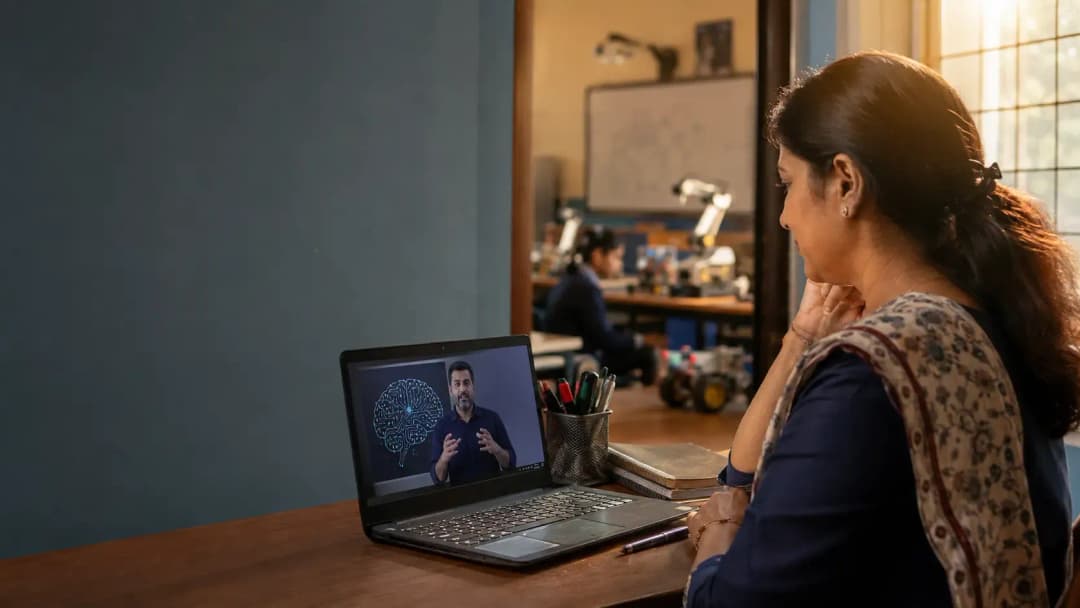
Somewhere in a staff room in Nashik this Sunday, a computer science teacher will open her laptop at 3:55 PM, mute the ceiling fan noise, and log into a YouTube stream. She has homework due after the session. She paid ₹400 plus tax for the certificate. And she genuinely wants this to work, because come Monday, she is expected to teach Computational Thinking and AI to a Class 6 section that has never touched a sensor or written a line of pseudocode.
That Sunday session is CBSE's 3030 Eklavya. And it is, by most measures, a serious initiative. But a serious initiative and a sufficient one are not the same thing, and schools that treat this programme as their AI readiness plan are going to find that out in November, not August.
What 3030 Eklavya Actually Is
CBSE and the Centre for Creative Learning at IIT Gandhinagar launched the current season of 3030 Eklavya on August 15, 2026. This is not the programme's first run. It began in 2021 as a general STEM initiative and has run multiple seasons since, drawing more than 65,000 registrations in recent cycles and crossing 2 crore cumulative views across its history. What makes this particular season different is the focus. For the first time, 3030 Eklavya is built specifically around Computational Thinking and Artificial Intelligence, directly following CBSE's April 9, 2026 notification that named CT and AI as the board's official training theme for 2026-27.
The format is simple. Eight live episodes, every Sunday, 4 to 5 PM, streamed free on YouTube. The first episode was titled "Computational Thinking and AI with Matchboxes," which tells you a lot about the pedagogy: hands-on, low-cost, activity-first. Teachers who complete all eight episodes and submit the homework can earn a certificate equivalent to 20 hours of Continuing Professional Development, recognised by CBSE. Students of Class 6 and above can also register, and participation is voluntary.
None of this is a criticism. IIT Gandhinagar's Centre for Creative Learning has built a genuinely good track record here, and getting a national board to run structured, curriculum-aligned AI training at this scale is not a small thing. It runs alongside CBSE's broader push, which includes more than 450 district-level orientation meetings for school leaders on the new CT and AI framework for Classes 3 to 8.
The Gap Between a Series and a System
Here is the problem. 3030 Eklavya is designed to build a teacher's own understanding of AI concepts. It was never designed to be the delivery mechanism for a school's daily curriculum. Those are two different jobs, and conflating them is where schools get into trouble.
Think about what the CT and AI framework actually asks of a school. It is not a one-time module. It runs across Classes 3 to 8, woven into existing subjects, with age-appropriate progression from basic pattern recognition in the primary years to actual AI application understanding by Class 8. That means weekly classroom time, hands-on activities that need equipment, and a teacher confident enough to run a session without a script in front of thirty children who ask questions the Sunday webinar never covered.
An 8-episode series, watched once a week for two months, cannot build that. It builds awareness. It builds a teacher's personal comfort with the subject, which matters and should not be dismissed. But awareness is not the same as classroom-ready delivery capacity across an entire academic year, for every section, every week.
There is also a completion problem that nobody likes to talk about openly. Past seasons of 3030 Eklavya have drawn tens of thousands of registrations, but attendance for a live Sunday session competing with family time, weekend errands, and simple screen fatigue is never the same as registration. Homework submission rates for optional, unpaid-time online programmes are lower still. Schools that assume "our teachers registered" means "our teachers are now AI-ready" are building a compliance plan on a number that doesn't hold up under scrutiny.
A CBSE school in Nashik we spoke with last year had eleven teachers register for the previous STEM-focused Eklavya season. Four completed all episodes. None of the four taught AI or robotics as their primary subject.
That is not a failure of the programme. It is a mismatch between what an optional online series can realistically deliver and what a mandatory, board-wide curriculum requires.
What Schools Actually Need Alongside It
We build AI and robotics labs inside schools, so we will say plainly where our interest lies. But the argument here does not depend on that. It depends on a basic operational fact: curriculum delivery needs a person in the room, every week, who knows the material cold and can adapt it live.
That is a different problem than teacher training, and it is the one most schools are underestimating right now. A Sunday series can raise a teacher's baseline understanding. It cannot replace an on-campus engineer who runs the sessions week after week, adjusts the pacing when a Class 5 section is struggling with a concept that landed fine with Class 7, and handles the hardware when a sensor stops responding mid-lesson.
The schools that will walk into the 2027-28 CBSE compliance review with something real to show are the ones treating 3030 Eklavya as a supplement, not a substitute. Send your teachers to it. Let them earn the CPD certificate. It is free, it is well designed, and there is no reason to skip it. But build the actual weekly delivery system separately, with someone whose full-time job is running it.
This is also where the zero-cost model changes the calculation for trustees. Building that delivery system in-house means hiring, training, and retaining specialised AI and robotics faculty, a genuinely hard hiring problem in most Tier 2 and Tier 3 cities. A managed lab model solves the same problem without the school carrying that hiring risk, because the engineer is provided, trained continuously, and replaced by the partner if they leave. That is a materially different proposition than sending four teachers to a Sunday webinar and hoping the knowledge transfers to thirty classroom sections.
The Honest Reading of What CBSE Is Signalling
Step back and look at the pattern. April 9: CT and AI named the annual training theme. Over 450 district meetings planned. NISHTHA training expanded to cover AI pedagogy. Now 3030 Eklavya, redirected entirely toward CT and AI for the first time in its history. CBSE is not treating this as a minor addition to the syllabus. It is building an entire training infrastructure around it, which is a strong signal that enforcement and inspection around actual classroom delivery, not just registration numbers, is coming.
Schools that wait for that inspection to arrive before building real delivery capacity will be doing so under pressure, on a compressed timeline, and probably at a higher cost than if they had planned ahead. Schools that use this window, while the mandate is still building momentum rather than fully enforced, get to set their own pace and vet their own approach properly.
Frequently Asked Questions
What is CBSE's 3030 Eklavya programme?
3030 Eklavya is a free, live online training series run jointly by CBSE and the Centre for Creative Learning at IIT Gandhinagar. The current season, launched August 15, 2026, focuses specifically on Computational Thinking and Artificial Intelligence across eight Sunday episodes.
Is 3030 Eklavya mandatory for CBSE schools?
No. Registration and participation are voluntary for both teachers and students of Class 6 and above. However, it sits within CBSE's broader push around CT and AI training, which schools should expect to become less optional as the curriculum mandate matures.
Does 3030 Eklavya replace the CT and AI curriculum for Classes 3 to 8?
No. The series builds teacher awareness and conceptual comfort with AI and computational thinking topics. It does not deliver the weekly, in-classroom curriculum that CBSE has mandated for Classes 3 to 8, which schools still need to plan and staff separately.
How many CPD hours does 3030 Eklavya offer teachers?
Teachers who complete all eight episodes and submit the required homework can earn a certificate equivalent to 20 hours of Continuing Professional Development, recognised by CBSE, for a nominal certificate fee.
Can a school use 3030 Eklavya alongside a managed AI lab?
Yes, and this is the sensible approach. Teachers can build their own conceptual foundation through the series while an on-campus engineer handles the actual weekly classroom delivery, so the school gets both the awareness-building and the execution capacity it needs.
What happens if a school does nothing beyond 3030 Eklavya?
The school will have a handful of teachers with a general awareness of AI concepts, but no structured, weekly delivery mechanism for the mandated curriculum across Classes 3 to 8. That gap tends to surface at the worst possible moment, during a board inspection or a parent asking pointed questions at an admissions meeting.
Where This Leaves Schools
3030 Eklavya deserves credit for what it is: a well-produced, free, national-scale effort to get teachers comfortable with AI concepts. Encourage every eligible teacher on your staff to register. But do not let a good training series become an excuse to postpone the harder, less glamorous work of building actual weekly delivery capacity for a curriculum that is not going away.
The schools that get this right in 2026-27 will not be the ones with the most CPD certificates on file. They will be the ones where a student in Class 5 can tell you, without prompting, what a sensor does and why it matters. That takes more than eight Sundays. It takes a person in the building every week whose job is exactly that.
If you want to see what a full-year, curriculum-mapped delivery model looks like alongside CBSE's CT and AI framework, start the conversation with our team.