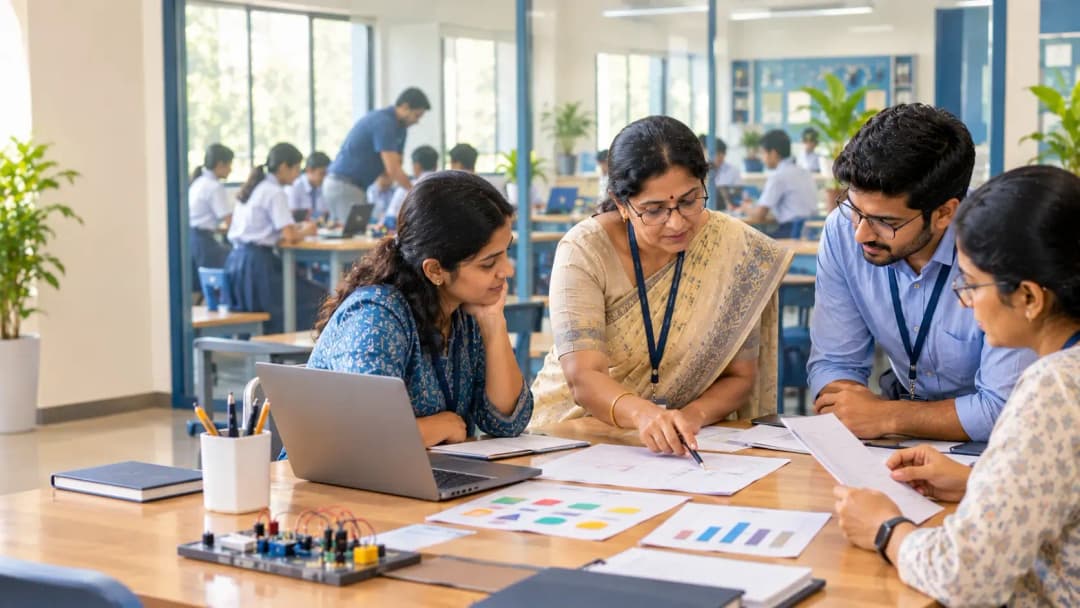
Picture a principal in Wakad. Her school began the new CT and AI periods for Class 3 in June, and her Class 6 Maths teacher keeps the CBSE handbook open on the staffroom table. On 20 and 21 November, CBSE holds the CBSE National Teachers Conference 2026 in Pune, on exactly this subject. She did not register.
Registration is closed now, and most of the coverage has stuck to dates, fees and eligibility. The better question is what CBSE is rewarding there. We read the circular, the training notification and the scoring sheet behind it, and the answer should change how a principal thinks about CT and AI this year.
What Is the CBSE National Teachers Conference 2026 in Pune?
It is a two-day conference on Computational Thinking and Understanding AI, announced in CBSE circular TRG-07/2026 dated 5 May 2026. It runs on Friday 20 and Saturday 21 November. CBSE named the city but, in the circular we read, not the venue. We are based in Bavdhan, so this one is close to home. For Pune schools, it is the rare national event that needs no flight.
Any teacher, principal, counsellor or special educator from a CBSE-affiliated school could take part, either as a delegate or as a shortlisted case-paper presenter. Fees were ₹5,000 for principals and ₹2,000 for teachers, with travel and stay at the participant's own cost. CBSE extended registration once, to 10 September, and processed seats first come, first served.
The theme is not random. In April, CBSE started a CT and AI curriculum for Classes 3 to 8 for the 2026-27 session. Then, in notification TRG-02, it named the same subject as the teacher-training theme for the year. So the conference is the end of a pipeline, not a standalone event.
How Does a Teacher's Case Paper Reach the Conference?
Through a district workshop first. TRG-02 invites schools, usually through their Sahodaya complex, to host one-day offline workshops called District Level Deliberations, or DLDs. A DLD is meant to have about 40 participants and no more than 16 presentations of 25 minutes each: 20 for the talk, 5 for questions. CBSE's DLD guidelines say plainly that it is not a project exhibition. Teachers present case papers on practice they have already run in a classroom.
A three-member Appreciation Committee scores the papers: one external CT or AI educator from a college or university, plus two principals or teachers who are not presenting. The top three go to the regional Centre of Excellence. A national expert committee then reviews the district winners sub-theme by sub-theme, and CBSE says results come one to two weeks before the conference. By our count, that means an announcement between 6 and 13 November.
Now the part most people miss. The best paper in each sub-theme gets an oral slot in Pune. The second and third get posters. There are seven sub-themes. By our reading of the guidelines, that is seven oral presentations for the whole country.
One workshop day earns a teacher 6 hours of school-based CPD under Domain-II. A place on the Pune stage is a much narrower ladder. CBSE's own training events lean heavily on peer sharing, and we have written about what that does and does not build inside a school in our look at the CBSE 3030 Eklavya AI series.
What Does CBSE Actually Score in a CT and AI Case Paper?
Every case paper is marked out of 100 on one sheet, and the same criteria apply at the national level. Read the weights before you read anything else.
Demonstrated impact, meaning data-driven, evidence-backed outcomes, carries 30 of the 100 marks. Novelty carries 10.
The rest of the sheet looks like this:
- Relevance to curriculum goals and real CT and AI problems: 10 marks
- Methodology, such as inquiry or project-based learning with a clear structure: 10 marks
- Inclusivity, meaning access and engagement for diverse students: 10 marks
- Scalability, meaning the practice can reach more students, classes or schools: 10 marks
- Replicability, meaning another school can adopt it and get similar results: 10 marks
- Sustainability, meaning it is built for long-term use: 5 marks
- Cost-effectiveness, meaning good outcomes from reasonable resources: 5 marks
Add it up. Impact, scalability and replicability together carry 50 marks. Novelty carries 10. A flashy robot demo with no before-and-after data is a 10-mark entry in a 100-mark exam. A quiet Class 5 pattern-recognition lesson, run across six sections with student work samples and a clear note on what changed, is a real contender.
The case-paper template says as much. It asks for student learning outcomes with data and assessment results, testimonials and student products, and changes in engagement. It even asks about local or low-cost materials. So we will be straight about something: most computational thinking needs no lab at all. Unplugged puzzles, Maths patterns and a good teacher go a long way, and CBSE's sheet rewards exactly that.
What it does not forgive is missing evidence. How many schools could produce an August baseline and a November result for a single Class 4 section today? The sheet scores teachers' papers, not student work. For student work, the school's own record is the assessment, which we unpack in how schools assess CT and AI in Classes 3 to 8.
What Do the Seven Sub-Themes Tell a Principal to Check at Their Own School?
Treat the seven sub-themes as a checklist, not a reading list.
The first two, Foundations of CT and AI Readiness and From Play to Abstraction, ask whether Class 3 and Class 8 look different. If both are doing the same block-coding game, there is no progression to present.
Sub-themes three and four, Mathematics as the Cornerstone and Interdisciplinary Connections at the Middle Stage, are about who owns CT. Not the computer teacher alone. CBSE's Class 6 handbook pairs CT with the Maths syllabus, which we broke down in what is inside CBSE's CT and AI resource books. Ask your Maths head which chapters carry CT. Then ask who owns the projects across Science, Social Science and languages. Our post on CT and AI projects for Classes 6 to 8 has worked examples.
Sub-theme five, AI in Real-World Contexts, is where a working space matters. A student who has watched a real model misread an image learns something no slide can teach. If students never touch a live AI system, this sub-theme becomes a presentation about AI instead of an experience of it.
Sub-theme six, Assessment and Pedagogy, is where schools are most exposed, because the proof lives in their own records.
Sub-theme seven, Ethics and Responsible Use of AI, is the one a trustee will ask about first. It starts with a written policy, which our AI policy guide for principals lays out. It ends with student data, which is why the DPDP Act matters for school AI labs.
What Can a School That Missed the Conference Do in the Next 30 Days?
Plenty, and none of it needs a seat in Pune.
Find the next district workshop. Ask your Sahodaya complex or district training coordinator when the next CT and AI DLD is planned. The guidelines expect workshops across the whole 2026-27 session. Case papers for this year's conference were collated until 30 September, so a workshop now will not send anyone to Pune. But it still earns CPD hours and puts your teachers in a room with peers who have run real lessons.
Start an evidence log this week. Pick two sections, say one in Class 4 and one in Class 7. Record a baseline task, repeat a similar one six weeks later, keep three samples of student work, and note engagement. That one page answers the 30-mark question.
Write one case paper in CBSE's 14-section format. Do it even if you never submit it. It is the cheapest honest audit of your CT and AI programme you will run this year. If a teacher at another school could not repeat your activity from your notes, the replicability marks are already gone.
For the wider picture of what CBSE schools are being asked to put in place, see our guide to an AI lab for CBSE schools and our piece on the practical implementation of NEP 2020.
Where Does an On-Campus Engineer Fit?
A conference gives a teacher two days. A Class 6 section needs a CT and AI period on the timetable every week for a full session. That gap is where many programmes quietly stall, and it is the gap our partnership model was built around.
Our on-campus engineer runs every session in the lab, alongside your teachers, not instead of them. Your Maths teacher still owns sub-theme three. Your class teachers still carry sub-themes two and four. The engineer carries sub-theme five, the live AI and hardware work. A single engineer running every session each week also gives your school a natural owner for the evidence log: attendance, project files and student work in one place. The lab goes live within 45 days of a confirmed partnership, at zero setup cost to the school. How the lab works has the detail, and our piece on what a good on-campus trainer actually does explains the role.
We are not claiming that wins a CBSE case paper. It does something simpler. It makes sure there is something to write about.
Frequently Asked Questions About the CBSE National Teachers Conference 2026
What are the seven sub-themes of the CBSE National Teachers Conference 2026?
They are Foundations of CT and AI Readiness; From Play to Abstraction; Mathematics as the Cornerstone of CT and AI Readiness; Interdisciplinary Connections across subjects at the middle stage; AI in Real-World Contexts; Assessment and Pedagogy in CT and AI; and Ethics and Responsible Use of AI.
Can my school still register?
Registration was extended once, to 10 September, and the link was set to close as soon as seats filled. We could not find a reopening notice. Check CBSE's training portal and circulars page before you plan around it.
Who can present a case paper in Pune?
A teacher who took part in a district workshop, whose paper placed in the district's top three, and then placed in the national top three for its sub-theme. The first-ranked paper in each sub-theme gets an oral slot, and the next two are shown as posters.
Is the conference mandatory for CBSE schools?
No. CBSE encourages schools to nominate teachers and principals, and it describes the district workshops as voluntary. It is not a hard date the way the Composite Skill Lab deadline is, which we map out in our month-by-month plan for 22 August 2027.
Does CBSE publish a classroom rubric for CT and AI?
Not one that we have found. The sheet above scores teachers' case papers, not student work. For students, CBSE names assessment methods and leaves the rubric and record format to each school.
How many CPD hours does a CT and AI workshop earn?
A full-day district workshop counts as 6 hours of school-based CPD under Domain-II. A half-day expert-led talk counts as 3 hours. Regional workshops hosted by the Board earn 6 hours, for a ₹700 fee.
Back to the principal in Wakad. She does not need a seat in Pune to act on what this conference is really about. She needs a baseline, an evidence log, and someone in the lab every week who can run the live AI sessions. The conference ends on 21 November. The record a school builds before and after it is what will still be there at the end of the session.
If you want to see how a 10-year pathway becomes that kind of record, the curriculum page is the place to start, and we are always happy to talk it through.