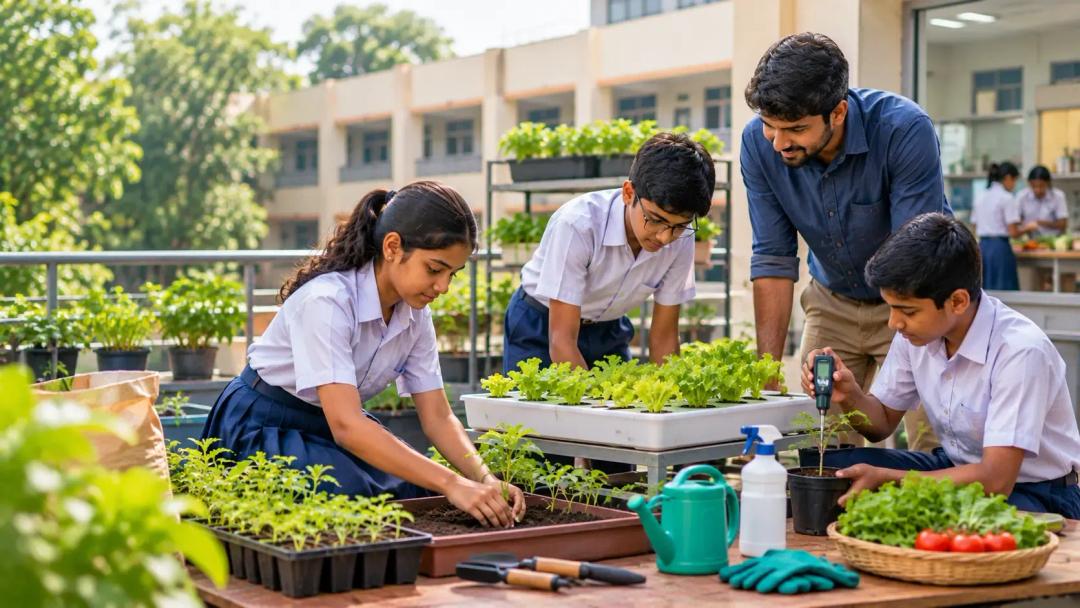
Picture a principal in Pune with CBSE's Composite Skill Lab booklet open on her desk. She reaches the agriculture pages and asks the obvious question. Where, exactly, are we supposed to grow things?
Her school has a playground, a parking bay and a rooftop water tank. No fields. Not even a spare patch of soil.
Composite skill lab agriculture and food production sounds like a farming problem. It isn't. It is a planning problem, and CBSE's own guidelines are more flexible about it than most school leaders expect. Below, we walk through what the Life Forms side of the lab asks for, what it costs you in space and attention, and where schools tend to get stuck.
What Does Composite Skill Lab Agriculture and Food Production Actually Cover?
CBSE builds skill education around three forms of work: working with life forms, working with machines and materials, and working in human services. The booklet recommends that a Composite Skill Lab be able to teach six skill subjects over two years, spread across all three. For Classes IX and X, that means two vocations from each form.
Life Forms is the first of the three. At the secondary level CBSE fills it with exactly two sectors: Agriculture and Gardening, and Food Production. That is the whole category.
The middle school rule is just as clear. In Classes VI to VIII, every class does three projects a year, one from each form of work, and the year ends with a Kaushal Mela where students show their work to parents and the community. By the end of Class VIII that adds up to nine projects. NCERT's Kaushal Bodh textbooks list the Life Forms options: a school kitchen garden, a plant nursery, a habitat garden, a biodiversity register, hydroponics, and caring for farm animals.
So a school cannot quietly skip this side. Every year, every class in the middle stage needs a Life Forms project.
We covered the full sector list in our guide to all 13 CBSE composite skill lab sectors, and our Kaushal Bodh post on machines and materials handles the other side. Here we stay with the garden and the kitchen.
Does a CBSE School Need Farmland for the Agriculture Skill Lab?
No. CBSE describes the agriculture sector as relevant to urban, semi-urban and rural settings. It names terrace farming, hydroponics, indoor farming and urban landscaping among the things the tools should help teach. The sample projects are modest: kitchen gardens, a small greenhouse, an irrigation system, soil sensors.
What the booklet asks for is smaller than farmland. The lab room should preferably sit close to an open area where gardening can happen. Preferably. Not necessarily. And if you do have a garden or a terrace, CBSE says the tools still live in the lab, and some projects run indoors.
That detail matters more than it looks. Space for planters is easy to find. Locked shelf space for secateurs, trowels and spray pumps is what a 600 sq ft room has to plan for from day one.
For a school like our principal's, a sensible starting point is a row of planters on the terrace, one hydroponic tray inside, and a tool cupboard by the door. Not a polyhouse. Not a plot of land. You can add later. That is our view, not CBSE's, and it applies to any CBSE school working with a small footprint.
What Does CBSE's Agriculture and Gardening Tool List Actually Contain?
Less than you would think. The agriculture list in the annexure runs to 22 tools for a class of 40 students. It includes one drip irrigation unit, one soil test kit, one hydroponic tray (2 by 1 foot, 4 inches deep), two hand hoes, four trowels and 20 pairs of gardening gloves.
The consumables list tells you more about the real work. Cocopeat, neem leaves, nursery bags, rooting hormone powder, sphagnum moss, saplings of mango, jamun, rose and hibiscus. Two kilograms of cow dung and a litre of cow urine, both marked as items to collect before the practical. Earthworms for vermicomposting. Seeds chosen to suit your geography, with maize and spinach named as examples. Even black jaggery appears, as an ingredient for organic fertiliser.
Read that list again. It is a gardener's shed, not a technology park.
So a quote that looks unusually heavy deserves a second look. Some supplier pages for this sector add items we could not find in CBSE's agriculture tool list, such as drones for aerial surveys. Check every line item against the annexure, which CBSE itself describes as flexible and open to adaptation by grade level. Our post on what CBSE's tool lists imply about group size shows how to read the quantities.
Can a Home Science Lab Be Used for the Food Production Skill Lab?
Partly. CBSE says an existing Home Science lab can be used to teach Food Production and baking, if it has the equipment. It cannot be converted into the Composite Skill Lab, because Classes XI and XII need it for their own specialisation.
The Food Production tool list is a kitchen. It has 32 tools, including two single-burner stoves, two 5-litre pressure cookers, one 800 W mixer-grinder, a digital kitchen balance and four knives for a class of 40. Ovens are optional. Aprons and head caps are the main consumables.
So the real question is whose timetable the kitchen sits in. Picture a CBSE school in Nashik with 800 students (an illustrative school, not a client). Its Home Science lab is booked for Class XI practicals three mornings a week. Food Production for Class IX needs a double period. Unless someone writes the slots down in August, nobody will find them in October. Our timetable maths for a composite skill lab shows how quickly a shared room fills up.
Gas deserves its own sentence. CBSE asks that gas fittings in the lab meet the required norms. A stove corner in a room with 40 children is a safety decision before it is a purchasing one.
Why Is the Calendar Harder Than the Equipment?
Because plants do not follow the bell schedule.
CBSE expects 110 hours of skill education a year in Classes VI to X, and the NCF-SE timetable it quotes suggests joining periods into longer blocks for hands-on work. A vermicompost bed is a weeks-long project, not a 40-minute one. A bed planted before the summer break still needs water when nobody is in school.
So who owns the calendar?
Most schools assume the skill teacher will. But the booklet itself admits that not every school will have a trained vocational teacher in Classes IX and X. It says locally experienced resource trainers can teach, with regular teachers coordinating. That sentence deserves more attention than it gets. CBSE already accepts that the person running this lab may not be on your permanent staff.
In our operating partnership model, an on-campus engineer and the school's skill coordinator share the calendar: sowing windows, the consumables that must be collected before a session, a roster for the summer break, and a harvest plan that feeds the Food Production classes. Our piece on the skill teacher gap goes further into who should teach what, and how the partnership works is laid out on our schools page.
How Can Nashik, Nagpur and Kolhapur Schools Tie Life Forms to Local Produce?
CBSE tells secondary schools to build links with local farms, cooperatives and processing units, so students can spend part of their time at real workplaces. In Maharashtra the local produce is strong. PIB points to Nagpur for oranges and Nashik for grapes, onions and tomatoes. Its factsheet on the state says the western sugar belt, which includes Kolhapur, makes Maharashtra India's largest sugar producer at roughly 35 to 40 per cent of national output. APEDA's Maharashtra page lists GI tags for Nashik grapes and Kolhapur jaggery, and Nagpur orange carries one too.
A hydroponic tray will not grow Nashik grapes. It can grow spinach in a Pune classroom. Both belong in the same lab, and the local crop is what makes the Food Production side feel real. Three ideas, all ours rather than CBSE-prescribed:
- Nashik: a Food Production unit on preservation built around tomatoes and onions, with a farm visit and a pickle versus fresh shelf-life test. Lasalgaon, one of India's best-known onion markets, is in the same district.
- Nagpur: a marmalade or squash batch from Nagpur oranges, with the peel going into the school's compost bed. Agriculture feeds Food Production, and Food Production feeds Agriculture.
- Kolhapur: jaggery as both product and ingredient. CBSE's agriculture consumables list already includes black jaggery for organic fertiliser, so a Kolhapur school can source it locally and teach where it comes from.
If you are planning a lab in Nashik or Nagpur, these are the local hooks to build around. For Kolhapur, our note on labs for Kolhapur schools at zero cost covers the wider picture.
What Does Safety Look Like in the Life Forms Corner?
CBSE's booklet gives safety a whole chapter, so this is only the slice that touches agriculture and food. Fertilisers and pesticides go in lockable, ventilated cabinets. Sharp tools such as pruners, shears and shovels hang on pegboards with safety locks. Work areas need shade and airflow to reduce heat exhaustion, which matters on a Pune terrace in April.
The safety corner by the door holds a 2 kg CO2 ABC extinguisher, two 10-litre sand buckets and a first aid box for a class of 40. If your chosen sectors need running water, the lab also needs a sink with proper drainage.
And the principal carries real duties here. CBSE lists safety policy, routine audits and staff training under the principal's responsibilities.
What Should a School Decide Now?
The deadline for already-affiliated CBSE schools is 22 August 2027. Five decisions cover most of the Life Forms corner:
- Whether Agriculture and Gardening and Food Production both run inside the lab, or Food Production moves to the Home Science lab.
- Where the outdoor beds go (terrace, courtyard or planters), and who holds the key.
- Which Home Science lab slots are reserved for Food Production, written down and signed off by the timetable in-charge.
- Who owns the calendar through the summer break.
- Where fertilisers and sharp tools are locked away.
None of these needs a large budget. All of them need an owner. Our month-by-month plan for the 22 August 2027 deadline puts decisions like these in order.
Our Composite Skill Lab covers the Life Forms theme alongside Machines and Materials and Human Services, delivered through an operating partnership at zero setup cost. The Composite Skill Lab setup page explains the full approach.
Frequently Asked Questions
Do we need a garden for the agriculture skill lab?
No. CBSE describes agriculture as suitable for urban, semi-urban and rural schools, and names terrace farming, hydroponics and indoor farming. A garden is welcome and the room should preferably be near open space, but the tools stay in the lab either way.
Can we use our Home Science lab for the Food Production skill lab?
CBSE allows it for Food Production and baking if the lab has the equipment. You cannot convert it into the Composite Skill Lab, because Classes XI and XII need it. Agree the timetable slots in writing before the term starts.
Is hydroponics compulsory in a Composite Skill Lab?
No. CBSE's agriculture tool list includes a single hydroponic tray for a class of 40, and hydroponics is one of several project options in the Kaushal Bodh textbooks. The annexure is a flexible list that schools adapt to the sectors they choose.
How many students can work in the lab at one time?
CBSE plans the room for a batch of 25 to 40 students, and its tool lists are quantified for a class of 40. Larger classes need more tools or smaller groups.
What is the "Working with Life Forms" category in CBSE's Composite Skill Lab?
It is one of the three forms of work in NCF-SE, covering agriculture, gardening and food production. In Classes VI to VIII it appears as one project a year. In Classes IX and X it becomes the Agriculture and Gardening and Food Production sectors.
Back to the Rooftop
Our principal in Pune does not need farmland. She needs a row of planters, a locked cupboard, a reserved slot in the Home Science timetable and someone who owns the calendar. Ordinary decisions, made early.
They are also the ones schools tend to leave until the deadline is close. If you would like to see how this plays out on your campus, start with the setup page and a conversation.